Answering your search for reliable wind turbine power inverters, this guide highlights five top options suited for different setups. Whether you’re aiming for a grid-tied system, off-grid cabin power, or marine use, these selections balance efficiency, practicality, and integration simplicity. The best fits vary: compact 500W to 1000W models suit off-grid cabins, mid-range systems work well for farms or boats, and multi-kilowatt kits suit larger homes or commercial needs.
| Product | Best For | Key Benefit | Notes |
|---|---|---|---|
| 20000W Vertical Axis Wind Turbine Kit with Controller & Grid Inverter | Large homes, Eco-conscious properties | High-capacity grid-tie with robust blades | Best for multi-environment wind scenarios |
| VEVOR 24V 1000W Solar Wind Power Kit | Off-grid homes and boats | Hybrid solar + wind with MPPT control | Versatile for varied outdoor settings |
| VEVOR 500W Wind Turbine Generator | RVs, boats, small cabins | Quiet operation with MPPT control | Compact, easy to install |
| Vertical Wind Turbines 3000w/8000w | Homes and small farms needing scalable wind | 360-degree wind capture; high-efficiency generator | Good for variable wind |
| Solinba 300w On Grid Tie Inverter | Grid-connected micro-systems | Pure sine wave output with grid compatibility | Easy integration for small turbines |
20000W Vertical Axis Wind Turbine Kit with Grid Inverter
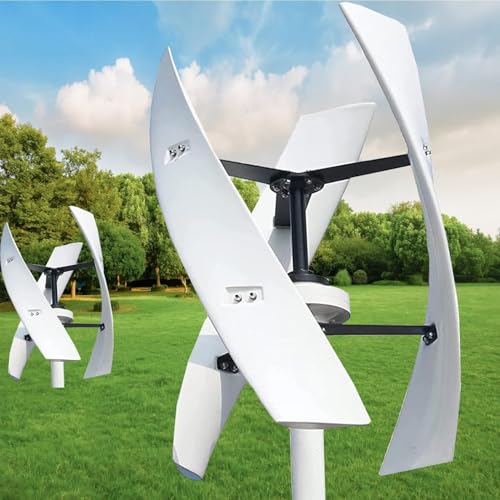
The kit uses precision-injection-molded blade technology with an aerodynamic design to maximize wind-energy conversion and stable power generation. It suits eco-conscious homes, monitoring systems, and marine energy projects, providing reliable performance across environments.
Best for: Large homes or small businesses seeking a robust grid-tied wind solution with integrated control. Why selected: high wattage capacity supports significant energy needs and broad wind ranges. Caution: installation requires proper electrical and structural assessment due to high power levels.
VEVOR 24V 1000W Solar Wind Power Kit
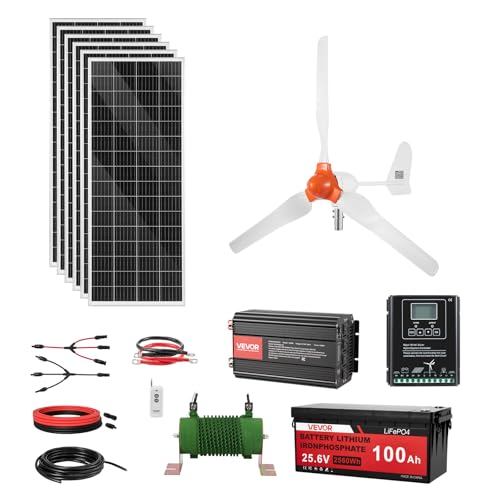
This hybrid kit pairs six 100W solar panels with a 400W wind turbine and a 3000W inverter, offering up to about 4 kWh/day under typical conditions. It is designed for off-grid homes, cabins, farms, boats, and rooftops, with a high-efficiency monocrystalline solar array and a durable build.
Best for: Off-grid properties needing a mixed solar-wind solution. Why selected: versatile for multiple environments with MPPT wind/solar hybrid control. Caution: performance depends on consistent wind and sun; space is needed for panels and turbine footprint.
VEVOR 500W Wind Turbine Generator

With a 12V three-phase AC permanent-magnet generator and MPPT control, this turbine delivers reliable power for homes, farms, RVs, and boats with a low-noise profile (around 55 dB). It starts at about 2.5 m/s wind speed and scales up to 12 m/s rated wind speed, offering solid performance in moderate wind conditions.
Best for: Small to mid-sized off-grid setups where quiet operation matters. Why selected: compact, easy to install, and MPPT-assisted adjustments. Caution: tower and mounting hardware must be correctly sized for your location and wind regime.
Vertical Wind Turbines 3000w/8000w With Controller

These vertical turbines feature Nylon fiber blades and a 360-degree wind-direction design, allowing operation without yaw alignment. A high-efficiency permanent magnet generator reduces torque and improves energy capture for variable winds.
Best for: Home or small business setups where wind direction changes frequently. Why selected: flexible vertical design and directional independence. Caution: higher-wower units require more space and robust mounting for sustained winds.
Solinba 300w On Grid Tie Inverter

This small grid-tie inverter accepts wind energy from a turbine and connects to the home grid, generating a pure sine wave AC that matches the grid’s frequency and phase. It supports wind-turbine-to-grid flows when the turbine produces within the inverter’s rated input.
Best for: Micro-turbine setups wanting an easy grid connection. Why selected: straightforward integration for grid-tied micro-systems. Caution: limited output; not ideal for larger residential power needs.
Buying Guide
Key considerations when choosing a wind turbine inverter system include power needs, wind resource, grid compatibility, and installation complexity. Consider these angles:
- Power capacity vs. demand: Match turbine and inverter capacity to your typical energy needs and site wind data. Larger homes or farms may require multi-kilowatt kits.
- Grid connection vs. off-grid: Grid-tie inverters require utility coordination and safety features; off-grid systems rely on batteries or hybrid controllers.
- Wind resource and location: Turbines with low start-up speeds are beneficial in areas with light winds; noisy or bulky units may demand more space and sound considerations.
- Efficiency and control: MPPT controllers optimize energy capture; hybrid solar-wind setups can stabilize power supply in variable weather.
- Maintenance and installation: Vertical-axis and multi-blade designs can improve reliability in turbulent winds, but require proper mounting and routing of electrical connections.
FAQ
- What is the difference between grid-tie and off-grid wind systems?
Grid-tie systems feed power back to the utility grid and require an export-ready inverter; off-grid systems store energy in batteries and operate independently. - Do wind turbine inverters require a specific turbine model?
Inverters are designed to accept a range of turbine outputs; always verify input voltage, wattage, and connector compatibility with your turbine. - Is 2.5 m/s wind speed enough to start generating power?
Many turbines begin generating at low wind speeds around 2–3 m/s, but practical output increases with wind speed and system efficiency. - What maintenance is typical for wind turbine inverters?
Regular inspections, cleaning, and connection checks help prevent corrosion, loose wiring, and overheating concerns. - Can I mix solar and wind in a single system?
Yes, hybrid controllers optimize energy from both sources, improving reliability for off-grid or remote sites.