The following van de graaff generator kits are among the most capable and reliable options for science classrooms, homeschool labs, and hands‑on demonstrations. Each selection emphasizes safe operation, clear demonstrations of electrostatics, and durable construction. This guide compares five kits based on voltage potential, motor or manual operation, the size of the dome, and included accessories to help educators and curious learners choose the best fit.
| Product | Brand | Key Feature |
|---|---|---|
| EISCO Hand Crank Van de Graaff Generator | EISCO Store | Manual crank, up to 100kV, 7.9″ sphere, 22″ tall |
| Van De Graaff Generator, 325KV, with Humidity Control | Corporation | Humidity controlled, 10″ dome, 26″ height, discharge wand |
| EISCO Van De Graaff Generator, Motor Driven | EISCO Store | Motor driven, up to 220kV, 7.9″ sphere, 22″ tall |
| Eisco Labs Electrostatics Exploration: 7-Piece Kit & Hand Crank | EISCO Store | 7-piece kit, up to 100kV, interchangeable components |
| Eisco Labs Van De Graaff Generator – Motor Driven | EISCO Store | 110/120V or 220/240V operation, visible acrylic shaft |
EISCO Hand Crank Van De Graaff Generator

This hand crank generator offers a compact, classroom‑friendly way to visualize energy transformation from mechanical to electrostatic energy. It delivers up to 100,000 volts under suitable conditions and stands 22 inches tall with a 7.9‑inch metal sphere. The design emphasizes safe handling and straightforward demonstrations, making it ideal for introductory physics lessons and student experiments centered on static electricity and charge accumulation.
Van De Graaff Generator, 325KV, with Humidity Control

This model targets more advanced demonstrations with a high voltage output of up to 325 kV and built‑in humidity control. It features a large 10‑inch dome and a 26‑inch tall structure, along with a discharge wand for safe, visible spark demonstrations. This kit is suitable for more experienced classrooms or outreach labs that require stronger charge accumulation and environmental adjustment to optimize performance.
EISCO Van De Graaff Generator, Motor Driven
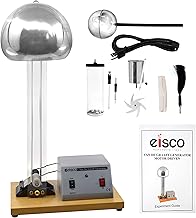
This motor‑driven Van de Graaff offers continuous operation for sustained demonstrations. Capable of generating up to 220,000 volts, it is paired with a 7.9″ metal sphere and a 22″ tall frame. The motor is mounted directly to the base, and a power cord is included for steady performance during longer classroom experiments and lab sessions that require reliable, hands‑free operation.
Eisco Labs Electrostatics Kit & Hand Crank Van De Graaff

This offering combines a 7‑piece electrostatics kit with a hand crank Van de Graaff, supporting up to 100 kV. The kit includes interchangeable components so configurations can be adapted to different experiments and teaching goals. It enables students to explore charge movement, electric fields, and the practical limits of electrostatics in a controlled setting.
Eisco Labs Van De Graaff Generator – Motor Driven

This motor‑driven unit supports operation at 110/120V or 220/240V, with a visible acrylic shaft for easy observation of internal mechanics. It provides practical demonstrations of high‑voltage charge accumulation while offering versatility for different regional electrical standards and classroom infrastructure. The included base and power options support long, uninterrupted demonstration sessions.
Buying Guide
Voltage capability and safety are the primary considerations. Higher voltages enable more dramatic demonstrations but require stricter safety protocols and supervision. For beginners, manual hand crank models up to 100kV offer a gentle introduction with lower risk, while motor driven versions up to 220kV or higher are better suited for advanced labs or demonstrations with larger audiences. Dome size and sphere diameter affect visual impact and charge capacity; larger domes can store more charge and present more striking visual effects but may require more bench space.
Operational characteristics matter as well. Manual crank systems develop charge through physical effort, helping students connect energy transformation concepts to real motion. Motor driven models provide consistency for ongoing demonstrations and independent student activities, though they demand careful electrical safety practices. Humidity control can stabilize discharge behavior in high‑voltage models, improving repeatability of demonstrations in classrooms with variable conditions. Look for durable bases, clear accessibility to the sphere, and included discharge wands or accessories to support safe, engaging experiments.
Compatibility and expandability are also important. Kits that come with accessory sets or compatible electrostatics components offer greater flexibility for multi‑week lesson plans and diverse experiments. Consider whether you need a compact, portable unit for outreach or a full setup for fixed lab use. Finally, verify that voltage and safety specifications align with your institution’s safety standards and teacher supervision requirements to ensure a secure, informative learning experience.