Answering the question “which UPS battery backup power supply should I buy?” this guide highlights reliable compact and high-capacity models. The top picks below are best for different buyers: students and small home offices need affordable, compact units; remote workers and media setups benefit from higher backup durations; and small businesses with multiple devices can opt for advanced protection and more outlets. A quick summary table follows, listing each selected product and its primary strengths.
| Product | Best For | Key Benefit | Outlets | Approximate Runtime at Low Load |
|---|---|---|---|---|
| APC BE600M1 | Students, Home Office | Affordable, compact, easy safe shutdown | 7 outlets | ~23 minutes at 100W |
| APC BX1500M | Mid‑range Home Office, Small Business | Higher capacity, LCD screen for status | 10 total (5 battery backup, 5 surge) | ~19 minutes at 300W |
| APC BE425M | Compact Router/Modem, Tiny Office | Small footprint, decent backup for essential devices | 6 outlets | ~15 minutes at 100W |
| CyberPower CP1500PFCLCD | PCs and Workstations | Pure sine wave, advanced LCD panel | 12 outlets (6 battery backup) | Varies by load; ample for workstations |
| CyberPower CP1500AVRLCD3 | Home Office with Networking Gear | Intelligent LCD, AVR, strong protection | 12 outlets | Healthy runtime at mid loads |
APC BE600M1 UPS Battery Backup
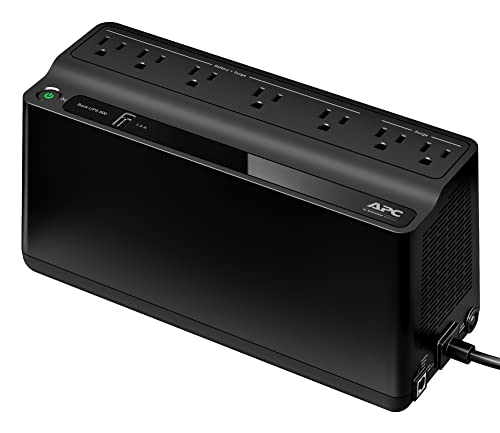
The APC BE600M1 provides short-term, battery-powered operation to keep essential devices running during outages and to allow safe shutdowns. It includes 5 battery-backed outlets plus 2 surge-only outlets for lower-priority gear, making it suitable for a home office with a computer and router. It is best for buyers prioritizing cost efficiency and compact form factor for basic uptime during brief outages.
Best for: a single computer plus networking gear in a small workspace.
Caution: runtime is modest at higher loads, so expect reduced backup time if multiple high-draw devices are connected.
APC BX1500M Back-UPS Pro

The BX1500M offers higher VA capacity (1500VA / 900W) with up to 19 minutes of backup at a 300W load. It supports a larger home office or media setup and provides 10 total outlets—5 with battery backup and 5 surge-only, plus built-in surge protection for coaxial and Ethernet lines. This model is best for users needing more devices protected and longer runtime than entry-level units.
Best for: a full home office or small business setup with multiple critical devices.
Caution: may be larger than entry-level options; ensure available desk space fits the unit and outlets on a single strip don’t overload a circuit.
APC BE425M Small UPS

The BE425M is designed for essential, low-power devices such as routers and modems. It delivers about 15 minutes of runtime at 100W and includes 4 battery-backed outlets plus 2 surge-only outlets. Its compact size makes it ideal for a small desk or dorm room where only basic connectivity needs to be protected.
Best for: protecting a router, modem, and a single small device at a minimal footprint.
Caution: limited runtime and power capacity—avoid using with several high-draw devices at once.
CyberPower CP1500PFCLCD PFC Sinewave

The CP1500PFCLCD combines 1500VA / 1000W output with a pure sine wave, suitable for active PFC power supplies and sensitive electronics. It has 12 outlets, including 6 that provide battery backup and surge protection, plus USB ports for quick charging. The color LCD panel makes monitoring easy—useful for workstations, NAS devices, and other gear requiring steady power.
Best for: office or gaming rigs that rely on high-performance PCs and multiple peripherals.
Caution: larger footprint and more complex setup; ensure adequate space and proper cord management.
CyberPower CP1500AVRLCD3 Intelligent LCD

The CP1500AVRLCD3 offers 1500VA/900W capacity with AVR and a robust LCD interface. It provides 12 outlets, split into battery backup and surge-protected groups, and includes USB ports for charging mobile devices. The AVR helps stabilize voltage, which is beneficial in areas with voltage fluctuations, reducing wear on connected electronics.
Best for: a home office with networking gear and multiple peripherals that benefit from voltage regulation.
Caution: ensure the unit’s physical footprint fits under your desk or within your cabinet space.
Buying Guide
- Load and runtime needs: Estimate total wattage of devices you plan to power during an outage. Higher-rated units provide longer runtime and support more devices.
- Output waveform: For modern PCs and power-efficient setups, a pure sine wave (or simulated sine wave with AVR where appropriate) preserves device longevity and performance.
- Outlets and layout: Count battery-backed outlets first, then surge-only outlets. Transformer-spaced outlets help accommodate bulky power bricks.
- Protection features: Look for surge protection on data lines (Ethernet/Coax) if you have modems or network gear. Coax/ethernet protection adds resilience against surges.
- Management and monitoring: LCD panels and software-friendly interfaces aid in monitoring battery health, load, and runtime estimates.
- Form factor and noise: Consider whether you need a compact unit for a small desk or a larger tower for a home office with many devices. Fans and cooling can affect noise levels during longer outages.
FAQ
- What is a UPS best used for? A UPS provides short-term battery power during outages and protects connected devices from surges and power fluctuations, allowing safe shutdowns and continuous connectivity.
- How many outlets should I look for? Start with battery-backed outlets for critical devices (computer, modem, router) and add surge-only outlets for peripherals.
- Do I need a pure sine wave UPS? For active PCs with power-sensitive components, a pure sine wave or high-quality simulated sine wave is preferable to avoid power supply hiccups.
- Will a UPS increase my uptime during outages? Yes, within its rated capacity, a UPS provides predictable runtime to keep essential devices running and to perform orderly shutdowns.
- How do I choose between models? Match total wattage and number of outlets to your device count, then weigh features like LCD monitoring and AVR against budget and space constraints.
- Is a higher VA always better? Higher VA generally means longer runtime and more outlets, but also larger size and higher cost. Choose based on your actual load and space.