Answering your search for reliable trailer solar panel kits, this guide helps you pick five top options tailored to RVs, campers, boats, and trailers. Each pick is evaluated for ease of setup, durability, and daily power output under practical sun conditions. Use this list to match the right kit to your powering needs, whether you’re at a remote campsite or on a boat dock.
Overview of chosen products
| Product | Key Use | Approximate Daily Output | Best For |
|---|---|---|---|
| ECO-WORTHY 200W Kit | RV/Caravan Off-Grid | ~800Wh | Higher power needs and long sunny days |
| Renogy 100W Starter Kit | Beginner RV/Camper | ~500Wh | Affordable entry with solid warranty |
| Renogy 200W Kit with Adventurer Controller | RV/Trailer | ~1000Wh | Compact footprint with good efficiency |
| [Ultra] ECO-WORTHY 400W Complete System | Full RV off-grid | ~1600Wh | All-in-one with batteries and inverter |
| SOLPERK 20W Panel Kit | Trickling/Maintain 12V batteries | Low (20W) | Battery maintenance and small trailers |
ECO-WORTHY 200W Solar Panel Kit for RVs and Off-Grid Use
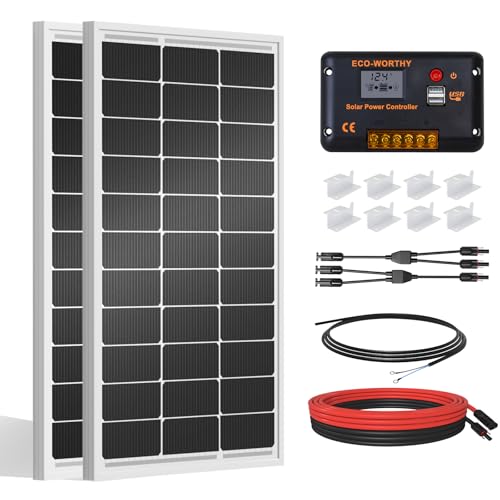
Best for: RVs, caravans, and larger trailer setups requiring higher daily energy. This kit uses high-efficiency monocrystalline panels and a 30A PWM controller, delivering up to 800Wh per sunny day under four hours of peak sun. The durable aluminum frame and IP65-rated junction box support long outdoor use. A potential limitation is reliance on PWM charging that may be less efficient in marginal sunlight compared with MPPT options.
Renogy 100W Starter Kit With PWM Controller

Best for: Beginners and budget-conscious buyers seeking a solid first solar system for an RV or small camper. The kit includes a 100W monocrystalline panel, a 30A LCD PWM charger, and necessary cabling. Efficiency is competitive at roughly 22.5%, with UL/CSA/IEC-level certifications noted in the data. The kit is better for modest power needs and quick setup; avoid if you require MPPT efficiency in challenging climates.
Renogy 200W Monocrystalline RV Solar Kit
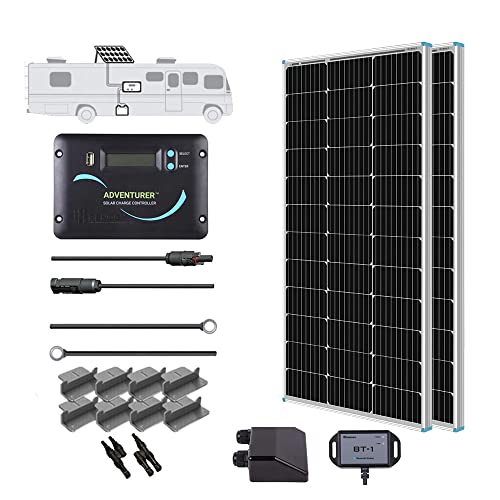
Best for: RVs, boats, and campers needing substantial power in a compact panel layout. The 200W kit delivers strong daily output (about 1000Wh in ideal sun) and uses corrosion-resistant framing to endure outdoor exposure. The Adventurer-Li PWM controller is designed for flush mounting and provides protection against common electrical issues. Consider this kit if your space is limited but you still want solid daily energy; the PWM controller is less efficient than MPPT in low-sun conditions.
[Ultra] ECO-WORTHY 400W Complete RV Solar System

Best for: Off-grid travel trailers that want an all-in-one solution without shopping separately for panels, battery, inverter, and controller. This kit claims 1600Wh daily output and includes four 100W panels, a 12.8V 280Ah lithium battery, a 2000W inverter, a 40A MPPT controller, and monitoring hardware. It is suitable for full-time camper use and longer trips. Limitation: the integrated system is heavier and more complex to install than smaller kits.
SOLPERK 20W 12V Panel Kit With MPPT Controller
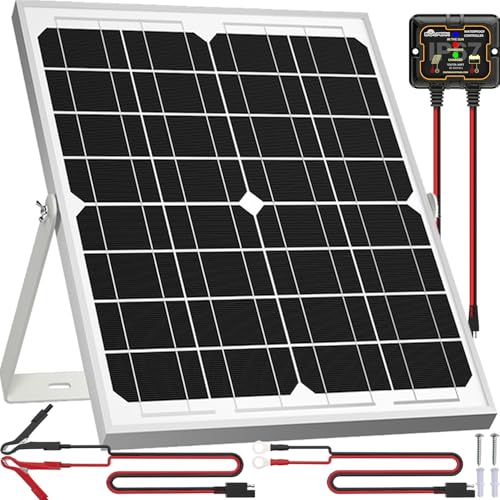
Best for: Small trailers and battery maintenance tasks where only a trickle charge is needed. The 20W panel with A+ monocrystalline cells achieves high efficiency for its size and includes a smart MPPT controller to improve charging efficiency. It’s a good match for maintaining a 12V battery while parked, but not ideal for heavy daily energy use or long-term off-grid living.
Voltset 20W 12V Solar Battery Charger Kit

Best for: Everyday use on trailers, cars, or boats needing reliable 12V charging. The kit features a high-efficiency MPPT charger with a universal 12V battery compatibility. It provides smart protection against overcharge and reverse polarity, making it a safe choice for long-term battery health. A limitation is the lower output for larger energy needs; better suited as a charger and maintainer rather than a primary power source.
Zuomeng 15W Solar Battery Maintainer Kit

Best for: Dump trailers and small utility trailers needing battery maintenance. This 15W kit includes an MPPT controller and a weatherproof panel, designed to prevent battery sulfation during long stow periods. It’s better for maintenance than for charging high energy loads; ensure your needs align with a low-output charging strategy.
Buying Guide: Key Considerations for Trailer Solar Kits
- Power needs and daily energy goal: Estimate your typical daily usage and match panel wattage to reach 60-80% of your daytime draw for battery longevity.
- Controller type: MPPT controllers extract more power, especially in cooler or variable conditions; PWM controllers are simpler and cost-effective but less efficient in challenging light.
- System expansion: If you plan to add batteries or an inverter later, choose a kit compatible with your future upgrades (voltage, battery chemistry, and controller current).
- Durability and weather resistance: Look for corrosion-resistant frames, IP-rated enclosures, and robust mounting hardware to withstand wind, rain, and snow loads.
- Space and footprint: RVs and trailers have limited roof or surface space. Consider panel efficiency and mounting options to maximize output per square foot.
- Wiring and safety: Ensure proper cabling gauges, fuse protection, and junction box ratings to prevent overheating and electrical faults.
- Warranty and service plans: Longer coverage on panel efficiency and controller performance can reduce long-term maintenance costs.
FAQ
- What’s the difference between MPPT and PWM controllers?
MPPT controllers extract more power, especially under fluctuating sun and cooler temperatures, while PWM controllers are simpler and typically cheaper. - Can a trailer kit power a full RV’s needs?
A larger 200W–400W kit can support moderate daily use, but high-consumption appliances may require larger or additional panels and a suitable battery bank. - Is 12V the only option for trailer kits?
Most kits target 12V systems for trailers and RVs; some kits include or support higher voltages when paired with appropriate batteries and inverters. - What maintenance is needed for solar panels on trailers?
Regular cleaning, inspection of panels and wiring, and ensuring mounting hardware remains tight are typical maintenance steps. - Should I choose a complete kit or mixed components?
Complete kits simplify installation and compatibility, while mixed components offer customization but require more planning. - What is a practical daily output to expect?
Output varies with sunlight, angle, and shading; under optimal conditions, a 100–200W kit may generate several hundred Wh daily, while larger kits approach or exceed 1000Wh with multiple panels.