Thin film flexible solar panels offer practical power on curved roofs, boats, RVs, and other uneven surfaces. This guide highlights five top options suited for different setups, from ultra-light travel rigs to durable marine installations. Read on to find which panel best matches your mounting surface, portability needs, and expected sun exposure. The buyer is typically looking for lightweight, bendable, and easy-to-install solar solutions that perform reliably under shade and on non-traditional surfaces.
Overview of selected products:
- Renogy Flexible Solar Panel 100 Watt — best for ultra-lightweight, stealthy installs on curved surfaces.
- Renogy 100W Flexible Panel — best for high efficiency with a compact, all-black look.
- BougeRV Yuma 200W CIGS Thin-Film — best for maximum flexibility on very curved surfaces.
- BougeRV Arch Pro 200W — best for stable, higher-voltage setups and shading resilience.
- BougeRV Yuma 100W CIGS Thin-Film — best for anti-shading performance on mid-range need.
Renogy Flexible Solar Panel 100 Watt 12 Volt Monocrystalline

Best for ultra-lightweight, curved roofs where stealth is key. This panel uses flexible monocrystalline cells and weighs significantly less than rigid panels, making transport and mounting easier on vans, RVs, boats, or cabin trailers. The ultra-thin lamination reduces visibility on slick surfaces, which is advantageous for discreet installations on marine or camper roods. Caution: avoid exposing to sharp impacts that could crease the panel’s lamination.
Renogy 100W Flexible Solar Panel 12V
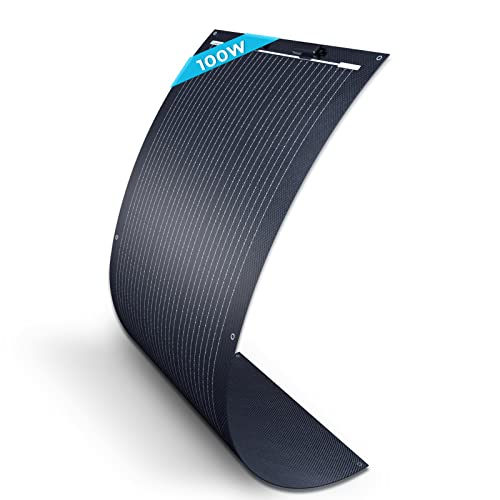
Best for higher efficiency needs in curved installations. It uses half-cut PERC cell technology to improve light capture and electrical performance, with an all-black appearance that remains glare-free. It weighs less than rigid options and can bend up to 240 degrees. Choose this if you want more efficient energy capture on non-flat roofs. Caution: ensure the panel’s open-circuit voltage aligns with your battery system when wiring multiple units in series.
BougeRV Yuma 200W CIGS Thin-Film Flexible Solar Panel

Best for maximum bendability on very curved surfaces. This 200W panel uses CIGS thin-film technology, delivering flexibility and light sensitivity advantages over traditional silicon cells. It’s designed for installations where space and multitop wiring are primary concerns. Limitation: open-circuit voltage and wiring compatibility should be checked against your chosen power station or storage system.
BougeRV Arch Pro 200 Watts

Best for stable output in shaded or variable light conditions. The Arch Pro uses advanced N-type16BB cells and bypass diodes to maximize energy capture during partial shading and low-light periods. It supports 12V battery charging and can be wired in series for higher voltages. Limitation: some power stations may have open-circuit voltage constraints; verify compatibility before purchase.
BougeRV Yuma 100W CIGS Thin-Film Flexible Solar Panel

Best for anti-shading performance on mid-range needs. The 100W CIGS panel emphasizes stable output in partial shade and low-light scenarios. It offers a longer potential lifespan in harsh outdoor conditions and is notably lighter and thinner than rigid panels. Caution: ensure the mounting surface is smooth for best adhesion and consider shading risks from nearby structures or mounting hardware.
Buying Guide
What surface will you mount on?
Flexible thin-film panels excel on curved, uneven, or moving surfaces such as boat hulls, A-frame RV roofs, and curved camper vans. If your surface is flat and rigid, consider a traditional rigid panel instead. For curved surfaces, prioritize panels with high bend radius, light weight, and low profile.
How important is weight and thickness?
Weight and thickness influence transport, ease of installation, and roof load. Ultra-light options (around a few pounds) are ideal for portable setups or temporary campsites. Thinner lamination reduces visibility but may be more susceptible to minor abrasions or impact damage; protect it with proper mounting hardware.
What about efficiency and shading?
Thin-film cells like CIGS can offer better performance in low-light and partial shading compared to some monocrystalline variants, but efficiency varies by technology. Panels with bypass diodes and shading mitigation tend to provide steadier power output in real-world conditions.
Voltage, currents, and system compatibility
Confirm open-circuit voltage, operating voltage, and current with your battery bank and charge controller. Certain panels designed for 12V systems can be wired in series for higher voltages, but this may require compatible charge controllers and storage systems. Verify compatibility with your RV, boat, or off-grid power setup before purchase.
Durability and installation considerations
Water resistance, UV stability, and physical flexibility matter for outdoor use. Pre-punched holes or included mounting hardware simplify installation on uneven surfaces, while adhesives like butyl tape can work on smooth, clean surfaces. Always allow for ventilation behind the panel to prevent heat buildup.
Long-term costs and lifespan
Thin-film panels often present a favorable balance between upfront cost, weight, and lifespan. CIGS panels may offer long-term durability and flexibility, potentially reducing replacement frequency on challenging installations. Compare the annualized cost of ownership when evaluating options.
FAQ
Q: Are thin-film panels suitable for marine use?
A: Yes, many thin-film panels are designed for marine environments, offering flexibility and lightweight features that suit boat hulls and deck installations.
Q: Can these panels be mounted on a curved RV roof?
A: Yes. Look for panels with high bend tolerance and lightweight construction to accommodate curved surfaces without compromising performance.
Q: Do flexible panels work in partial shade?
A: Some models perform better in partial shade due to technology like CIGS and bypass diodes that minimize shading losses.
Q: What should I check before buying?
A: Check voltage compatibility with your charge controller, surface compatibility for mounting, weight, and whether the panel includes or requires additional installation accessories.