Finding a reliable stick welder generator combo helps you weld in remote jobsites or on DIY projects without sacrificing power or arc stability. This guide highlights five top options and explains who each is best for, along with practical buying tips. Ideal buyers include contractors needing dual-use machines for on-site power and welding, hobbyists seeking portable capability, and farmers handling repairs away from a shop. Below is a quick comparison to help you decide at a glance.
| Product | Best For | Key Strength |
|---|---|---|
| Hobart Champion Elite 225 | Pro contractors needing robust power | High AC output and strong welding arc |
| 4500 Watt Engine Driven Welder (Zinnore) | Compact, versatile 2-in-1 | 4,500W generator + 160A stick welding |
| Lincoln Weld-Pak 225i | Home shop to small shop, portable | Dual voltage, smooth arc, portable |
| ARCCAPTAIN 220Amp MMA Welder | Beginners and pros needing control | Synergic control with LED display |
| SOARFLY 250Amp Stick Welder | DIYers and maintenance crews | Dual voltage, 250A output |
Hobart Champion Elite 225 Engine-Driven Generator and Stick Welder

The Hobart Champion Elite 225 combines engine-driven portability with reliable stick welding, featuring a 10,000-watt peak auxiliary power and a 9,500-watt continuous AC output. This setup is best for professional contractors who need a dependable power source at remote jobsites while performing heavy-duty welding. The arc performance is designed to be smooth and consistent, supporting durable welds in demanding environments. A practical limitation is weight and transport between sites, so plan for a vehicle with sufficient payload.
Engine-Driven Welder, Champion 145 Series

The Champion 145 Series provides a compact, recoil-start option with gas operation and a 4,750 W peak power. It’s well-suited for portable, light-duty welding tasks and small repairs. Best for hobbyists or remote projects where lightweight, quick-start capability matters. A consideration is its peak power limit compared to heavier-duty models, which may affect longer welds or thicker materials.
4500 Watt Engine Driven Welder 160 Amp Stick Welder AC Power Welder Generator

This 2-in-1 unit offers a 4,500W generator and a 160A stick welding capability, ideal for jobsites where power and portability both matter. It provides wide electrode compatibility and a stable arc with high-frequency IGBT technology and DC output. Choose this if you need strong welding performance in a mobile package, but be aware of its heavier weight and potential noise at load.
Lincoln Electric Weld-Pak 225i Stick Welder, Dual Voltage

The Weld-Pak 225i offers dual-voltage operation (120V/230V) with a 10–225 amp output range, balancing light and heavy-duty welding needs. It emphasizes portability, featuring a lightweight design and a built-in tool-box top to organize cables and accessories. Best for home shops or small jobs where versatility and ease of transport matter. A limitation is that duty cycle and fabricability are tied to input voltage, so plan for the available power source.
ARCCAPTAIN 220Amp MMA Welder with Synergic Control

The ARCCAPTAIN 220A MMA Welder features a modern LED display, synergic control, and hot start, arc force, and anti-stick functions. It suits both beginners seeking automatic current matching and professionals who want adjustable settings for precise control. It’s a strong pick for versatile on-site use, but users should verify the power source compatibility and fan behavior during continuous work to avoid overheating.
SOARFLY Stick Welder, 250Amp with Large LED Display
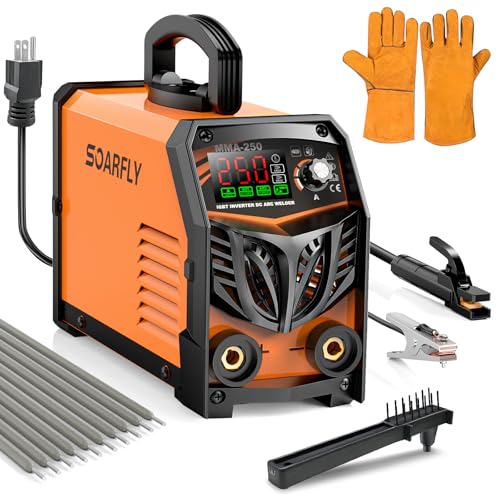
The SOARFLY 250A welder offers dual voltage (110V/220V) with a bright LED display for real-time monitoring. It is suitable for maintenance, fabrication, and home repairs, providing versatility for both household outlets and job sites. The main caveat is that 220V operation may require an adapter not included with the unit, affecting portability in some setups.
Buying Guide
What should you consider when choosing a stick welder generator combo?
- Power needs: Assess required generator wattage and welding amperage. Higher amperage supports thicker materials and more demanding welds.
- Voltage compatibility: Dual-voltage capability adds flexibility for home and jobsite use. Check whether 110V or 230V inputs align with your typical power sources.
- Duty cycle: A higher duty cycle allows longer welding without overheating. Match this to your typical session length and material thickness.
- Portability: Weight and noise impact transportability. If you work remotely, consider built-in handles, wheels, and engine type.
- Arc stability: Look for features like IGBT technology, hot start, arc force, and anti-stick to improve starting and welding quality.
- Reliability and maintenance: Practical design elements such as easy access for maintenance, availability of spare parts, and overall build quality matter for long-term use.
- Accessories and setup: Some units include clamps, rods, and cables. Decide if you need a bundled kit or will source components separately.
Frequently Asked Questions
- What is a stick welder generator combo best used for?
They are ideal for remote jobsites and DIY projects where both welding and portable power are needed. Choose based on welding amperage and generator output for your material thickness and run time.
- Is dual voltage necessary for all users?
Not always, but it adds flexibility. 120V is common for small repairs and light metal, while 230V supports heavier work and longer runs.
- What is a good duty cycle for frequent welding?
A duty cycle around 60% at the rated amperage is common for mid-range machines; higher is better for longer welding sessions.
- Do I need extra accessories to start welding with these machines?
Some models include basic kits; others require purchasing clamps, rods, and cables separately. Verify what is included before buying.
- How important is arc stability for beginners?
Arc stability helps beginners achieve cleaner welds and easier arc starts, reducing spatter and frustrating starts.
- Can these units run off standard household outlets?
Dual-voltage units may run on both 110V and 230V sources, but ensure your outlet and wiring meet safety requirements for your chosen input.