Find the right solar power panels kit for your off-grid needs. This guide compares five popular kits, highlighting who each option is best for, and why it stands out. Ideal buyers include RV travelers, cabin owners, boaters, campers, and anyone seeking reliable portable or home backup power. The table below summarizes core specs to help quick comparisons.
| Product | Brand | Approx. Power | Best For |
|---|---|---|---|
| ECO-WORTHY 200W Kit | ECO-WORTHY | 200W | RV and off-grid campers needing a mid-size kit |
| Renogy 100W Starter Kit | Renogy | 100W | New off-grid setups and beginners |
| ECO-WORTHY 1.6KWh Complete Kit | ECO-WORTHY | 400W panels + 48V battery + inverter | Full home backup or RV, energy-intensive loads |
| DOKIO 300W Foldable Kit | DOKIO | 300W | Compact, portable RV/camping power |
| Go Power GP-PSK-130 | Go Power | 130W | Portable, low-profile solar charging |
ECO-WORTHY 200 Watts Kit With High Efficiency Panel
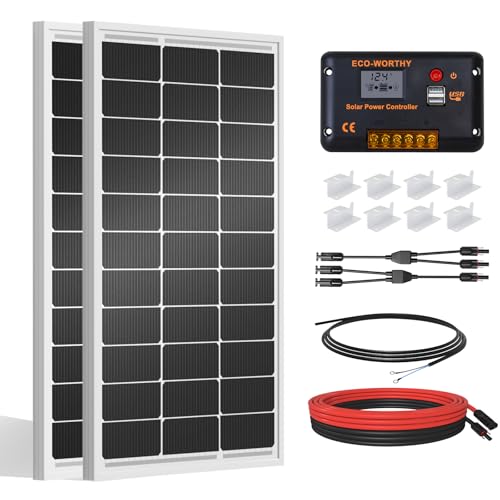
The ECO-WORTHY 200W kit uses high-efficiency monocrystalline cells to maximize output in typical sunlight, supporting up to 800Wh per day under strong sun. It’s designed for RVs, campers, marine applications, and other off-grid setups. Best for weekend travelers or small off-grid cabins needing a reliable mid-range solar option. The kit features a corrosion-resistant aluminum frame, withstanding wind and snow loads, and an IP65-rated junction box for durable protection. Limitation: performance depends on ideal sun; real-world output varies with conditions.
Voltset 12V Solar Battery Charger Kit

The Voltset 20W kit delivers fast 12V charging with an advanced MPPT controller and A+ monocrystalline panels. It’s ideal for maintaining car, RV, boat, or trailer 12V batteries, with built-in multi-layer protection against overcharge, discharge, shorts, and reverse polarity. It’s best for those needing a small, worry-free trickle charger. Caution: 20W is modest for larger loads; it’s most effective for maintaining batteries rather than powering high-demand devices.
Renogy 100W Starter Kit

The Renogy 100W Starter Kit combines a 100W monocrystalline panel with a 30A PWM charge controller and essential hardware. It’s suitable for RVs, campers, and off-grid shacks starting their solar journey. The kit emphasizes reliability and safety with UL/IEC-rated components and weather-resistant design. Best for newcomers and small setups seeking a straightforward install. Limitation: PWM controllers are less efficient than MPPT in partial shade or variable conditions, but remain a solid budget choice for beginners.
ECO-WORTHY 1.6KWh Complete Solar Panel Kit

This ECO-WORTHY kit targets full off-grid living or high-demand RV use. It pairs 400W panels (12BB cells) with a 99% efficient MPPT controller, delivering up to 1.6kWh daily output under optimal sun, and supports 12V and 110V AC loads. It also includes a 48V 314Ah lithium battery for substantial storage and a robust 10kW inverter for heavy appliances. Best for energy-intensive needs or cabin backups. Limitations: higher upfront cost and more complex installation compared to smaller kits.
ECO-WORTHY 10kW Complete Home Solar System

Designed for home power resilience, this ECO-WORTHY kit supports up to 10kW of continuous output with 120V/240V split-phase. It includes five 590W panels equivalent to 2,950W PV capacity and a 48V 314Ah LiFePO4 battery with a smart BMS. The system integrates a 7-inch display, Bluetooth/Wi-Fi monitoring, and RS485/CAN communication for compatibility with common inverters. Best for full-house backup or scalable off-grid homes. Caution: larger footprint and professional installation may be required.
Buying Guide
What should you consider when choosing a solar power kit?
- Power needs: Estimate daily watt-hours and peak loads to pick panel and inverter sizes that cover typical usage.
- Storage requirements: Decide between lead-acid, LiFePO4, or other chemistries and storage capacity to meet usage patterns.
- System type: Choose between portable, RV/CV-specific, or full-home kits based on mobility and permanence.
- Charge controller: MPPT controllers offer higher efficiency than PWM, especially in variable sun; consider budget and climate.
- Durability: Look for corrosion-resistant frames, IP-rated components, and weather resistance for outdoor use.
- Expansion: If you anticipate growth, prefer kits and components that allow parallel connections or future battery additions.
Frequently Asked Questions
- What is the difference between MPPT and PWM controllers?
MPPT controllers extract more power, especially in cooler temperatures and cloudy days, while PWM controllers are simpler and cheaper. - Can a 100W panel power an RV full-time?
A 100W panel can support modest loads and battery maintenance, but higher daily energy needs may require larger kits or supplementary sources. - Is LiFePO4 storage worth the extra cost?
LiFePO4 offers longer life, better safety, and higher depth of discharge, which can justify the cost for long-term use. - Do these kits require professional installation?
Small portable kits may be DIY-friendly, while full-home or high-capacity systems often benefit from professional installation. - Can I expand a kit later?
Many kits support adding panels, inverters, or batteries, but check compatibility with existing components. - What affects real-world output?
Sunlight intensity, panel angle, temperature, shading, and wiring losses all influence actual daily production.