Answering the growing demand for compact, all-in-one solar solutions, these products integrate inverters directly with solar panels or solar systems. They’re ideal for off-grid cabins, RVs, tiny homes, and emergency backup power. Each option below highlights who benefits most, plus practical caveats to consider before buying.
| Product | Best For | Key Benefit |
|---|---|---|
| Aninerel 12000W Solar Hybrid Inverter | Heavy-load homes and workshops | High continuous/peak output with parallel expansion |
| ECO-WORTHY 200W Starter Kit | RVers and beginners | All-in-one easy install |
| SUMRY Hybrid Inverter 4000W | Medium homes with or without batteries | High MPPT and robust performance |
| BLAVOR Portable Power Station 1600W | Portable power on the go | Built-in solar panel and LiFePO4 |
| SUMRY Solar Inverter Charger 3600W | Battery-based or battery-less setups | Versatile PV and battery configurations |
Aninerel 12000W Solar Hybrid Inverter

The Aninerel system is designed for higher-demand setups, offering 12,000W continuous output and a 24,000W peak. It converts 48V DC from solar panels or batteries to 120V single-phase or 240V split-phase AC. Best for homeowners, cabins, or workshops needing substantial, scalable power. It supports up to six parallel units for up to 72kW total output, increasing surge capacity for large loads.
Who it’s best for: users with heavy daily loads or space to expand power via parallel units. Why selected: its dual MPPT charging with up to 220A battery input maximizes solar harvest and supports high-voltage PV arrays (up to 500VDC). It also works with common battery chemistries and can operate without a battery in direct solar-to-load mode.
Caution: Parallel operation requires proper wiring and safety planning. Check that your array voltage and battery bank are compatible with the 500VDC PV input limit.
ECO-WORTHY 200W Solar Starter Kit
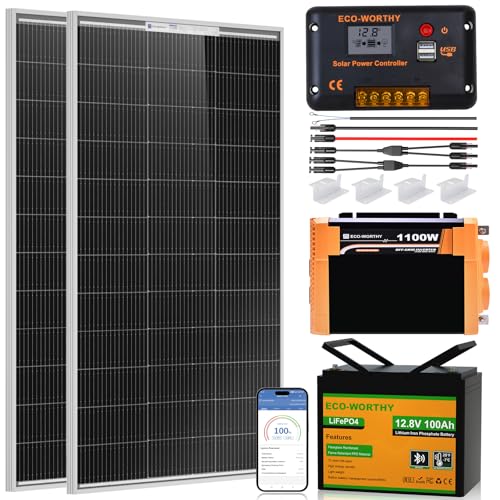
This complete kit provides a simple, beginner-friendly off-grid solution: two 100W panels, a 100Ah lithium battery, a 1100W inverter, and a 30A PWM controller. It’s designed to be plug-and-play for RV trips or micro-cabins, delivering about 800Wh daily under good sun. It’s ideal for users who want a straightforward setup without sourcing separate components.
Who it’s best for: RV travelers and newcomers seeking a turnkey system. Why selected: the entire package avoids DIY guesswork and includes essential cables and mounting components. It’s easier to install than piecing together individual components.
Caution: Limited expandable capacity compared with larger systems; consider future growth if you plan to run high-power appliances frequently.
SUMRY Hybrid Inverter, 4000W

The SUMRY 4000W inverter combines a pure sine wave output with a built-in 140A MPPT controller and a high PV input tolerance (up to 5600W). It supports battery-less operation or compatibility with AGM, Lithium, and other chemistries. It’s a balanced choice for households that want reliable grid-like performance with flexible battery options.
Who it’s best for: households seeking robust performance with battery flexibility. Why selected: the integrated MPPT and high PV tolerance improve charging efficiency under varying light. It’s a good middle-ground option for users not ready to commit to multi-unit parallel systems.
Caution: Battery-less operation depends on PV input conditions; in cloudy conditions you may rely on grid or stored energy if available.
BLAVOR Portable Power Station 1600W

This portable power station includes a built-in 40W solar panel and a 1024Wh LiFePO4 battery, delivering up to 1600W of continuous output with 3200W surge. It’s well-suited for camping, emergencies, or short power outages where portability matters. The long-life LiFePO4 cells offer many charge-discharge cycles and safer operation.
Who it’s best for: outdoor enthusiasts and households needing a compact, all-in-one backup. Why selected: built-in solar panel eliminates extra gear, and multiple outlets support several devices at once. Caution: solar panel performance depends on sunlight angle and weather; for full power, consider additional panels or larger battery capacity if you anticipate frequent high-load usage.
SUMRY Solar Inverter Charger, 3600W

This all-in-one solution combines a 3600W inverter with a built-in 120A MPPT charge controller and a 100A AC battery charger. It supports PV input up to 500VDC and can operate with or without a battery, depending on configuration. It’s a strong option for grid-like performance in battery-supported or battery-free setups.
Who it’s best for: homeowners who want a flexible inverter charger with strong PV input acceptance. Why selected: the integrated MPPT controller and the ability to run loads directly on PV power provide versatility for various installation scenarios. Caution: operation without battery reduces energy storage resilience during nighttime or cloudy days.
Buying Guide: Key Considerations For Solar Panels With Built-In Inverter
- Power needs: Match continuous and peak output to your appliance load. Higher-wattage devices require larger inverters and potential parallel units.
- Battery compatibility: Check whether the unit supports your preferred battery chemistry (LFP, Li-ion, Lead-Acid) and if it can operate without a battery.
- PV input and expansion: Look at MPPT capability, PV input voltage range, and whether parallel expansion is supported for scalability.
- System type: Decide between all-in-one portable units, fixed home systems, or hybrid configurations for off-grid viability.
- Portability vs. capacity: Portable units weight less but may have lower storage; fixed systems offer higher storage and parallel capacity.
- Safety and protections: Ensure protections for over-temperature, over-load, short-circuit, and battery management systems are included.
- Installation effort: Beginner-friendly kits come with cables and mounts, while heavier setups may require professional wiring.
- Monitoring and control: Consider built-in displays, Bluetooth/WiFi monitoring, and remote management features for maintenance and optimization.
FAQ
- What’s the advantage of an inverter built into a solar panel system?
It simplifies wiring, reduces components, and can improve stacking efficiency for compact setups. - Can these systems run without batteries?
Some models support direct solar-to-load operation, but performance depends on PV input and sun conditions. - Are parallel units reliable for higher power needs?
Yes, parallel capability increases total output and surge capacity, but requires correct wiring and safety checks. - Which kit is best for a beginner?
The ECO-WORTHY starter kit offers an all-in-one setup with guided installation and essential components. - Do these inverters support lithium batteries?
Most listed models support lithium (LiFePO4) and other chemistries, but verify each model’s compatibility. - How do I choose between a battery-less option and one with storage?
Battery-based systems provide resilience for outages; battery-less setups rely on solar power when sun is available.