Answering your search for watts-per-panel guidance, these five solar panels offer a range of wattage and technologies to fit 12V/24V off-grid setups. The list highlights who each panel is best for, from portable yard setups to rooftop installations. Buyers should consider system voltage, wiring configuration, and mounting flexibility when choosing panel wattage per unit. Below is a quick comparison to help you decide which panel fits your needs.
| Product | Wattage | Best For | Notes |
|---|---|---|---|
| DOKIO 400W Monocrystalline Panel | 400W | Mid-size off-grid, sheds, garden setups | 3 m leads; parallel on 12V recommended |
| DOKIO 800W (2×400W) | 800W | Larger off-grid systems, cabins | Two panels; longer leads; MPPT advised |
| Callsun N-Type 400W (2×200W) | 400W total per 2×200W set | Rooftops, RVs, small off-grid | N-Type cells; bifacial options available |
| Rvpozwer 200W N-Type 200W | 200W | Compact installations, boats, trailers | 18BB N-Type cells; pre-drilled holes |
| Callsun 450W Bifacial 2-Pack | 450W total | Ground-mits/open-area setups, large rooftops | Bifacial, anti-shade design |
DOKIO 400W Monocrystalline Panel

The DOKIO 400W panel is best for individuals building a mid-sized off-grid system for a shed, garden, or yard power station. It uses monocrystalline cells and provides 400W under standard testing conditions. For 12V systems, parallel wiring yields steadier charging, while series wiring is more voltage-intensive and should be used only if your controller supports higher input voltage. The 3 m MC4 leads offer flexible routing to reduce extra connectors and potential failure points. Use this panel when you want straightforward setup with moderate power density for a compact footprint.
Best for: homeowners with a modest off-grid setup or a shed power station who value longer cable runs and straightforward 12V parallel wiring. Caution: long runs can introduce voltage drop if wiring is not properly sized for your system.
DOKIO 800W (2×400W) Panels

This two-panel 800W configuration suits larger off-grid systems, backyards, or cabin setups where higher daily energy output is needed. Each 400W panel has 3 m leads, enabling longer reach without frequent extensions. It is compatible with various 12V and 24V configurations; MPPT controllers are strongly recommended to maximize efficiency and balance voltage. Fewer connections relative to a bundle of smaller panels can reduce potential failure points and simplify wiring.
Best for: homeowners planning a bigger off-grid array who want high total wattage from a compact footprint. Caution: ensure your charge controller can handle the combined current and voltage of two 400W panels in parallel or series as configured.
Callsun N-Type 16BB 400W (Two 200W Panels)

This Callsun setup uses advanced N-Type cells with 16BB busbars for improved efficiency and reduced hot spots. The bifacial option increases potential output by capturing rear-side light, which can be beneficial in reflective or open-area installations. TwinCell anti-shade technology helps maintain energy production when part of the panel is shaded. Choose this if you want higher efficiency and better shading tolerance in rooftop or open-field layouts.
Best for: users seeking high efficiency and shading resilience in a mid-size 400W array, such as rooftop setups with partial shade. Caution: bifacial performance depends on rear-side reflectivity and mounting angle; real-world gains vary by installation conditions.
DOKIO Monocrystalline 800W Kit (2×400W)
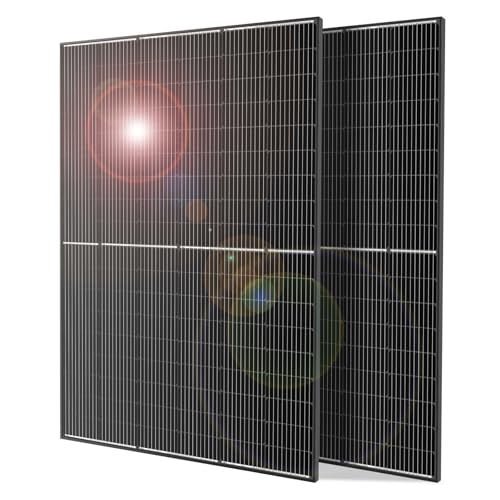
This 800W dual-panel kit is designed for larger off-grid deployments, such as cabins or multi-equipment setups. With parallel-first wiring on 12V systems, it prioritizes stable charging and safer voltage. Each panel has 3 m leads for flexible routing, reducing the need for multiple connectors. MPPT compatibility is recommended to optimize energy capture and adjust to changing sunlight. Use this kit when you need a compact, high-wattage array with simplified wiring.
Best for: users expanding a 12V off-grid system who want a straightforward, higher-wattage solution in a compact package. Caution: ensure your inverter and wiring can handle the total current from two 400W panels in parallel.
Buying Guide
What wattage per panel fits my system?
Consider your inverter or charge controller’s input limits and your daily energy needs. Higher wattage per panel can reduce the number of panels required, but may demand a larger controller and separate mounting considerations. For 12V systems, parallel wiring often yields steadier charging, while 24V or higher may benefit from series configurations if supported by your controller.
How do bifacial panels compare to standard panels?
Bifacial panels capture light on both sides and can deliver more total energy under the right conditions, such as open ground with reflective surroundings. They’re most effective when rear-side light is abundant and mounting allows rear exposure. In shaded or low-reflectivity environments, gains may be modest.
What installation factors influence performance?
- Orientation and tilt relative to the sun’s path
- Shade from trees, buildings, or obstructions
- Wiring configuration and cable length
- Quality of connections and MPPT controller optimization
Which panel features impact durability and longevity?
Look for tempered glass, robust aluminum frames, sealed junction boxes, and weatherproof connectors. Higher wind and snow load ratings indicate stronger panels for exposed installations. IP ratings on connectors protect against water ingress in outdoor environments.
How should I size my system holistically?
Determine daily energy consumption and peak loads, then select panels to meet or exceed that with headroom for cloudy days. Choose a charge controller and inverter sized for the total current from all panels in your array. Plan for future expansion if your energy needs may grow.
What are common limitations to expect?
Real-world output deviates from STC ratings due to sun angle, temperature, shading, and wiring losses. Longer cable runs can introduce voltage drop if wiring gauge is insufficient. Some panels require MPPT controllers to maximize performance, especially at higher voltages.
Summary of selected options
- 400W mid-size panels for compact off-grid setups
- 800W dual-panel kit for larger remote systems
- N-Type 400W with anti-shade design for rooftops and RVs
- 200W compact N-Type for tight spaces
- 450W bifacial 2-pack for high-output, open-area layouts
Frequently Asked Questions
- What does “400W per panel” mean in real-world use? – It indicates peak power under standard test conditions; actual output varies with sun exposure and temperature.
- When should I use parallel vs. series wiring? – Parallel is safer for 12V systems and yields more stable current; series increases voltage and is suitable only if your controller supports it.
- Are bifacial panels worth it for typical home setups? – They can boost output in reflective or open environments, but gains depend on mounting and surroundings.
- Do I need MPPT for these panels? – MPPT controllers maximize energy harvest, especially when using higher voltages or longer cable runs.
- How many panels do I need for a given daily energy goal? – It depends on daily consumption, sun hours, panel wattage, and system losses; calculate with a detailed energy plan.
- What are key signs of a durable solar panel? – Weatherproof rating, tempered glass, corrosion-resistant frame, IP-rated connectors, and robust junction boxes.