This guide helps buyers choose practical solar panel kits for sheds, cabins, or small off-grid spaces. The top picks balance ease of setup, reliable power, and value. Best for hobbyists and backyard builders are compact starter sets; better for larger sheds or extended off-grid use are mid-range kits; choose this if you want higher daily output and expandable systems.
| Product | Type | Approx. Daily Output (Under Ideal Sun) | Best For |
|---|---|---|---|
| Renogy 100W Starter Kit | Starter Kit | ~500 Wh | New to solar; small sheds |
| ECO-WORTHY 200W Kit | Complete Kit | ~800 Wh | Medium sheds; RV backups |
| ECO-WORTHY 1.6KWH Complete Kit (400W) | Complete System | ~1,600 Wh | Larger sheds; home backup |
| Renogy 200W Starter Kit | Starter Kit | ~1,000 Wh | Expanding sheds; multi-appliance use |
| Hoysicy 100W Kit | Panel Kit | ~400–500 Wh | Budget-friendly sheds; battery maintainer |
Renogy 100W Solar Panel Starter Kit

Best for: Beginners or compact sheds needing a reliable, easy-to-install solar setup. This kit combines a 100W monocrystalline panel with a 30A PWM charge controller and basic mounting hardware. It’s selected for straightforward installation and steady daily output in small spaces.
- Efficient performance with about 500Wh daily under typical sun, 22.5% cell efficiency.
- UL 61730, CSA 61730, and IEC 61730/61215 certified with weather resistance.
- 10-year panel material/workmanship coverage; 2-year controller coverage; 25-year power output warranty enthusiasm (service plan).
Caution: Real-world daily output depends on sun exposure; the PWM controller is reliable but not as efficient as MPPT in low-light conditions. Best used with sufficient daytime sun and a storage battery. This kit is ideal for small sheds, cabins, or porches that don’t require heavy power loads.
ECO-WORTHY 200W Solar Panel Kit
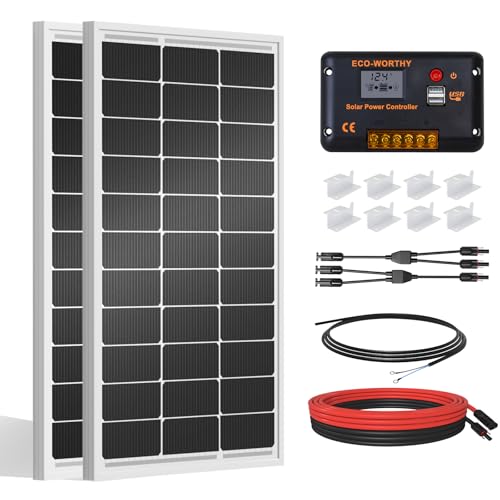
Best for: Mid-sized sheds or off-grid cabins needing higher daily output with straightforward setup. This 200W kit includes efficient monocrystalline panels and a 30A PWM controller for dependable charging.
- Daily output around 800Wh in optimal sun; panels rated for robust performance.
- High-durability frame and IP65-rated junction box for weather resilience.
- Suitable for RVs and other off-grid needs beyond sheds, offering simple expansion.
Limitation: PWM charging is reliable but can be less efficient in low-light conditions compared with MPPT controllers. Consider this kit if you want a balance of cost and output for a medium-size shed or temporary off-grid use.
ECO-WORTHY 1.6KWH Complete Solar Panel Kit (400W)

Best for: Larger sheds or small off-grid homes where higher energy demand is expected. This 400W system delivers around 1.6 kWh daily under ideal conditions and includes MPPT-powered charging for improved efficiency.
- Utilizes 12BB solar cells with a 23% conversion rate and a 400Wh daily baseline under ideal sunlight.
- 99% efficient MPPT controller with peak conversion up to 98%; 40% higher efficiency than PWM in some conditions.
- Includes a complete kit design suitable for do-it-yourself installation and steady expansion.
Caution: The MPPT advantage shines with proper wiring and battery selection; ensure adequate space and safe mounting for roof or ground installation. Best for sheds that can accommodate a larger array.
Renogy 200 Watt Starter Kit

Best for: Sheds needing higher power with a simple two-panel setup for future expansion. This kit provides a practical upgrade path from a basic 100W system and supports multiple battery types with a PWM controller.
- Two 100W panels with 22% cell efficiency; bypass diodes improve performance in varied light.
- Wanderer PWM controller supports Sealed, Gel, Flooded, and Lithium batteries, with four-stage charging.
- Vetted for long service life with solid encapsulation and heat management.
Caution: If you anticipate heavy summer use or 110V appliances, plan for battery capacity and possible controller upgrade to MPPT for better efficiency in variable days.
Buying Guide
What shed size and energy load should guide your kit choice?
Small sheds with minimal lighting can run on 100W–200W kits. For cabins with freezers, fans, or essential appliances, 400W–800W kits offer better daily reliability. For larger spaces or more appliances, consider 1.6kWh kits or higher and plan for battery storage and possibly an inverter.
What controller type matters?
PWM controllers are sufficient for simple, low-cost setups; MPPT controllers improve efficiency in less-than-ideal sun, especially with larger systems or variable temperatures. If the shed has consistent sun exposure and you want maximum efficiency, choose MPPT-enabled kits when available.
What about durability and weather resistance?
Look for weather-rated components, corrosion-resistant frames, and IP-rated junction boxes. For sheds in harsh climates, prioritize kits with robust framing and secure mounting hardware.
Do you need an inverter or battery storage?
Most shed applications benefit from a charger controller plus a battery bank. If you need 110V AC appliances directly, add an appropriate inverter. Plan battery capacity to match daily energy usage and cloudy-day buffers.
Expansion and future-proofing
Choose kits that allow adding panels or upgrading controllers later. Starting with a modest kit and keeping compatible battery types helps with long-term scalability.
FAQ
- What size solar kit is best for a small shed?
Typically a 100–200W kit suffices for lights and small devices; larger sheds may benefit from 400–800W for more appliances.
- Is MPPT better than PWM for sheds?
Yes, MPPT typically provides higher efficiency, especially in variable sunlight or larger systems, but at a higher upfront cost.
- Do these kits require a battery?
Most shed setups perform better with a storage battery to balance daytime generation with nighttime use.
- Can I expand a kit later?
Many kits support adding panels or upgrading controllers; check compatibility with existing batteries and inverters.