Yes, solar panels for outbuildings provide dependable power for sheds, workshops, and garages. This guide highlights five practical options, focusing on durability, efficiency, and suitability for off-grid or backup power. Each product is evaluated for who it’s best for and why, with clear guidance on potential limitations. Ideal buyers include remote property owners, DIY enthusiasts, and anyone needing steady 12V or 24V power for tools, lighting, and security cameras.
Product Comparison Snapshot
| Product | Best For | Key Benefit | Limitations |
|---|---|---|---|
| SOLPERK Solar Panel Kit 20W | Small outbuildings, battery maintenance | Smart MPPT controller, 12V charging | Low wattage for larger loads |
| Callsun 450W Bifacial 2-Pack | Rooftop or open-area outbuildings | High power per panel, bifacial energy | Higher upfront cost |
| Callsun N-Type 400W Bifacial | Mid-size installations | Anti-shade design, strong reliability | Requires compatible mounting |
| Renogy 200W Portable | Temporary setups, RVs, camps | High efficiency, foldable, portable | Not ideal for fixed outbuildings |
| FlexSolar 100W Portable | Emergency power, light-duty use | Ultra-portable with multiple outputs | Limited wattage for permanent use |
SOLPERK Solar Panel Kit 20W 12V
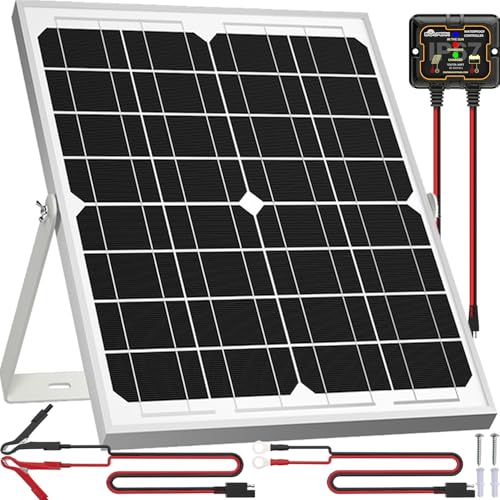
Best for battery maintenance in small outbuildings or vehicles. This kit features a monocrystalline cell structure with 21%-30% efficiency and a waterproof construction designed to withstand harsh weather. The included MPPT controller improves charging efficiency, and the adjustable mount supports versatile installation on trailers, boats, and limited-space sheds. Use this when you need a simple, reliable trickle charger to keep 12V batteries healthy for occasional power needs.
- Best for small battery banks (12V), long-term maintenance
- Better for trailer, boat, or garage setups requiring a compact unit
- Limitations: Low total wattage may not run high-demand tools or lighting continuously
Callsun 450W Bifacial Solar Panel 2-Pack

Best for higher-output outbuildings requiring more energy per panel. These 450W modules use N-Type 16BB cells and a bifacial design to capture light from the front and rear, boosting total energy yield. The dual-module parallel anti-shade design minimizes power loss when portions of the panel are shaded. Choose this if your outbuilding can accommodate larger sets and you want to maximize daily production.
- Best for high-demand use with ample roof or ground space
- Better for long-term off-grid systems and heavy load scenarios
- Limitations: Higher upfront cost and installation complexity
Callsun N-Type 16BB 400W Bifacial Panel

Best for mid-sized off-grid installations needing reliability and shading tolerance. This 200W per panel option (paired for 400W) leverages N-Type 16BB cells and anti-shade parallel design to minimize power losses in variable sunlight. It’s well-suited for sheds and workshops where trees or building shadow intermittently affect output.
- Best for consistent, dependable daily energy
- Better for spaces with potential partial shade
- Limitations: Installation pairing and mounting considerations required
Renogy 200W Portable Solar Panel

Best for flexible, on-the-go power needs near outbuildings or during travel. This 200W foldable panel uses high-efficiency 16BB N-Type cells and a lightweight design suitable for camping, RVs, or quick deployment around a workshop. It includes multiple charging options and a compact form factor for easy transport.
- Best for temporary setups or occasional use near outbuildings
- Better for portable power stations and mobile charging
- Limitations: Not ideal as a fixed, long-term roof installation
FlexSolar 100W Portable Solar Panels

Best for emergency power and light-duty use around the property. This kit offers USB-C PD 3.0 and USB-A outputs plus DC power, designed for compatibility with portable power stations and devices. Its foldable, IP67-rated construction supports outdoor use in outbuildings where occasional power is needed without a large fixed install.
- Best for backup power and light electronics near sheds or garages
- Better for emergency readiness and portable charging
- Limitations: Lower wattage means slower charging for larger loads
Buying Guide: Key Considerations for Outbuildings
How much power do you need?
Assess your outbuilding’s typical loads: lighting, security cameras, small tools, and battery charging. For a shed with basic lighting, a few hundred watts may suffice. For workshops with drills and compressors, plan for higher output or a scalable array.
Fixed vs portable installations
Fixed roof or ground-mounted panels deliver steady energy, ideal for long-term outbuildings. Portable panels work well for temporary sites, seasonal use, or when you frequently relocate equipment.
Monocrystalline vs bifacial designs
Monocrystalline cells offer high efficiency in a compact footprint. Bifacial designs capture light from the rear, increasing energy under reflective surfaces or bright surroundings. Bifacial panels can justify the higher upfront cost in suitable setups.
Charge controllers and system topology
Active charge controllers (especially MPPT) improve charging efficiency, especially when solar input fluctuates. For outbuildings, ensure compatibility with your battery chemistry (lead-acid, LiFePO4, etc.) and whether you need 12V or higher voltage systems.
Durability and weather resistance
Outbuildings face varied conditions. Look for tempered glass, corrosion-resistant frames, and enclosure ratings (IP65–IP67) to withstand rain, dust, and temperature swings.
Installation and maintenance considerations
Consider mounting options, space availability, and wiring requirements. Some kits include mounting hardware and waterproof enclosures, which reduce installation complexity for DIY setups.
Scalability and future needs
Plan for expansion if your outbuilding grows in power demand. Panels with modular configurations or higher-wattage options enable easier upgrades without complete overhauls.
FAQ
- Q: What size solar system is best for a small shed?
- Q: Are bifacial panels worth it for outbuildings?
- Q: Do I need a professional to install solar panels on an outbuilding?
- Q: Can portable solar panels power a power station for workshops?
- Q: How long do solar panels last in outdoor outbuildings?
- Q: Should I choose a higher-wattage panel if space is limited?
A: A modest system around 100–300W can cover lighting and a USB-powered device load; add more panels if you plan to run power tools.
A: They can be beneficial with reflective surfaces or open layouts, but may not justify cost in shaded or compact spaces.
A: Simple fixed installations can be DIY with proper safety precautions; complex roof angles or electrical wiring may require a professional.
A: Yes, portable kits with multiple outputs can charge power stations and accessories, good for temporary setups or seasonal use.
A: Most panels are designed for decades of service, with lifespans commonly around 25 years or more under proper maintenance.
A: Yes, higher efficiency or higher wattage per panel can maximize output in tight spaces, but ensure mounting feasibility and wiring capacity.