Direct answer: For commercial needs, high-capacity bifacial and monocrystalline panels offer the best balance of space efficiency, durability, and return on investment. The top selections below target commercial rooftops, remote facilities, and ground-mount projects. Each product is suited to different project scales and mounting options, from large-scale rooftop arrays to back-up or off-grid installations. Use the quick comparison table to identify the best fit for your site and budget.
| Product | Type | Rated Power | Best For |
|---|---|---|---|
| SUNGOLDPOWER 590W Bifacial (6 pcs) | Bifacial N-Type | 590W per panel, 6 panels | Large commercial rooftops, grid-tied or off-grid setups |
| JJN 425W Bifacial | Bifacial N-Type | 425W | Mid-size commercial roofs, efficient space use |
| JJN 550W Bifacial | Bifacial | 550W | Homes with commercial-adjacent needs, easy expansion |
| SUNGOLDPOWER 590W Bifacial (10 pcs) | Bifacial N-Type | 590W per panel, 10 panels | Large grounds or rooftop projects with space optimization |
| ECO-WORTHY 400W N-Type | N-Type Monocrystalline | 400W | Smaller commercial spaces or upgrades to existing systems |
SUNGOLDPOWER 590W Bifacial Solar Panel (6 Panels)

Powerful bifacial design leverages front and rear radiation for higher output. Uses N-Type 16BB cells with up to 22.8% efficiency. Designed for rooftop or ground-mount installations, including 24V/48V DC backup or grid-tied systems.
Best for: Large commercial rooftops or ground-mounted arrays where space efficiency and long-term savings matter most. This setup is well-suited to projects seeking fast payback on high-output installations.
Limitations: Higher upfront cost relative to standard panels; ensure compatible mounting hardware for bifacial backing and rear-row shading management.
JJN Bifacial 425W Solar Panel

425W bifacial panel with 16BB N-Type cells and a transparent backsheet enables rear-side power generation for up to 25% increased efficiency. Durable with a corrosion-resistant frame, IP65/IP68 rated components protect against weather exposure.
Best for: Mid-scale commercial rooftops or outdoor installations where reliability under variable weather matters. Ideal when maximizing output per square foot is a priority.
Limitations: Slightly lower wattage per panel than larger modules; array sizing may require more panels for the same total capacity.
JJN 550W Bifacial Solar Panel

550W bifacial design enables higher output with a front-and-backside approach, offering up to 30% more efficiency depending on installation conditions. Pre-drilled mounting holes and straightforward wiring simplify rooftop deployment.
Best for: Home-adjacent commercial sites or small-to-mid-size business installations where higher per-panel output reduces space needs.
Limitations: Requires proper sun exposure and shading management to realize the 30% rear-side gains.
SUNGOLDPOWER 590W Bifacial Solar Panel (10 Panels)
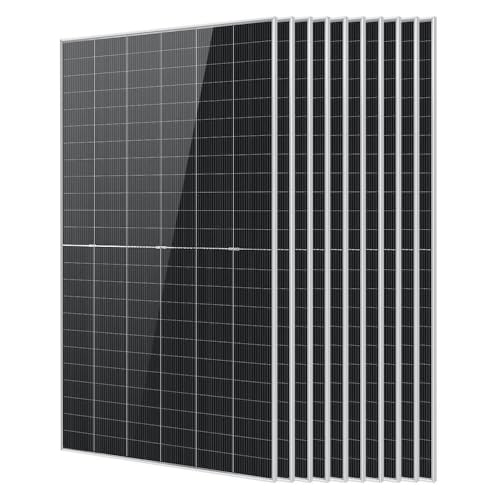
Expanded fleet of bifacial panels for large installations, maintaining high efficiency with N-Type 16BB cells. Suited for high-output commercial projects where dual-face generation and space efficiency are critical.
Best for: Large commercial campuses, industrial rooftops, or ground arrays where maximizing total energy output per area matters. Offers scalable configuration for future expansion.
Limitations: Higher total system weight and mounting complexity; ensure structural assessment for tall arrays and optimized rear-face shading mitigation.
ECO-WORTHY 400W N-Type Solar Panels (4x100W)

Four 100W modules featuring N-Type technology for improved efficiency at 25%. The kit includes a design suitable for off-grid, hybrid, or home-backup configurations, with pre-installed bypass diodes and IP68-rated junction box components.
Best for: Smaller commercial projects or retrofit applications where simplicity and ready-to-install modules are preferred. Suitable for 12V/24V charging scenarios with room to scale.
Limitations: Lower total power than larger systems; may require more panels to reach higher capacity targets.
Buying Guide
What matters most for commercial solar panels?
Power output, efficiency, and system layout drive value. Bifacial panels can boost output in properly illuminated sites, while N-Type cells deliver higher efficiency and shading tolerance. Consider roof or ground-mount feasibility, mounting hardware, and space constraints when selecting modules.
How to size a commercial solar installation?
Determine daily energy usage and peak demand. Match system kW capacity to expected daytime production, accounting for site shading, latitude, and weather. Plan for future expansion with modular panels and scalable inverters.
Which mounting and wiring considerations are critical?
Roof strength, wind load, and tilt angle affect performance and safety. Ensure proper wiring configurations (series vs parallel) and MPPT optimization for 12V/24V/48V systems. Waterproof and weatherproof components extend life in outdoor environments.
What installation challenges should be anticipated?
Shading, back-side reflection, and panel orientation influence gains. Bifacial designs require rear-side exposure and careful layout to maximize benefits. Ground-mount or roof mounting may require professional structural assessment.
How to compare total cost of ownership?
Include module price, installation, inverters, racking, and maintenance. Consider potential incentives, warranty terms, and expected savings from energy bills over 10–25 years. Optimize for payback period and return on investment rather than sticker price alone.
FAQ
- Q: Are bifacial panels better for commercial use? A: They can be, especially where rear-side illumination is significant; verify site exposure and mount design.
- Q: What is N-Type cell technology? A: N-Type cells improve efficiency and shading tolerance, often delivering higher performance in real-world conditions.
- Q: Can these panels be used off-grid? A: Yes, several models support off-grid or hybrid configurations with appropriate inverters and batteries.
- Q: Do higher wattage panels require fewer panels for the same capacity? A: Generally yes, but system design, wiring, and mounting also matter for total cost and performance.
- Q: Is installation complexity higher for large bifacial arrays? A: Larger arrays require careful layout and shading analysis, plus proper mounting structure to manage weight and wind.
- Q: What maintenance is typical for solar panels? A: Regular inspection of wiring, mounts, and inverters; cleaning if necessary to maintain performance.