Answering the most common campervan search intent, these solar panels provide reliable off-grid power for RVs, vans, and campers. They are suitable for different buyers: compact, portable setups for weekend travelers; modular kits for long trips; and high-capacity systems for full-time van life. The following selections balance efficiency, durability, and ease of installation, helping readers compare key features at a glance.
The quick comparison below highlights five strong options. Use it as a starter guide to match your vehicle, power needs, and climate conditions.
| Product | |||
|---|---|---|---|
| ECO-WORTHY 200W Kit | 200W 12/24V with 30A PWM controller | RV and larger campervans needing steady power | High efficiency mono cells and robust framing for durability |
| Renogy 200W Portable Panel | 200W portable, IP65, foldable | Compact van setups and mobile charging on the go | High efficiency with lightweight, backpack-sized design |
| Callsun N-Type 400W (2x200W) Bifacial | 400W bifacial, 2×200W modules | Rooftop installations needing extra rear-side power | Bifacial design adds rear-row energy capture |
| DOKIO 400W (4×100W) Flexible Panels | 400W flexible, 18V, semi-flexible | Curved van roofs and irregular surfaces | Flexible mounting and scalable 12V/24V options |
| Callsun N-Type 400W Bifacial (2×200W) | 400W bifacial, dual-module | Off-grid vans and rooftop systems seeking high efficiency | Efficient, shading-tolerant design with bifacial gains |
ECO-WORTHY 200 Watts Solar Panel Kit
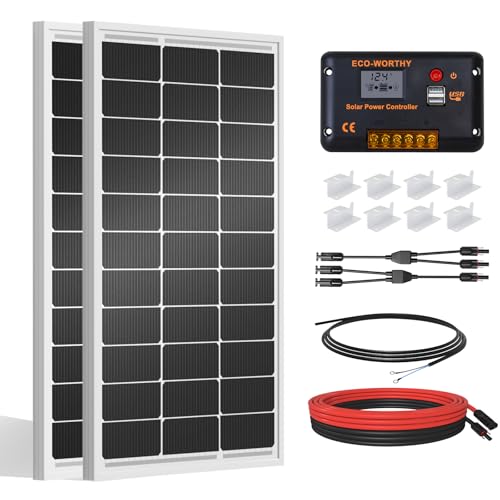
The ECO-WORTHY kit uses mono-crystalline cells for higher efficiency in good sunlight and is designed for RVs and campers. It includes a 30A PWM charge controller and is suitable for 12V or 24V systems. Best for buyers needing a complete, ready-to-install kit with durable framing and weather resistance. Caution: PWM controllers are generally less efficient than MPPT in very low-light conditions.
Who it’s best for: Weekend campers and mid-size RVs seeking a simple, reliable power upgrade without advanced electronics. This kit is a good starting point for permanent installations that prioritize durability and straightforward wiring.
Renogy 200W Portable Solar Panel

Renogy’s 200W portable solar panel emphasizes high efficiency with advanced N-Type cell technology and a foldable, lightweight design. The panel packs down to compact dimensions and uses a magnetic closure for quick setup. It’s ideal for limited-space camper layouts and flexible charging scenarios. Caution: Foldable panels may require careful storage to prevent damage during transit.
Who it’s best for: Van lifers who value portability, quick deployment, and USB-C/USB outputs for charging multiple devices on the go. Suitable for backup power or supplementing a fixed roof system.
Callsun N-Type 16BB 400W Bifacial

This Callsun model uses N-Type cells with 16BB busbars and bifacial technology to capture rear-side light, boosting total output. The dual-module anti-shade design helps maintain energy production when part of the panel is shaded. Best for rooftop van setups where space is fixed and efficiency matters. Caution: Bifacial gains depend on reflective mounting surfaces and optimal sun angles.
Who it’s best for: Van owners aiming for higher efficiency in a rooftop array and who can optimize installation to exploit rear-side light capture. Great for longer trips with steady sun exposure.
DOKIO 400W Flexible Solar Panels

DOKIO offers a 400W flexible panel set designed for vans and boats with semi-flexible construction that bends up to 30 degrees. The kit is scalable for 12V or 24V systems and supports series or parallel connections. Best for curved roof surfaces and installations needing a low-profile solution. Caution: Flexible panels are more vulnerable to sharp impacts and require careful mounting to avoid creasing or corner damage.
Who it’s best for: Campers with curved or irregular roof surfaces who need a low-profile installation and scalable power capacity for larger electrical systems.
Callsun N-Type 16BB 400W Bifacial (2×200W)

This Callsun bifacial setup splits into two 200W modules, combining high-efficiency N-Type cells with a bifacial design and anti-shade capabilities. It delivers improved output on rooftops or reflective installations. Best for van roofs with sufficient sun exposure and mounting space. Caution: Total system performance depends on installation quality and rear-surface reflectivity.
Who it’s best for: Van owners seeking maximum efficiency from a compact rooftop array and who can install dual modules to optimize shading tolerance and overall output.
Buying Guide: Key Purchase Considerations
- System voltage and compatibility: Choose panels and controllers that match your battery bank (12V or 24V) and charger type (PWM vs MPPT) for efficiency.
- Panel technology: N-Type cells and bifacial designs offer higher efficiency and better shading tolerance, but may come at a higher price. Consider sun exposure and mounting surface when choosing.
- Flexibility vs rigid design: Flexible panels suit curved roofs but are more delicate; rigid panels are durable and easier to mount with traditional hardware.
- Durability and weather resistance: Look for corrosion-resistant frames, IP ratings, and load ratings to handle wind and snow loads in camping environments.
- Portability and space: Portable or foldable options save space for smaller campers, while roof-mounted systems provide permanent, high-output power.
- Installation considerations: Ensure ventilation for heat dissipation, avoid mounting on flammable materials, and plan cable routing with proper protection and seals.
- Future upgradability: If you anticipate expanding power, consider modular systems that scale with additional panels or larger controllers.
Frequently Asked Questions
- Can I use multiple solar panels on a campervan? Yes, combining panels in parallel or series—depending on your controller and battery setup—can increase total output.
- What is the difference between PWM and MPPT controllers? PWM controllers are simpler and cost less but typically less efficient, especially in cold or low-sun conditions. MPPT controllers optimize voltage to maximize energy harvest.
- Do bifacial panels require special mounting? Yes, bifacial panels perform best on reflective or open surfaces that allow rear-side light to reach the backsheet.
- How do I choose panel size for my van? Start with your daily energy needs (amp-hours) and available roof space or cargo area, then select a panel count and capacity to meet peak draw during sun hours.
- Are flexible panels durable for off-road use? They tolerate curved surfaces well but can be more susceptible to damage from sharp impacts; protect edges and avoid heavy abrasion.
- Is roof weight a concern? Panels and mounting hardware add weight, so verify your van’s roof load capacity and distribute weight evenly during installation.