Answering the demand for portable, off-grid power, these solar panels and battery banks provide reliable power for camping, RV trips, and emergency use. The top picks here cater to different buyers: compact, lightweight options for minimalist travelers; high-capacity kits for home backup or extended trips; and all-around kits for mixed devices. The following table highlights five strong contenders and their core strengths to help you compare quickly.
| Product | Best For | Key Benefit |
|---|---|---|
| Jackery Solar Generator 1000 V2 | Outdoor enthusiasts and emergency prep | High capacity with fast charging options |
| Jackery HomePower 3000 | Home backup and RV use | Very large capacity with UPS capability |
| SOARAISE Solar Charger Power Bank | Multi-device travelers | Four built-in cables and four solar panels |
| EnginStar Portable Solar Generator | Compact, versatile power | Small footprint with multi-port outputs |
| Apowking Portable Solar Generator | Budget-friendly, camping use | Split into 7 outputs for diverse devices |
Jackery Solar Generator 1000 V2

The Jackery Solar Generator 1000 V2 combines substantial capacity with versatile outputs. It offers 1,070Wh and a 1,500W AC output, making it suitable for powering refrigerators, laptops, and essential devices during camping or power outages. The unit supports 1,070Wh storage in a portable frame and includes USB-C output. It is best for campers who want reliable power for multiple devices and longer trips. A potential limitation is the weight, which can be heavier than ultra-compact models, impacting transportability.
Who it’s best for and why selected
Best for: Outdoor enthusiasts and emergency prep users who need robust, reliable power for several devices. Why: High capacity, strong AC output, and a foldable handle to ease movement.
Caution
Fast charging features may draw more current and shorten the life of the battery if used continuously at maximum load.
Jackery HomePower 3000

The Jackery HomePower 3000 is designed as a home backup and RV companion with a large 3072Wh LiFePO4 battery and 3600W continuous output. It includes a UPS feature that switches within 20 milliseconds to protect essential appliances during outages. This model is best for households or RV setups needing reliable, big-capacity power with fast transfer to backup devices. The main limitation is its size and weight, which reduces portability compared to smaller models.
Who it’s best for and why selected
Best for: Home backups, small businesses, and RV users who require long-lasting power and seamless UPS capability. Why: High capacity and quick automatic transfer make critical loads resilient during outages.
Caution
Its larger footprint means it’s less suitable for ultra-lightweight travel or minimalist camping.
Apowking Portable Solar Generator

The Apowking kit provides 146Wh of energy with a 40W solar panel included, delivering seven output options. It suits short trips, camping, or emergencies where light but dependable power is needed. Best for: budget-conscious travelers or hikers who want a compact generator with multiple outputs. A limitation to note is the smaller capacity, which may require more frequent recharging for power-hungry devices.
Who it’s best for and why selected
Best for: Budget-minded users who still want diverse outputs. Why: The 7-output setup and included solar panel offer flexibility at a lower cost point.
SOARAISE Solar Charger Power Bank
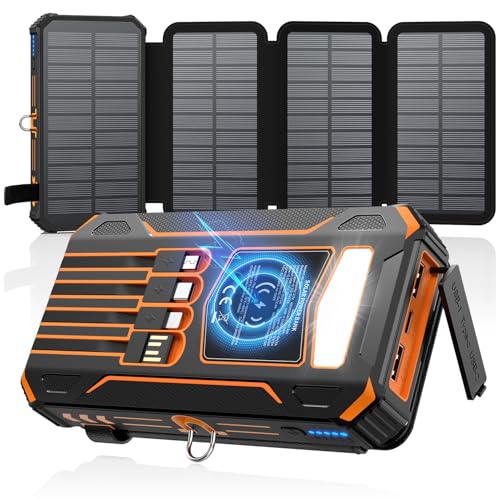
The SOARAISE model features 48,000mAh capacity with four built-in solar panels and multiple charging cables. It is designed for multi-device charging with a wireless pad and several USB outputs. Best for: multi-device travelers who want a single charger with solar recharging and many built-in connectors. Limitation: High efficiency is hardware-dependent—outdoor lighting conditions still influence solar input performance.
Buying Guide: Key Considerations For Solar Panels And Battery Banks
How to choose based on capacity and power needs
Calculating watt-hours (Wh) helps determine how long a device will run. For example, a 1000Wh pack can power a 60W device for roughly 16 hours, assuming ideal conditions. Consider your essential devices and plan for surge power when needed.
What outputs are essential for your setup?
Look for a mix of AC outlets for household items, USB-C PD for laptops and phones, and DC outputs for car or RV appliances. A TT-30 RV port and USB-C PD can expand compatibility for many devices.
Portability vs. capacity
Smaller systems offer easy transport but lower runtime. High-capacity models are heavier but provide longer backup power and more flexible charging options, including faster AC and solar charging.
Charging options and speed
Multiple charging methods (AC wall, solar panels, car charging) increase reliability. One-hour fast charging for some models can dramatically shorten charging downtime, especially during emergencies.
Durability and safety considerations
Look for LiFePO4 chemistry for longevity and a UL-certified UPS where needed. Consider weight, enclosure protection, and weather resistance for outdoor use.
Compatibility and expansion
Some systems offer scalable expansions or additional panels. If you anticipate future power needs, choose a platform that supports modular growth or better solar panel compatibility.
FAQ
- What is the best solar generator for camping? The best pick depends on capacity and weight. For balanced camping use with robust charging, the Jackery Solar Generator 1000 V2 offers solid capacity and multiple outputs without extreme weight.
- Do these systems work during a power outage? Yes. Units with UPS features or high-capacity battery banks can maintain essential devices during outages, depending on the load.
- Is a higher watt-hour rating always better? Generally yes for longer runtimes, but higher capacity also increases weight and cost. Choose based on how long you need power and what you’ll run.
- Can solar panels recharge these devices quickly? Solar input speed depends on panel wattage, sunlight, and efficiency. Some models offer fast charging modes via AC or high-wpower solar charging.
- What should I consider for RV use? Look for RV-oriented ports (like TT-30), solid inverter performance, and portability that fits in vehicle storage. A larger capacity unit with multiple outputs can cover more devices during trips.
- Are LiFePO4 batteries safer for long-term use? Yes. LiFePO4 chemistry tends to provide longer life, stability, and safer thermal performance for repeated charging cycles.