Answering the common buyer question: which solar panel best powers a portable power station? This guide compares five well-suited options for outdoor camping, RV trips, and emergency backup. Each entry explains who it’s best for, why it was selected, and any practical limitations to consider. Use the quick-reference table below to compare key details at a glance.
| Product | Best For | Output | Portability | Notes |
|---|---|---|---|---|
| GRECELL 100W Portable Solar Panel | RV enthusiasts needing flexible connectors | Up to 100W / 20V | Foldable, compact | Smart charging chip; multiple adapters |
| ZOUPW 100W Portable Solar Panel | All-around universal compatibility | 100W / 25% efficiency | Foldable with kickstands | IP67 waterproof coating; 5-in-1 cable |
| Renogy 200W Portable Solar Panel | High-output power users | Up to 200W | Lightweight folding design | Magnetic closure; USB-C PD |
| HQST 200W Ultra-Light Portable Solar Panel | Compact carry with broad compatibility | Up to 200W | Very light; foldable | XT60/DC adapters included; rugged build |
| FlexSolar 100W Portable Solar Panel | Emergency kits and backpacks | 100W / PD3.0 | Ultra-portable; carry bag | 3-in-1 outputs; durable lamination |
GRECELL 100W Portable Solar Panel for Power Station Generator
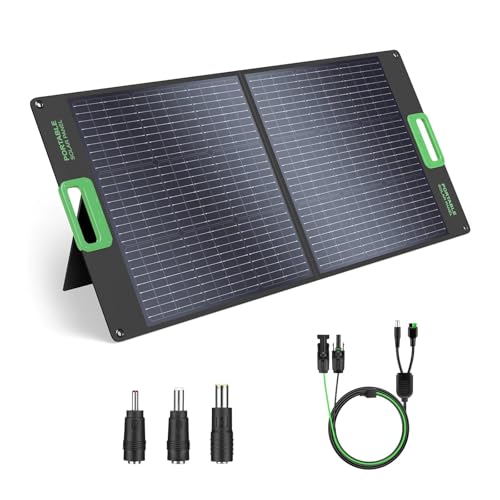
Best for campers who need broad compatibility. This foldable 100W panel comes with a versatile connector kit (8mm, 5.5×2.5mm, 3.5×1.35mm, 5.5×2.1mm, and Anderson) to fit most portable power stations on the market. It delivers up to 20V and 25A max with a 23.5% cell efficiency. A built-in smart chip protects against overcharging and overload while maximizing charging speed. It’s ideal for RV camping, remote work setups, and emergency outages. Caution: ensure your power station accepts the included connector types before pairing.
Apowking Portable Solar Panels 40W

Best for light-weight setups that still require multiple outputs. The 40W panel offers up to 22% efficiency with 18V DC output plus USB-C and USB-A ports, and a 10-in-1 connector kit for wide compatibility with power banks and portable stations. The foldable design and IPX4 rating make it suitable for varied weather. Choose this if ultra-portable weight is a priority and you need flexible USB charging alongside power station input. Limitation: lower wattage means slower topping up in low-sun conditions.
ZOUPW 100W Portable Solar Panel

Best for users needing rugged reliability. This 100W panel uses 23.5% efficiency mono cells and includes a True 5-in-1 universal connector to fit 99% of power stations, including Jackery, EcoFlow, Anker, and Bluetti. IP67 ETFE coating and waterproofing protect against the elements, making it a solid choice for RV trips and boating. Best for those who want plug-and-play versatility; avoid if you require a lighter, less rugged setup for minimalist trips.
Renogy 200W Portable Solar Panel

Best for high-output needs. Renogy’s 200W panel uses 16BB N-Type cells that deliver up to 25% efficiency, outperforming many standard panels. The lightweight build (about 13.89 lbs) folds down with a magnetic closure, making setup quick in tight spaces. It features a USB-C PD port and multiple MC4 outputs for charging multiple devices or directly feeding a power station. Suitable for larger power stations and heavy daily use. Limitation: higher wattage requires more space for optimal sun exposure.
HQST 200W Ultra-Light Portable Solar Panel
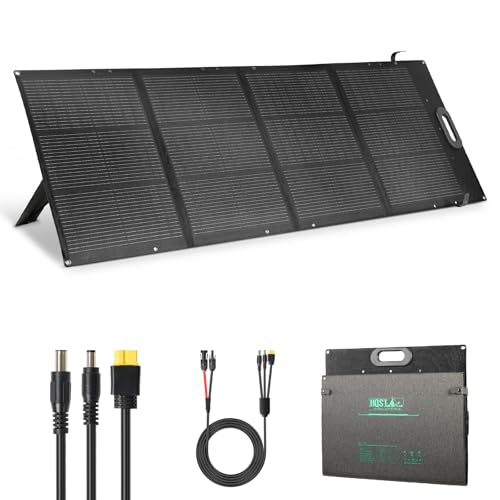
Best for portability with broad compatibility. HQST’s 200W panel is designed for camping, off-grid use, and emergencies. It uses 16BB N-Type cells for up to 25% efficiency and weighs less than many competing 200W models, thanks to a compact foldable form and included four-adapter cable (XT60, DC7909, DC5521) for wide compatibility. Ideal for travelers who want strong performance without sacrificing ease of transport. Better for users who prioritize quick setup and a compact footprint; avoid if you need additional integrated USB-C PD ports beyond the built-in outputs.
Buying Guide: How To Choose The Right Solar Panel For A Portable Power Station
- Power needs: Estimate your daily energy requirements. If you rely on higher-wattage devices, a 200W panel may shorten topping-up times, while 100W panels suit light-use situations.
- Portability and space: Consider foldable dimensions, weight, and how easily you can transport and store the panel in your vehicle or backpack.
- Connector compatibility: Look for panels offering a broad range of connectors or 5-in-1 cables to minimize adapter clutter and to fit your power station’s input.
- Durability and weather resistance: ETFE or IP-rated laminations protect against moisture, salt spray, and UV exposure for outdoor use.
- Output characteristics: Panels with smart charging or IC protection help optimize charging speed and protect connected devices from overcharging.
- Multi-device charging: If you plan to power phones, laptops, and power stations simultaneously, prioritize panels with USB-C PD and multiple USB outputs in addition to DC/MC4 options.
- Compatibility with power stations: Check MC4, XT60, DC adapters, and Anderson compatibility to ensure smooth integration with your specific model.
- Economy vs. performance: Higher efficiency panels deliver more power per sun hour but may cost more. Weigh your sun exposure and camping duration when choosing.
Frequently Asked Questions
- What is the typical efficiency range for portable solar panels?
Most portable panels range from about 20% to 25% efficiency, with higher-end models often achieving 23–25% under optimal sun. - Can I charge a power station directly with USB-C power delivery?
Yes, many modern portable panels include USB-C PD outputs that can charge devices and supplement power stations, though the primary input usually uses MC4 or DC connectors. - Are IP ratings important for camping panels?
IP67 or IP65 ratings, along with ETFE laminations, help panels resist water, dust, and weather, especially for outdoor use in rain or splashes. - Is a larger wattage panel always better?
A larger wattage panel can top up power stations faster, but it also takes up more space and may be heavier. Choose based on space, sun exposure, and backup needs. - Can I connect multiple panels to a single power station?
Yes, many setups support series or parallel connections. Be sure to respect the voltage and current limits of your power station and use proper adapters. - Do panels come with built-in battery charging protection?
Many panels include smart chips to protect devices from overcharging, but always verify safety features for your specific model.