Answer: A solar generator with enough continuous power and a reliable battery to keep a freezer running during outages is essential emergency gear. For freezers, look for high continuous watts (at least 1,800–2,000W) and a sturdy battery capacity (1,000–3,500Wh) with fast charging options. The top picks below are best for homeowners needing fridge-freezer reliability, RV users seeking off-grid power, and campers needing quick, quiet backup power. Each product includes clear usage scenarios, ideal buyers, and practical cautions.
| Product | Capacity | Output | Best For |
|---|---|---|---|
| Jackery HomePower 3000 | 3072Wh | 3600W | Home backup with UPS; fridge and router during outages |
| Jackery HomePower 3600 Plus | 3584Wh | 3600W (7200W in parallel) | Large homes, ongoing outages, RV power |
| Jackery Solar Generator 1000 v2 | 1070Wh | 1500W | Outdoor use, camping, small fridge in travel |
| EF ECOFLOW Delta 2 | 1024Wh | 1800W | Versatile home and off-grid backup |
| Jackery Explorer 2000 v2 | 2042Wh | 2200W | Power outages, camping, small business backup |
Jackery HomePower 3000 Portable Power Station

The Jackery HomePower 3000 offers a robust 3600W output (7200W surge) with a 3072Wh LiFePO4 battery. It is designed as an essential home backup to keep a fridge running for 1–2 days, plus essential devices like WiFi and lights during outages. The unit includes a UL-certified UPS switching within 20 milliseconds, ensuring uninterrupted power for critical appliances such as security cameras and medical refrigerators. Best for homeowners seeking reliable daily-use backup and a seamless transition to standby power during emergencies.
Best for: Homeowners who want fast UPS protection for a fridge, router, and lighting without frequent recharging. Caution: The unit is large and heavier than portable mini-stations, so plan for storage and handling.
Jackery HomePower 3600 Plus Portable Power Station
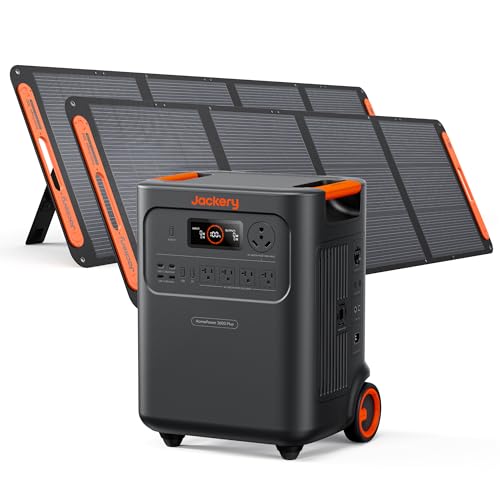
The 3600 Plus delivers 3600W continuous output (7200W in parallel) with 3584Wh capacity and optional expansion up to 21kWh per unit. It supports dual voltage (120V & 240V in parallel) and can power a three-person home for extended outages. The system emphasizes safety with a high-temperature ceramic membrane battery design and long cycle life (up to 6,000 cycles). Best for households needing substantial, expandable backup power, especially in regions prone to lengthy outages.
Best for: Larger homes and RV setups needing robust, scalable power. Caution: Expansion requires additional units; ensure proper synchronization for parallel usage.
Jackery Solar Generator 1000 v2

The Solar Generator 1000 v2 pairs a 1070Wh LiFePO4 battery with 1500W AC output (100W USB-C) and a lightweight design at about 23.8 lbs. It supports fast charging via the Jackery App and offers flexible solar charging options. Best for outdoor use, camping, and emergency fridge use in smaller setups where portability matters. A potential limitation is the relatively lower capacity for long outages compared to larger models.
Best for: Individuals seeking portable, reliable power for a compact fridge or essential devices on the go. Caution: Limited battery capacity may require frequent recharging for larger loads.
EF ECOFLOW Delta 2 Portable Power Station

The Delta 2 features 1024Wh capacity and up to 1800W continuous output, with the capability to expand using extra batteries. It offers fast charging (AC input) and multiple outlets for home backup, camping, and RV use. Best for users needing strong AC power and broad compatibility with household appliances. Caution: Capacity is moderate for longer outages; plan charging strategies and potential solar panel add-ons for extended use.
Best for: Home backups and off-grid adventures where multiple devices need concurrent charging. Caution: Do not rely on Delta 2 for very long outages unless expanded with additional battaries.
Jackery Explorer 2000 v2 Portable Power Station

The Explorer 2000 v2 offers 2042Wh LiFePO4 capacity with a 2200W rated output and 20ms UPS. It includes USB-C PD 100W fast charging and is designed to cover power outages, camping, and small business needs. Best for users who need a strong, versatile unit with reliable, quick restoration during outages and for portable work sites. Caution: Heavier unit; mobility may be challenging in tight spaces.
Buying Guide
- Power needs: Calculate the continuous watts your fridge/freezer requires and compare to the unit’s continuous output. Fridges typically require 600–1200W starting surge; plan for higher surge handling.
- Battery capacity: For multi-day outages, target 1000–3000Wh. LiFePO4 chemistry offers longer life and better stability in temperature swings.
- UPS and surge protection: If you must avoid any interruption, choose models with fast UPS switching to protect sensitive devices.
- Expandability: If you anticipate longer outages, consider expandable systems or the ability to couple multiple units for higher total capacity.
- Port selection: Ensure you have enough AC outlets and include USB-C PD ports for fast charging of phones and laptops.
- Solar compatibility: Check whether the unit supports solar charging and the panel options. Sun exposure and panel efficiency affect recharge times during outages.
- Weight and portability: For frequent moving or RV use, lighter models with integrated handles are advantageous.
FAQ
- What size solar generator do I need to run a freezer during an outage?
– Look for at least 1,000–2,000W continuous output and 1,000–3,000Wh capacity, depending on freezer size and how long outages may last. - Can I use solar panels alone to recharge during a multi-day outage?
– Yes, if the solar array is sufficiently large and weather permits; many systems support solar charging but may require multiple panels for faster recharge. - Do these units protect against power surges?
– Many models include UPS features or surge-capable outputs to protect connected appliances; verify specifics per model. - Is LiFePO4 better than other chemistries?
– Yes, LiFePO4 offers longer cycle life, better thermal stability, and safer handling compared to some lithium variants.
Note: The selections above are based on stated features and typical usage scenarios for refrigeration backup, home resilience, and off-grid readiness.