Small wind turbine generators offer hands-on insight into renewable energy, teaching core concepts from energy conversion to electrical output. This guide highlights five compact options suitable for hobbyists, classrooms, and demonstrations. Explore practical designs, assembly requirements, and how each model performs under different wind conditions to choose the best fit for learning and small-scale power projects.
Summary of selected products
| Product | Brand | Notable Feature |
|---|---|---|
| Small Wind Turbine Generator Micro DC Motor Power | Unbranded | Large 17.5 cm blades for strong wind performance |
| EUDAX Mini Generator Motors 3V-12V DC | EUDAX Store | Compact DC motor used as mini wind turbine component |
| A-iPower 4600W Portable Inverter Generator | A-iPower Store | Open-frame portable power with inverter stability |
| EUDAX DIY DC Power Micro Motor Wind Turbine | EUDAX Store | Educational micro motor wind turbine for demos |
| 2PCS Vertical Axis Wind Turbine Model Kit | Unbranded | Vertical axis design for diverse wind exposure |
Small Wind Turbine Generator Micro DC Motor Power

This compact wind turbine provides a practical platform for exploring electricity generation on a small scale. The model emphasizes that natural wind may not consistently power lights, emphasizing the role of wind energy magnitude in output. It uses a 280 motor and large 17.5 cm blades arranged with 11 blades per leaf, delivering higher potential output when wind is adequate. The design is intended for educational use and experiments, with caution that it is not a toy and should be kept away from children. Real-world testing shows the generator can produce measurable voltage and current under sufficiently strong airflow.
EUDAX Mini Generator Motors 3V-12V DC Motor

Designed as a versatile DC motor set for DIY projects, this mini generator concept suits demonstrations of wind-to-electric energy conversion. The motor provides multiple voltage levels (3V to 12V) with corresponding rated speeds. The compact body (24mm diameter, 22.21mm height) and 14 cm lead wire enable easy integration into small turbines or teaching kits. It is well-suited for classroom experiments, model wind turbines, or hands-on exploration of how rpm relates to voltage and current in wind power contexts.
A-iPower 4600W RV-Ready Portable Inverter Generator
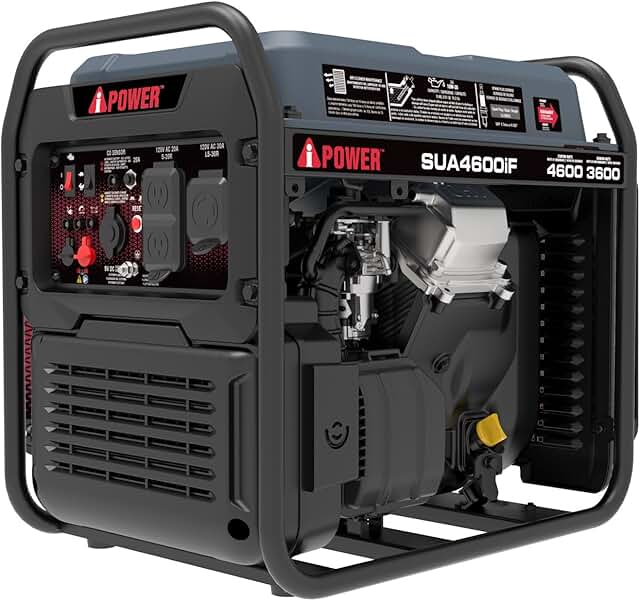
This open-frame generator emphasizes portability and consistent AC power for off-grid or RV use. With a 149cc engine, it provides up to 4600 starting watts and 3600 running watts, sufficient for a range of appliances and tools. The unit weighs about 56 pounds, balancing power output with transportability. Inverter technology ensures a clean 3% Total Harmonic Distortion, making the output suitable for sensitive electronics. While not a small wind turbine, this option demonstrates scaling considerations in portable power systems and complements wind-based experiments with a reliable electricity source for comparison.
EUDAX DIY DC Power Micro Motor Wind Turbine Blades

This kit focuses on micro motor wind turbine blades, ideal for teaching demonstrations of wind-powered electricity generation. The product outlines representative voltage outputs and rated speeds (3V to 12V, up to 6500 RPM) to illustrate how wind energy translates into electrical energy. Its compact form supports classroom setups and self-contained experiments, encouraging learners to assemble, test, and observe the effects of blade design and wind speed on output.
2PCS Vertical Axis Wind Turbine Model Kit

This educational kit provides a vertical-axis wind turbine model set designed to explore energy generation from wind from multiple directions. It emphasizes hands-on learning, assembly, and experimentation with wind capture efficiency and energy conversion. The kit is suitable for classrooms or individual projects where students compare vertical-axis versus horizontal-axis turbine concepts and measure output under different airflow scenarios.
Buying Guide
- Purpose and scale: Choose models based on learning goals—demonstrations, classroom labs, or small personal projects. Vertical-axis designs offer multi-direction wind capture, while horizontal-axis types may require stronger, steadier airflow.
- Wind source and environment: Several small kits rely on artificial airflow (fans or blowers). For real-world wind testing, ensure sufficient wind speed and stability to observe meaningful voltage and current changes.
- Electrical characteristics: Understand voltage ranges (3V–12V in many kits) and rpm requirements. Higher rpm usually yields higher voltage, but device safety and load characteristics matter for accurate measurements.
- Materials and safety: Look for robust blades and housings, non-toxic components, and clear safety guidelines. Some items are educational demonstrations rather than consumer-grade energy solutions.
- Measurement and instrumentation: Pair kits with a multimeter or data logger to capture voltage, current, and power. Record wind speed with a anemometer to correlate wind energy with output.
- Assembly effort: Some kits arrive pre-assembled, others require DIY assembly. Consider the time and skill level available for setup and ongoing experiments.
- Durability and reuse: Reusable components and modular parts enable repeated experiments, making them suitable for ongoing courses or clubs.
- Safety and supervision: Small generators can pose pinch points and moving parts. Supervise setups, especially in educational environments with students.
Selecting the right small wind turbine generator involves balancing educational value, ease of use, and the amount of wind available for experiments. By combining kits that illustrate different turbine designs with reliable power sources for baseline comparisons, learners can build a comprehensive understanding of wind energy conversion and practical limitations in small-scale systems.