When outages strike, a reliable residential emergency generator keeps essential systems running. This article highlights top portable and inverter-style options that balance efficiency, noise, and convenience for American homes. Each choice supports home backup, off-grid living, and mobile use such as RVs or camping. Below, you’ll find brief product summaries, practical considerations, and a buyer’s guide to help you decide which model best fits your energy needs and budget.
| Product | Brand | Type | Best For |
|---|---|---|---|
| Jackery Explorer 1000 v2 Portable Power Station | Jackery | Portable Power Station | Home backup, off-grid living |
| Anker SOLIX C2000 Gen 2 | Anker | Portable Power Station | High-capacity home backup, outages |
| Power Equipment 4400 Watts Inverter Generator | Oxseryn Store | Gas-Powered Inverter Generator | RV camping, home backup |
| Jackery Portable Power Station Explorer 300 | Jackery | Portable Power Station | Outdoor activities, travel |
| A-iPower 4600W RV-Ready Generator | A-iPower Store | Gas-Powered Inverter Generator | Tailgating, home backup |
Jackery Explorer 1000 v2

The Jackery Explorer 1000 v2 offers a large 1070Wh LiFePO4 battery with flexible outputs, including 1500W AC and 100W USB-C. It supports fast charging and is designed for reliable home backup and off-grid living. Its modular design pairs well with solar panels for extended outages and mobile power needs.
Anker SOLIX C2000 Gen 2

The Anker SOLIX C2000 Gen 2 is a high-capacity solar generator with a 2048Wh LiFePO4 battery and a 2400W continuous output (4000W peak). It promises fast recharging and is suitable for home outages, camping, and larger energy loads. Its design emphasizes safety, durability, and rapid recharge, making it a strong all-around option for multi-day outages or frequent power needs.
Power Equipment 4400 Watts Inverter Generator

Powerful performance is highlighted by 4400 peak watts and 3400 running watts, suitable for RVs and home backup. It offers multiple outlet configurations, including AC and RV connections, plus a 2-gallon fuel tank with a fuel gauge. This unit emphasizes long runtime and practical readiness, with ECO mode to improve efficiency during extended outages.
Jackery Portable Power Station Explorer 300

Compact and lightweight, the Explorer 300 provides 293Wh and multiple outputs, including USB-C and USB-A. It is designed for outdoor use and can recharge from AC outlets, cars, or Jackery solar panels. It suits travelers, campers, and those needing a portable standby source for essential devices.
A-iPower 4600W RV-Ready Generator
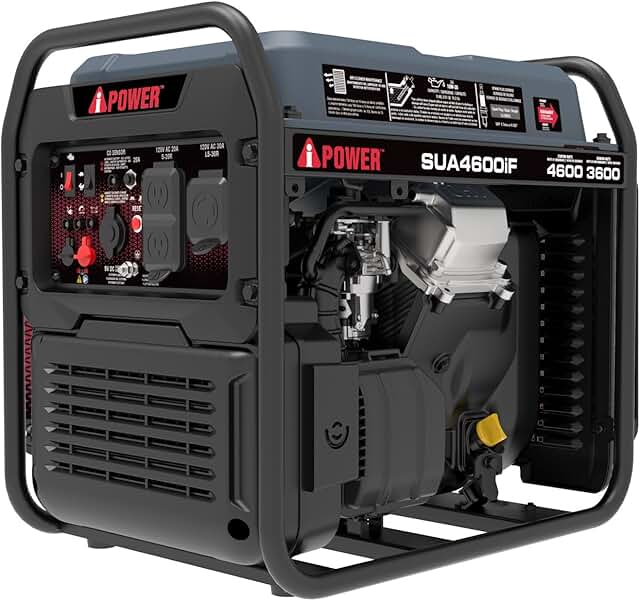
Designed for RV use and home backup, this model delivers 4600 starting watts and 3600 running watts. It is relatively light for its power class and uses inverter technology to provide a clean power output suitable for sensitive electronics. Its portability supports tailgating and off-grid living scenarios.
Buying Guide: Key Purchase Considerations
- Power needs: Determine essential loads (refrigerator, lights, communications, medical devices) and match the continuous wattage and surge (starting) watts of the generator or power station to those needs.
- Fuel type and availability: Gas-powered units offer broad availability and long runtimes, while battery-based and solar-backed systems provide quiet operation and easier recharging with solar panels.
- Battery chemistry: Lithium iron phosphate (LiFePO4) batteries provide longer life cycles and improved safety compared to some other chemistries, a factor in home backup reliability.
- Output options: Look for a mix of AC outlets, USB-C/USB-A ports, and dedicated RV or car charging ports to cover all devices and appliances.
- Recharging options: Solar compatibility and fast-charging capabilities shorten downtime between outages and outdoor use sessions.
- Portability and noise: For residential use, prioritize models with reasonable noise levels and manageable weight for easy placement and relocation.
- Maintenance and support: Check manufacturer assurances, warranty terms, and replacement part availability to minimize downtime during emergencies.
- Safety features: CO sensors, automatic shutoff, and surge protection help protect devices and occupants during outages.
- System integration: Consider how a generator or power station integrates with home backup plans, including potential for multi-unit setups or solar panel expansion.