Answering the need for portable, rechargeable power, these units provide clean, on-demand energy for camping, emergencies, RV trips, and outdoor work. This guide highlights five top options, outlining who each is best for, why it stands out, and any important limitations. Whether you’re a weekend camper, a home backup planner, or a road-tripping traveler, you’ll find a model that fits your power needs and budget.
| Product | Capacity | Best For | Key Benefit |
|---|---|---|---|
| MARBERO Portable Power Station | 88Wh | Lightweight campers and quick outs | Slim, portable design with multiple outputs |
| EnginStar Solar Generator | 300W/296Wh | Off-grid adventures and backup power | Strong AC output with many ports |
| Jackery Explorer 300 | 292Wh | Hikers and weekend travelers | Ultra-lightweight with LiFePO4 chemistry |
| Jackery Explorer 1000 v2 | 1070Wh | Extended trips and home backup | High capacity with fast charging |
| LIBRIDS C600 | 640Wh | Home backup and mid-range needs | UPS feature for outages and fast charging |
MARBERO Portable Power Station 88Wh
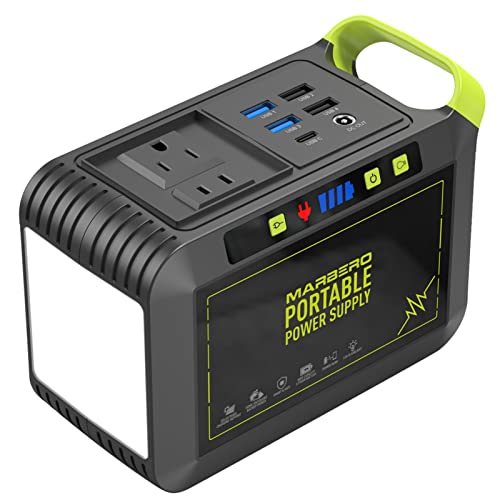
Best for ultra-light, on-the-go scenarios. MARBERO’s 88Wh unit is compact, weighing about 3.2 pounds, with a slim profile that fits into backpacks. It offers eight output ports and a BMS for safety, plus a 120W peak AC output to run small appliances. It’s ideal for short outdoor trips, backyard use, or as a backup for essential devices. Caution: not designed for high-wattage appliances for long durations.
Why selected: Its combination of portability, multiple outputs, and fast-charging capability (with MARBERO panels) makes it a versatile companion for lightweight travel and quick power needs. The built-in car DC output supports car fridges and small devices in emergencies.
EnginStar Solar Generator, 300W

Best for robust off-grid use and multi-device charging. EnginStar provides 300W continuous power with 8 outputs, including two 110V AC outlets and multiple USB ports. Its design supports fast recharges via wall, car, or solar inputs, making it suitable for camping, road trips, or as a home backup during outages. Caution: Not every solar panel option may match all charging inputs; check compatibility for your panel choice.
Why selected: High-capacity output with a broad port array allows simultaneous charging of phones, laptops, cameras, and small appliances, delivering reliable off-grid power for longer activities.
DaranEner Portable Power Station, 192Wh

Best for compact power with fast USB-C PD charging. DaranEner delivers 192Wh of capacity with LiFePO4 chemistry for longevity and safety. It features two AC outlets, multiple USB ports, and 60W USB-C PD fast charging. The hybrid charging approach (AC, car, or solar) makes it adaptable for outdoor trips and emergency home use. Caution: Not suited for high-wattage appliances like large refrigerators or power tools.
Why selected: The mixed port set and LiFePO4 chemistry provide a strong balance of safety, longevity, and versatile charging for travel and backcountry use.
LIBRIDS Portable Power Station C600

Best for home backup and emergency outages. LIBRIDS C600 offers 640Wh with 600W continuous output and 1200W surge capacity, plus 10ms UPS to keep essential devices running during outages. It charges quickly (about 1.5 hours) and provides four AC sockets along with multiple DC/USB ports. Caution: Higher capacity units can be heavier to transport regularly.
Why selected: The UPS feature and higher sustained power make it well-suited for home backup, CPAP use, and longer off-grid adventures where steady power is required.
Jackery Explorer 300

Best for hikers and compact trips. Explorer 300 weighs around 7.5 pounds and uses LiFePO4 chemistry for longevity. It delivers 292Wh capacity with 600W peak, supporting two AC outlets, a 100W USB-C PD, and multiple USB-A ports. It’s durable, easy to carry, and pairs with solar panels for off-grid charging. Caution: Moderate capacity means longer runs on high-wattage appliances may require strategic planning.
Why selected: The lightweight design combined with reliable LiFePO4 chemistry makes it an excellent choice for those prioritizing portability without sacrificing essential power for devices and small equipment.
Jackery Explorer 1000 v2

Best for extended trips and home backup. The Explorer 1000 v2 offers 1070Wh capacity with a 1500W continuous output (3000W surge). It supports fast charging to 100% in about an hour under emergency mode and features LiFePO4 chemistry for long lifespan. It’s capable of powering multiple appliances and, when paired with solar panels, supports off-grid living. Caution: Heavier unit may require planned transport and setup for outdoor use.
Why selected: High capacity and rapid charging, plus durable battery chemistry, make it suitable for longer excursions, emergency planning, and powering larger devices when necessary.
Buying Guide: How To Choose Your Rechargeable Portable Power Station
- What will you power? Match capacity (Wh) and continuous output (W) to your essential devices. For phones and lights, smaller units suffice; for laptops or small appliances, prefer 300-1000W range.
- What charging options are important? Look for AC, USB-C PD, car charging, and solar compatibility. MPPT charging can optimize solar input.
- Weight and portability matter. If you hike or commute often, prioritize lighter models with comfortable handles and compact dimensions.
- Battery chemistry and lifespan. LiFePO4 batteries typically offer longer cycles and stability under higher temperatures, ideal for longer-term use.
- Safety features. A built-in battery management system (BMS), overcharge protection, short-circuit protection, and UPS capability are valuable for reliability.
FAQ
- Do rechargeable power stations require solar panels to work? No, they can charge from AC or car inputs; solar panels are optional for off-grid charging.
- What does “UPS” mean in this context? Uninterruptible Power Supply automatically switches to battery power during outages to keep essential devices running.
- Can I run a full-size fridge from these units? Some models can run small fridges within their continuous wattage; check exact ratings for your appliance.
- Is LiFePO4 preferable to lithium-ion? LiFePO4 generally offers longer life cycles and better thermal stability for outdoor and home backup use.
- How long do these batteries typically last? Battery life depends on usage, but LiFePO4 versions often sustain thousands of charge cycles before significant capacity loss.
- Can I use any solar panel with these generators? Many support 12-60V solar inputs; verify panel compatibility with each model’s input spec and MPPT support.