Answering the search for reliable radio frequency power generators, this guide highlights five solid options suited for different needs—entry-level users, DIY hobbyists, and professionals. Each product is evaluated on frequency range, modulation options, and practical limitations, with guidance on who benefits most. The top picks balance versatility, ease of use, and build quality. Use the buying table below to compare at a glance and pick the best fit for your project or lab setup.
| Product | Best For | Key Strength |
|---|---|---|
| Jiabailie TSG-17 | Entry-level labs and hobbyists | Wide 100 kHz–150 MHz range with multiple modulation options |
| FALUSHAN TSG-17 | Commercial and household testing | Broad frequency range with sine and AM modulation |
| QUSKLISU Signal Generator | Budget-conscious projects | Similar range and modulation; compact option |
| Mokxihit Upgraded RF SG A9 | Varied applications requiring wider sweep | 35 MHz–4400 MHz wide range and dual modes |
| UNI-T UTG932E | Precision work and advanced testing | Dual channels with extensive waveform storage |
Jiabailie High Frequency Signal Generator, TSG-17

The Jiabailie TSG-17 offers a robust metal build with a protective coating, designed for durability in lab benches and field setups. Its frequency range spans 100 kHz to 150 MHz, divided into six ranges for flexible signal generation. Modulation supports AM, FM, and more, allowing users to tailor outputs to test receivers, filters, and RF circuits. Best for beginners and students who need a reliable entry point into RF signal generation with straightforward controls.
Best for: new hobbyists, classroom demonstrations, and simple RF alignment tasks.
Caution: moderate caution around high-frequency operation in crowded lab spaces; ensure proper ground and shielding when testing sensitive equipment.
Signal Generator, TSG-17 High Frequency RF/AM
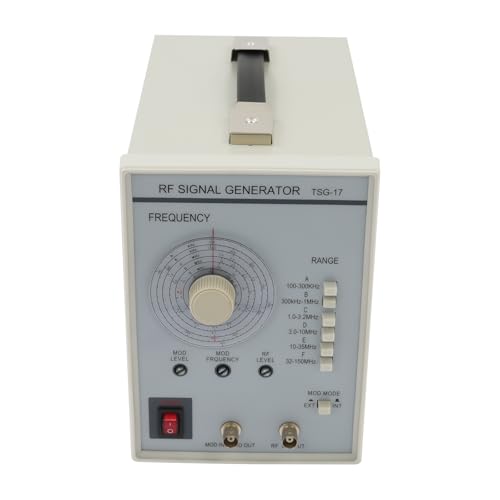
The FALUSHAN model mirrors the TSG-17 concept with a 100 kHz to 150 MHz span and a 3-harmonic ceiling up to 450 MHz. It emphasizes sine and amplitude modulation outputs, with an output range stated from 1 mV to 100 m (measured at the output terminal). This unit is well-suited for classroom labs and small workshops needing dependable RF output with clear modulation options.
Best for: educational labs and small-scale testing where stable sine and AM signals are needed.
Caution: be mindful of maximum harmonic capabilities; output stability can vary with modulation depth and load conditions.
Signal Generator, TSG-17 110V RF Generator
The QUSKLISU variant brings similar frequency coverage and modulation styles, with an RF/AM output description including a minimum amplitude at the output and three harmonic up to 450 MHz. This model is a practical option for users who want a compact device with familiar operation and reliable sine/AM capabilities for basic RF testing, alignment, and measurement tasks.
Best for: budget-conscious users and those upgrading from very basic signal sources.
Caution: verify output amplitude specifications under your expected load; unstable loads can affect accuracy at higher frequencies.
Upgraded RF Signal Generator 35MHz-4400MHz SG-A9

The Mokxihit SG-A9 raises the bar with an expansive 35 MHz to 4400 MHz range, making it suitable for more demanding RF projects, including communications and RF engineering experiments. It supports dual modes, including a single frequency and a sweep mode, and outputs a sine wave with about 1 mW of power. It’s best for more advanced hobbyists and labs that need a wider scan capability in a single device.
Best for: users needing wide-range testing across VHF to near-UHF bands and flexible measurement workflows.
Caution: the device is more complex; ensure you understand sweep operations and confirm compatibility with your test setup before running full-spectrum tests.
UNI-T UTG932E 30MHz Function Generator

The UNI-T UTG932E delivers strong capabilities for advanced testing: dual channels, multiple output waveforms (sine, square, pulse, ramp, noise, DC, arbitrary), and modulation types including AM, FM, PM, FSK. It also offers 24 groups of non-volatile waveform storage and a built-in frequency counter with a 1 μHz to 30 MHz range. This model is best for precision work, long-term signal generation tasks, and projects that require storage and quick waveform recall.
Best for: engineers and technicians who need dual channels, diverse waveforms, and accurate measurement features in one compact unit.
Caution: higher feature density may require a learning curve; verify that the instrument’s accuracy meets your experimental tolerances for critical tests.
Buying Guide
What frequency range do you need?
Consider whether you need just RF in the few hundred kHz to tens of MHz, or a wider spectrum up to several GHz. Wider ranges offer more testing versatility, but may add cost and complexity.
Which modulation types are essential?
If you only need simple sine waves, a basic generator suffices. For testing receivers and RF subsystems, AM, FM, or PM capabilities, plus a stable output, are important.
Single-channel vs. multi-channel?
Single-channel generators are typically compact and affordable. Dual-channel units excel for simultaneous testing of two signals or for comparative measurements.
Output stability and load considerations
Look for clear specifications on output amplitude, especially under load. Real-world performance can vary with impedance and connected devices. Always match output impedance to your test circuit.
Storage, interfaces, and ease of use
Waveform storage and easy recall save time in repetitive testing. Built-in counters and measurement features help verify signals without extra equipment.
Power and safety considerations
Check power requirements and ensure your laboratory wiring and safety gear are appropriate for RF work. Protect sensitive equipment with proper shielding and grounding practices.
Summary of the five top picks
- Jiabailie TSG-17: Best for entry-level RF work and learning the basics.
- FALUSHAN TSG-17: Best for educational labs needing reliable AM and sine outputs.
- QUSKLISU Signal Generator: Best for budget projects with dependable sine/AM signals.
- Mokxihit SG-A9: Best for broader spectrum testing from VHF to near-UHF.
- UNI-T UTG932E: Best for precision testing with dual channels and rich waveform options.
FAQ
- What is a signal generator used for?
– It creates controllable RF signals for testing receivers, amplifiers, and RF circuits. - Which frequency range is most common for hobbyists?
– Many hobby models operate from about 100 kHz to 150 MHz, which covers common RF equipment tests. - Do I need multiple channels?
– Dual channels are helpful for comparing signals or testing two devices simultaneously, but single-channel units can be sufficient for basic tasks. - What should I verify before buying?
– Confirm the modulation options, output amplitude, load handling, and stability across the intended frequency range. - Is wider range always better?
– Wider ranges offer more versatility, but ensure the device fits your actual use-case and budget.