Propane regulator selection is essential for reliable operation of generators, RV appliances, grills, and heaters. The top picks below use a two-stage design to deliver stable gas pressure, reduce fluctuations, and protect connected equipment. This guide highlights who each regulator is best for, plus practical considerations to help you choose.
| Product | Best For | Why It Stands Out |
|---|---|---|
| GasSaf 5FT Two Stage Regulator | Compact setups, RVs, and small generators | Two-stage stability, 11 W.C outlet, easy QCC1/Type1 compatibility |
| GasSaf 15FT 2 Stage Regulator | Longer runs, larger appliances | Extended hose length, strong output up to 180,000 BTU/Hr, CSA certified |
| MOASKER 6FT Two Stage Regulator | Durable, versatile systems | Solid brass build, universal QCC1/Type1 compatibility, dual-stage stability |
| CALPOSE 12FT 2 Stage Regulator | Medium-to-long hose needs | Two-stage regulation, 11″ WC outlet, zinc alloy body |
| GGC 5FT Two Stage Regulator | Budget-friendly two-stage option | Two-stage with safety relief, 11″ WC output, durable brass hose |
GasSaf 5FT Two Stage Propane Regulator With Hose

Two-stage design stabilizes output better than single-regulator setups. It provides an outlet pressure of 11 W.C and uses a 3/8″ female flare nut with 5/8″-18UNF thread connections. Compatible with QCC1 / Type1 connections, it’s suitable for RV appliances, gas generators, grills, stoves, fire pits, and water heaters. Best for compact systems requiring dependable stability and straightforward installation.
Best for: RVs and small to mid-size generators that benefit from consistent low-pressure gas flow. Choose this if you want a short, reliable regulator with easy compatibility. Limitation: Hose length is shorter, which may constrain layout flexibility in larger setups.
GasSaf 15FT 2 Stage Propane Regulator With Hose

This dual-stage regulator emphasizes stable gas flow with minimized pressure fluctuations, suitable for RVs, generators, stoves, grills, and heaters. It supports outlets up to 180,000 BTU/Hr and maintains an outlet pressure near 11″ WC. Best for: setups needing longer hose runs without sacrificing pressure. Caution: Ensure the length of hose aligns with your installation path to avoid kinks or stress on fittings.
MOASKER 6FT Two Stage Regulator With Hose
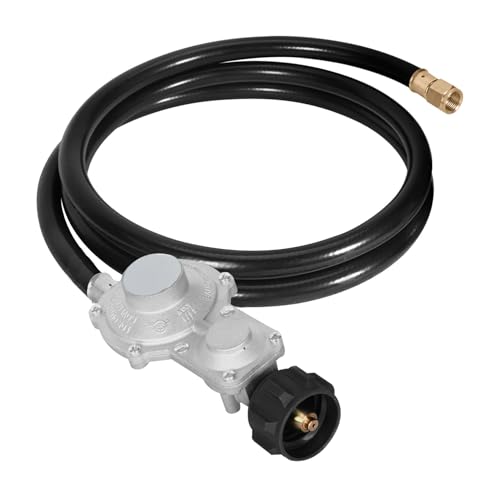
Dual-stage design delivers stable gas flow, ideal for appliances sensitive to pressure changes. It features a 3/8″ female flare nut and QCC1 / Type1 compatibility, making it widely adaptable for RVs, generators, grills, stoves, fire pits, and water heaters. Best for: users seeking durable brass construction and universal tank compatibility. Limitation: Data notes general compatibility; verify exact fittings for your device model before installation.
CALPOSE 12FT 2 Stage Propane Regulator With Hose

The two-stage regulator reduces pressure fluctuations to keep constant flow. It delivers 11″ WC outlet pressure and supports up to 160,000 BTU/hr, making it suitable for high-demand equipment. Built with zinc alloy and brass connectors for weather resistance and longevity. Best for: longer hose needs with reliable performance in outdoor setups. Caution: Not explicitly rated for indoor use in all configurations; verify local code requirements.
GGC 5FT Two Stage Propane Regulator With Hose
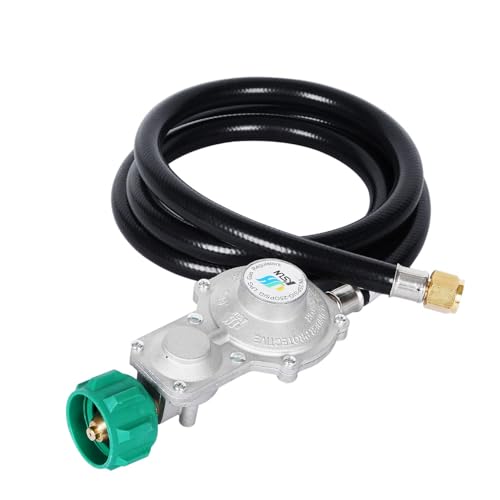
Two-stage design stabilizes output and includes a safety relief device to automatically release pressure if too high. It uses a 3/8″ internal NPT connector and 11″ WC output with a maximum 180,000 BTU rating. Best for: users seeking a safe, economical two-stage option with robust brass hoses. Limitation: Safety features are mechanical—proper installation is essential to avoid leaks or misfit connections.
Buying Guide: How To Choose The Right Propane Regulator For A Generator Or RV
- Two-stage vs. single-stage: Do you need tighter pressure control for sensitive appliances? Two-stage regulators reduce fluctuations and improve stability under varying tank pressures.
- Outlet pressure and BTU capacity: Ensure the regulator provides around 11″ WC and supports your total BTU demand. Higher BTU ratings are necessary for powerful generators or heaters.
- Connector compatibility: Look for QCC1/Type1 compatibility and 3/8″ female flare nuts to match your tank and hoses.
- Hose length: Longer hoses help with placement and mobility but can introduce additional pressure loss if too long. Balance length with your layout needs.
- Durability and materials: Brass fittings and zinc alloy bodies offer corrosion resistance and longevity in outdoor setups.
- Safety features: Consider regulators with built-in relief devices to prevent overpressurization and leaks.
- Installation considerations: Confirm required inlet/outlet sizes and ensure clear, leak-free connections with your existing equipment.
- Use case variety: If you operate multiple appliances simultaneously (generator, heater, grill), opt for a regulator with higher BTU capacity and stable multi-device performance.
Frequently Asked Questions
- What is a two-stage propane regulator?
– A regulator with two internal stages that smooths pressure from the tank to the appliance, reducing fluctuations and improving flame stability. - Why is 11″ WC outlet pressure common?
– It’s a standard low-pressure setting that suits most consumer propane appliances, balancing safety and performance. - Can I use any regulator with any propane tank?
– Compatibility depends on connection type (QCC1/Type1) and flare nut size. Verify tank valve standards before pairing. - What factors affect regulator lifespan?
– Exposure to heat, moisture, and frequent pressure cycling; choose brass fittings and protective housings for longevity. - When should I replace a regulator?
– If you notice inconsistent flame, leaks, or audible hissing, inspect for damage and consider replacement. - Is a longer hose always better?
– Not necessarily; longer hoses can introduce pressure drop and potential leaks if not high-quality. Choose an appropriate length for your setup.