Propane powered portable generators offer reliable backup power with clean emissions and long shelf life, making them a smart choice for homes, campsites, and emergencies. This guide highlights top propane or dual-fuel units, comparing run times, wattage, and safety features to help you pick the right model for your needs.
Summary of selected products:
| Product | Brand | Power Range | Fuel | Notable Features |
|---|---|---|---|---|
| PowerSmart 3800-Watt Portable Inverter Generator | PowerSmart | 3800 starting / 3300 running Watts (gas); 3500 starting / 3100 running Watts (propane) | Gas & Propane | 30A RV outlet, CO protection, quiet operation |
| WEN 4,750-Watt Dual Fuel Generator (DF475T) | WEN | Gas: 4750 surge / 3800 running; Propane: 4350 surge / 3500 running | Gas & Propane | 100V/120V/240V transfer switch readiness; electric start option |
| WEN 5,600-Watt Dual Fuel Generator (DF5600X) | WEN | Gas: 5600 surge / 4500 running; Propane: 5000 surge / 4050 running | Gas & Propane | CO watchdog sensor; wheel kit and electric start |
| Westinghouse 2550 Peak Watt Inverter | Westinghouse | 2550 peak / 1900 running | Gas & Propane | Ultra-quiet, portable with TT-30R RV outlet; economy mode |
| Aceup Energy 4000 Watt Dual Fuel Inverter | Aceup Energy | Gas: 4000 peak / 3200 running; Propane: 3500 peak / 3000 running | Gas & Propane | Quiet operation; EPA compliant; THD < 1.5% |
PowerSmart 3800-Watt Portable Inverter Generator
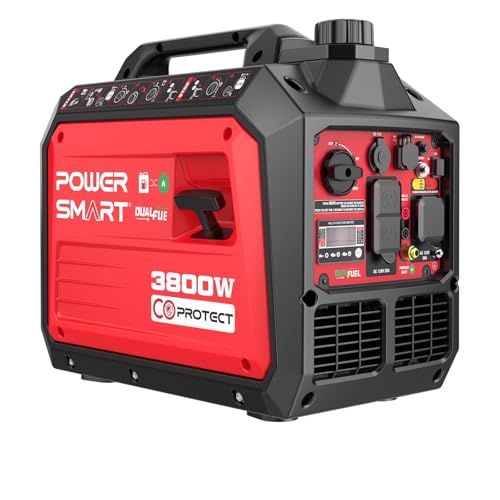
The PowerSmart unit operates on gasoline or propane, delivering 3800 starting watts and 3300 running watts on gas, with 3500 starting and 3100 running watts on propane. It includes a 30A RV outlet, making it suitable for emergencies, camping, and outdoor adventures. Notable for its quiet operation, it produces around 59 dBA from 23 feet at 25% load and 70 dBA at full load, which helps keep noise to a minimum in residential areas or campsites. The dual-fuel design provides flexibility when fuel availability is a concern, and the CO protection feature adds a level of safety in enclosed spaces.
WEN 4,750-Watt Dual Fuel Generator

The DF475T model switches between gasoline and propane with a simple dial, offering 4750 surge watts and 3800 running watts on gasoline, and 4350 surge / 3500 running watts on propane. It supports 120V and 240V operation, which is ideal for transfer switches and emergency backups. An electric start makes startup quick and convenient, especially during power outages. This model balances power with portability, making it suitable for home backup, job sites, and RV use where maneuverability matters.
WEN 5,600-Watt Dual Fuel Portable Generator

The DF5600X offers dual-fuel flexibility with 5600 surge watts and 4500 rated watts on gasoline, and 5000 surge / 4050 running watts on propane. It features electric start for quick ignition and a CO watchdog sensor to automatically shut down the unit if carbon monoxide levels become dangerous. With wheel kit included, it is designed for easier transport and use during larger power outages, campsites, or remote work sites. The unit is well-suited for powering larger essentials in emergencies or on construction sites.
Westinghouse 2550 Peak Watt Inverter

The Westinghouse inverter offers 2550 peak watts and 1900 running watts, with dual fuel capability and multiple outlets including an RV-ready TT-30R, two 120V outlets, and USB options. It is designed for home backup and portability, delivering low noise at around 52 dBA and up to 12 hours of run time on a compact fuel tank. The economy mode helps optimize fuel efficiency and extend runtime, making it a practical choice for light to moderate power needs during outages or outdoor events.
WEN Quiet Dual Fuel 3600-Watt RV-Ready Inverter

The DF360iX runs on gasoline (3600 surge / 2900 rated) or propane (3500 surge / 2600 rated). It emphasizes quiet operation, producing less noise than typical generators, and it delivers clean power suitable for sensitive electronics due to low total harmonic distortion (THD). It’s a good fit for RV use, camping, and home backup situations where quiet operation and power quality matter most.
Westinghouse 4650 Peak Watt Dual Fuel
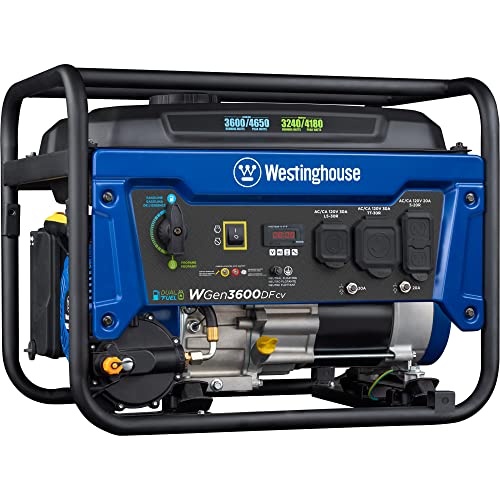
This unit delivers 4650 peak watts and 3600 rated watts on gasoline, or 4650 peak and 3240 rated watts on propane. A four-gallon fuel tank with a fuel gauge provides up to 14 hours of run time per tank. It includes one 5-20R duplex outlet, one RV-ready TT-30R outlet, and one L5-30R outlet, all with rubber safety covers. It ships with essential accessories like oil and a basic tool kit, enabling quick setup for home backup, construction sites, or RV use. The dual fuel capability enables flexible fueling options during extended outages.
Aceup Energy 4000 Watt Dual Fuel Inverter

The Aceup Energy unit provides 4000 peak watts and 3200 running watts on gasoline, and 3500 peak / 3000 running watts on propane. It features a 149cc engine with recoil start and a run time of up to five hours at half load on 1.32 gallons of gas. Quiet operation is emphasized with about 60 decibels in Eco mode at 23 feet, making it suitable for home use, camping, or RVs. The inverter technology with THD below 1.5% helps protect sensitive devices such as phones, TVs, and laptops from power fluctuations.
DuroStar 13,000-Watt Dual Fuel Generator

The DuroStar DS13000MX provides 13,000 watts of power with dual fuel capability (gasoline or propane), a remote electric start, and is designed as a whole-home power backup solution. It is suitable for larger homes or job sites where higher wattage is required. The lightweight design relative to its power, and transfer switch readiness, make it a strong option for emergency power, RV parks, or remote work environments. It supports a robust set of outlets and safety features to support extended outages and demanding power needs.
Buying Guide: Key Purchase Considerations
- Power needs: Estimate essential watts (refrigerator, sump pump, lights, HVAC, electronics) and choose a model with a comfortable margin above that demand. Dual-fuel units give flexibility if propane is your primary storage fuel.
- Fuel availability and shelf life: Propane stores longer than gasoline and doesn’t degrade as quickly. If you rely on generator power during outages, propane can offer more predictable long-term readiness.
- Run time vs. fuel tank size: Larger tanks provide longer runtime, but add weight and size. Inverter generators prioritize fuel efficiency and clean power but may have lower continuous output.
- Power quality: For sensitive devices, select units with inverter technology and THD (total harmonic distortion) values near or below 5%, ideally under 1.5% for premium electronics.
- Noise levels: Quieter models are preferable for residential use, campsites, or shared neighborhoods. Look for decibel ratings at a standard distance (often 23 feet).
- Safety features: CO sensors or watchdogs, auto shutoff on CO detection, and proper ventilation are important, especially for indoor or semi-enclosed use.
- Portability and practicality: Wheel kits, handles, and compact form factors improve usability in a home or RV setting. Parallel capability can increase total available power when using two units.
- Reliability and support: Consider brands with established service networks and readily available replacement parts.
Propane-powered and dual-fuel generators provide flexible energy options for emergencies, outdoor living, and remote work. When selecting a unit, align wattage, fuel availability, and noise tolerance with your typical power needs to ensure reliable performance when you need it most.