Procure a propane-powered generator that blends reliability with flexibility. This guide highlights five top-rated models suitable for home backup, recreation, and emergency power, focusing on dual-fuel capability, inverter efficiency, and safety features. Each choice balances performance and portability to help you keep essential systems running when the grid falters.
| Product | Fuel Type | Key Strength |
|---|---|---|
| WEN 5,600-Watt DF5600X | Dual fuel (Gas/Propane) | CO Shutdown Sensor, electric start |
| WEN 4,750-Watt DF475T | Dual fuel (Gas/Propane) | Wide voltage range 120V/240V, electric start |
| Oxseryn 4400-Watts Inverter | Gas powered | Inverter technology, multiple outlets, RV ready |
| Westinghouse 12500-Watt Dual Fuel | Gas/Propane | Remote start, transfer switch ready |
| WEN DF360iX | Dual fuel (Gas/Propane) | Quiet operation, CO Watchdog |
WEN 5,600-Watt Dual Fuel Portable Generator with CO Watchdog

- Dual fuel design runs on gasoline (5600 surge watts, 4500 running) and propane (5000 surge, 4050 running).
- Electric start turns the 224cc engine on with the push of a switch.
- CO Shutdown Sensor automatically turns off the generator if dangerous carbon monoxide levels are detected.
This model suits households seeking a robust dual-fuel option with integrated safety monitoring. Its compact footprint and wheel kit improve maneuverability for typical yard use and temporary backup scenarios.
WEN 4,750-Watt DF475T Dual Fuel Portable Generator

- Switch between gasoline (4750 surge, 3800 running) and propane (4350 surge, 3500 running).
- Voltage range supports 120V to 240V applications, aiding transfer switches and backup power.
- Electric start powers the 224cc 4-stroke OHV engine with a key turn for quick ignition.
Designed for moderate power needs with flexible fuel choices, this generator is a solid fit for small homes or RV setups requiring dependable dual-fuel operation.
4400-Watts Inverter Generator by Oxseryn
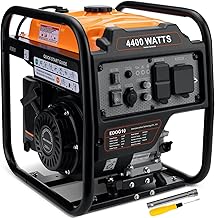
- Powerful output of 4400 peak watts and 3400 running watts with 2x120V outlets and a 30A RV port.
- Gas-powered with a 2-gallon tank, featuring inverter technology and ECO mode.
- EPA compliant with low-oil shutdown and cold-start capabilities for reliable cold-weather starts.
Ideal for RV users and small-home backups where clean, stable power matters for electronics and appliances, while keeping fuel usage efficient.
Westinghouse 12500 Watt Dual Fuel Generator

- High-capacity power: 9500 running/12500 peak watts on gasoline; 8500 running/11200 peak on propane.
- Remote start with key fob plus both electric and recoil start options.
- 12-hour run time on a 6.6-gallon tank with a fuel gauge; transfer switch ready and multiple outlets including RV and household receptacles.
This model is aimed at whole-home backup or larger job sites where sustained power is necessary and transfer-switch compatibility is a priority.
WEN DF360iX Quiet Dual Fuel Inverter

- Dual-fuel design supports gasoline (3600 surge, 2900 running) and propane (3500 surge, 2600 running).
- Extremely quiet operation, suitable for sensitive environments and quiet neighborhoods.
- Delivers clean power to protect electronics like smartphones and laptops.
Quiet, portable, and gentle on electronics, this generator is well-suited for camping, tailgating, or modest home backup where noise reduction is valued.
Buying Guide: Key Considerations for Propane-Powered Generators
- Fuel flexibility: Dual-fuel units offer gasoline and propane options, expanding emergency supply choices and reducing the risk of running out of one fuel.
- Power needs: Match surge and running watts to your essential loads. Inverter models typically deliver cleaner power for electronics, while traditional open-frame units are often better for higher startup loads.
- Safety features: Look for CO sensors, automatic shutdown, low-oil protection, and proper ventilation. RV-ready outlets support mobile setups, while transfer-switch readiness ensures seamless home backup integration.
- Portability and setup: Wheel kits and compact footprints improve maneuverability for yard storage and quick deployment during outages.
- Maintenance and durability: Engine displacement, fuel efficiency, and oil protection impact long-term reliability. Consider models with easy-start features for cold weather.
- Runtime and tank size: Larger tanks extend operation between refuels, especially important for prolonged outages. Inverter generators often optimize fuel use for longer runtimes at moderate loads.
- Noise and emissions: Inverter generators and newer models emphasize quiet operation and EPA compliance, which matters for neighborhood and camp use.
- Outlets and compatibility: Ensure the available outlets (120V, 240V, RV, USB) suit your devices, appliances, and transfer-switch requirements.
- Cost of ownership: Include maintenance, fuel prices, and potential add-ons like wheel kits, covers, and extra battery backups when budgeting.