When planning home backup power, a propane-powered generator offers fuel flexibility, cleaner emissions, and easier long-run operation. This guide compares five top options to help homeowners pick the right size and features for outages, storms, or RV-ready needs. Each pick targets a common buyer: “best for whole-home resilience,” “best for smaller homes,” “best for portability,” and more. The buying table below highlights key specs to compare quickly.
| Product | Propane Power (Watts) | Best For |
|---|---|---|
| Westinghouse 12500 Watt Dual Fuel | 8500 Running / 11200 Peak (Propane) | Whole-home backup with transfer switch readiness |
| DuroStar DS13000MX | 13,000 (Gas & Propane) | High-power backup for larger homes or job sites |
| WEN DF475T | 4350 Surge / 3500 Running (Propane) | Compact, budget-friendly dual fuel option |
| Westinghouse 4650 | 4650 Peak / 3240 Rated (Propane) | Reliable RV-ready and home back-up with CO sensor |
| DuroMax XP13000EH | 13,000 (Gas & Propane) | Full-home power with dual fuel flexibility |
Westinghouse 12500 Watt Dual Fuel: Best For Transfer-Ready Generators

The Westinghouse 12500 Watt Dual Fuel is designed for serious home backup. It runs 8500 watts and 11200 peak on propane, with a 6.6-gallon tank and a digital hour meter. It includes a remote start, and it’s transfer-switch ready to support home panels. This model suits homeowners who want reliable power during extended outages and plan to connect to a home transfer switch for seamless restoration of essential circuits.
Best for: Homes seeking strong propane-powered performance with transfer switch readiness and remote start. It’s also suitable for users who want a clearly labeled fuel gauge and real-time output data from the VFT display. Caution: the unit is heavy; consider installation and space planning for outdoor operation.
DuroStar DS13000MX: Best For High Output Dual-Fuel

With 13,000 watts of power on both gas and propane, the DS13000MX is built for whole-home power during outages or for demanding sites. Its dual-fuel capability provides fuel flexibility, which is helpful when gas availability is uncertain. A CO alert adds a safety layer by automatically shutting down if dangerous levels are detected. This generator suits larger homes and moderate-duty commercial uses where high starting watts are needed.
Best for: Households needing maximum surge power and flexibility between gas and propane. Choose this if you anticipate longer outages or need to back up multiple heavy-load circuits. Caution: higher cost and weight, and it may require a larger fueling footprint.
Westinghouse 4650: Best For RV Use And Quick Essentials
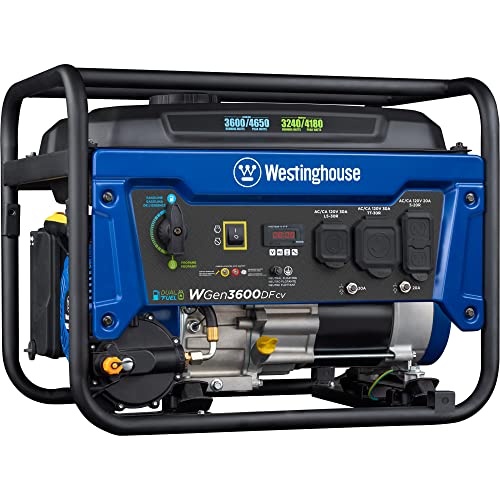
The Westinghouse 4650 is compact yet capable, delivering propane-powered performance with 3240 running watts on propane and multiple outlets including RV-ready options. A 4-gallon tank keeps it lightweight while the CO sensor adds safety. This model is ideal for RV owners and small homes that want a portable, easy-to-store backup option with essential outlets and a sturdy build.
Best for: Small homes or RV users who need portable backup with essential outlets and a safety CO sensor. Caution: limited runtime per tank compared to larger models; plan for refueling during longer outages.
DuroMax XP13000EH: Best For Full-Home Backup

The XP13000EH is a powerhouse designed for full-home backup with 13,000 watts of power in gas or propane. It emphasizes durability and long-run capability, making it a strong choice for larger households or properties with significant energy needs during outages. As a top-tier dual-fuel model, it streams fuel flexibility into a single, robust system ready for transfer switches and emergency readiness.
Best for: Homeowners needing robust, dual-fuel performance and the ability to power essential and higher-load circuits during outages. Caution: larger footprint and heavier than compact models; ensure proper placement and ventilation.
Buying Guide: How To Choose The Right Propane Powered Gen
- Power requirements: Start with your essential circuits and calculate total running watts. Choose a unit with a higher running watt rating than your minimum need to avoid overloads.
- Fuel flexibility: Dual-fuel units offer propane and gasoline. Propane burns cleaner and stores longer, while gasoline can deliver higher peak power for short bursts.
- Transfer switch readiness: If you plan to connect to a home transfer switch, ensure the generator supports a compatible outlet configuration and has clear labeling for safe transfer operations.
- Safety features: Look for CO detectors, automatic shutoff, and rubber outlet covers. These features improve safe operation during prolonged outages.
- Run time and fuel capacity: A larger fuel tank extends operation without refueling. Compare run-time specifications at a representative load to estimate outage duration.
- Portability vs. permanent installation: Wheel kits and lighter frames help move the unit for temporary use, while transfer-switch-ready, higher-output models suit permanent outdoor setups.
- Noise and emissions: Inverter-based models and those with fuel-efficient modes run quieter and consume less fuel, which is important for residential use.
Frequently Asked Questions
- What size propane generator do I need for a home? Start by listing essential circuits and calculating total watts. A generator in the 6,000–10,000 watt range covers most essentials, while 12,000 watts or more powers larger homes and multiple circuits.
- Is propane better than gasoline for home backup? Propane stores longer and burns cleaner, while gasoline can deliver higher continuous power. Dual-fuel units offer flexibility for outages and fuel availability.
- Do I need a transfer switch for a generator? A transfer switch simplifies safe connection to a home electrical panel and prevents backfeeding. It’s strongly recommended for any whole-home backup setup.
- What maintenance should I expect with dual-fuel generators? Regular oil changes, air filter checks, spark plug checks, and fuel stabilizer use help maintain reliability over time.
- Can I run a generator indoors or in a garage? No. Generators must be placed outdoors in a well-ventilated area to prevent carbon monoxide buildup and fire hazards.
- How long can a propane tank last on backup power? Run time depends on load and tank size. Propane offers longer shelf life, but larger tanks extend operation during outages.