Answering the common question “which portable solar backup generator should I buy?” this guide highlights five reliable options that balance portability, power, and practicality for outdoor use, camping, RV trips, and emergency power. Each pick is evaluated for who benefits most, from weekend campers to home backup planners. The table below provides quick at-a-glance comparisons to help you choose quickly.
| Product | Best For | Key Capacity |
|---|---|---|
| ZeroKor Portable Solar Generator (300W) | Casual campers and weekend RVers | 280Wh |
| MARBERO Portable Power Station (88Wh) | Lightweight day trips and backups | 88Wh |
| Jackery Solar Generator 1000 V2 | Mid-size/off-grid bundles | 1070Wh |
| Jackery Explorer 300 | Light to moderate power needs | 292Wh |
| EF ECOFLOW Delta 2 | Higher demand travelers and home backups | 1024Wh |
ZeroKor 300W Portable Solar Generator

Features include a 60W solar panel, a 280Wh battery pack, and multiple outlets: two 300W AC outlets, a 9V-12.6V DC port, three USB ports, and a quick-charge USB port. It also includes a built-in SOS flashlight for emergencies. The design supports charging from wall AC, a 60W solar panel, or car power, making it a versatile on-the-go solution.
Best for: Casual campers and short trips where compact power is enough for devices like phones, tablets, and small accessories. Choose this if you need a straightforward, all-in-one solar backup with basic outlets and portability.
Caution: Do not run devices over 300W on the unit to avoid damage, particularly heat-prone appliances like hair dryers or coffee makers.
MARBERO Portable Power Station 88Wh
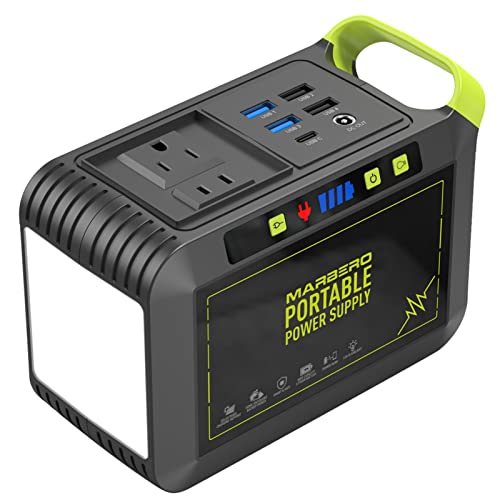
This compact unit emphasizes lightweight portability with a slim profile (about the size of a DSLR) and a 3.2 lb weight. It offers eight output ports and a built-in BMS for safety. It can be charged efficiently via MARBERO’s 30W or 60W solar panels, plus a car DC charger, enabling power on camping trips, short road runs, or emergency use for small devices.
Best for: Backpackers, hikers, and ground crews needing a very light, small-power option for phones, lights, and small electronics. It’s particularly suitable when solar recharging and compact size are priorities.
Caution: The 88Wh capacity means limited runtime for larger appliances; plan for short durations and prioritize essential devices only.
Jackery Solar Generator 1000 V2

With a 1,070Wh LiFePO4 battery and 1,500W continuous AC output, the Explorer 1000 V2 supports a wide range of devices and appliances. It’s noted for fast charging capabilities and a long lifespan, thanks to durable LiFePO4 chemistry. The unit remains portable at about 23.8 lbs and includes convenient USB-C and USB-A ports along with standard AC outlets.
Best for: Campers and weekend homeowners who need reliable, higher-capacity power for laptops, cameras, small appliances, and occasional home backup. Choose this if you require more sustained power without sacrificing portability.
Caution: One-hour fast charging is available via specific charging modes; rely on solar charging or wall charging for longer-term recharges to optimize battery health.
Jackery Explorer 300

This ultralight option delivers 292Wh with LiFePO4 chemistry, keeping weight down to about 7.5 lbs. It features two AC outlets, a 100W USB-C PD port, two USB-A ports, and a 120W car port. The robust battery chemistry supports thousands of charge cycles, extending long-term usability for outdoor adventures and occasional camping power.
Best for: Lightweight hikers and campers who want dependable off-grid power for laptops, cameras, and essential electronics without carrying heavy gear. It’s a practical middle-ground between capacity and portability.
Caution: Lower overall capacity compared to larger models, so plan for shorter outages or fewer devices during extended power needs.
EF ECOFLOW Delta 2

The Delta 2 offers 1,024Wh LiFePO4 capacity and an impressive 1,800W continuous AC output, with optional solar panel charging. It’s designed for serious off-grid needs and can serve as a robust home backup with expandable solar inputs and multiple outlets (USB-C, USB-A, DC). It’s well-suited for extended trips or temporary home power during outages.
Best for: Families or power users who require stronger output and flexible charging, including RVs or larger devices like home appliances when needed. It’s a strong choice for frequent off-grid use and emergencies.
Caution: Higher power needs mean larger upfront size and weight; ensure you have appropriate ventilation and space when using high-power appliances.
Buying Guide: Portable Solar Backup Generators
- Power needs: Estimate daily device usage. For phones and small devices, 300–600Wh units may suffice. For laptops or appliances, consider 800Wh–1,500Wh units or higher.
- Portability vs. capacity: Lighter units are easier to carry on hikes and short trips, but larger capacities support longer outages or home backup. Balance weight with runtime requirements.
- Charging options: Look for MPPT solar charging, car charging, and wall outlets. Some models offer fast wall charging or rapid solar input; select based on your access to sun and outlets.
- Battery chemistry and lifespan: LiFePO4 batteries offer longer life and safety advantages. Consider the expected charge cycles and total lifespan when planning a multi-year investment.
- Outlets and ports: Ensure the available outlets match your devices. USB-C PD is a plus for modern laptops and tablets; multiple AC outlets help run small appliances during outages.
- Safety features: Built-in protection (BMS, overcharge, and high-temperature safeguards) reduces risk of damage during use and charging.
- Expandability: Some models support extra batteries or higher solar input, which can scale power for growing needs or longer outages.
Frequently Asked Questions
- What is a portable solar backup generator? A compact power station that stores solar-generated energy and provides AC, USB, and DC outputs for off-grid use and emergency power.
- How do I choose the right capacity? Match the total wattage of devices you plan to run with the battery capacity in watt-hours (Wh). Higher Wh means longer runtimes.
- Are LiFePO4 batteries better? Yes, LiFePO4 chemistry offers longer life cycles, better stability, and improved safety compared with some other lithium chemistries.
- Can these be charged entirely by solar? Many models support solar charging, often with MPPT technology for efficient conversion. Solar-only charging depends on panel wattage and sunlight.
- Is UPS or surge protection available? Some models include rapid transfer features and surge protection, ensuring critical devices stay powered during interruptions.
- Do they power high-watt appliances? Most compact units are best for small devices; higher-watt models can run larger appliances but check continuous wattage ratings before use.