If you’re seeking reliable, portable solar power, a monocrystalline panel is usually the best choice for higher efficiency and compact design. This guide highlights top portable options, sized for RVs, camping, and emergency backup. Each product is evaluated for who benefits most, performance notes, and practical trade‑offs. The right panel can power power stations, charge batteries, and extend outdoor adventures with minimal setup.
Buyer type summary:
- Best for frequent campers and RV owners: Renogy 200W and ZOUPW 450W standouts for versatility and power compatibility.
- Best for compact spaces and lighter setups: DOKIO 100W and 200W foldables offer easy transport and quick setup.
- Best for rugged, all‑weather use: CTOLITY and ZOUPW 450W emphasize IP ratings and robust construction.
Buying table (selected products):
| Product | Best For | Key Strength | Notes |
|---|---|---|---|
| GRECELL 200W Portable Solar Panel | Outdoor RV, power stations | IP65 waterproof, high efficiency | Kickstands included |
| Renogy 200W Portable Solar Panel | Space‑limited setups | 25% efficiency, compact foldable | Magnetic closure |
| DOKIO 200W Portable Foldable Kit | Emergency backup | Separate controller | Long cable for shade safety |
| VEVOR 200W Foldable Solar Panel | Multi‑device charging | 24% efficiency, multiple ports | MC4 and MC4 connector cable |
| ZOUPW 450W Portable Solar Panel | High power, large power stations | 40–60V input, IP67 | Lightweight for size |
GRECELL 200W Portable Solar Panel for Power Station

Best for outdoor adventures where quick setup and wide compatibility matter. This 200W panel uses 6‑layer ETFE lamination and monocrystalline cells to reach up to 23.5% conversion efficiency, placing it above many polysilicon options. The panel includes four kickstands for versatile angling and is IP65 waterproof, protecting against splashes and dust. It’s well suited for RVers and campers who want a ready‑to‑go solution that pairs with most power stations when used with a charging controller and appropriate cabling.
Who it’s best for: outdoor enthusiasts who value high efficiency in a foldable, weather‑resistant package and who often operate near water or dust. Why selected: strong durability, waterproofing, and broad compatibility with popular power stations.
Limitation: does not include a charging controller, so users must supply one for safe operation with their battery system.
Renogy 200W Portable Solar Panel

Best for compact camping setups where weight and packing size matter. Renogy’s 200W panel emphasizes industry‑leading 25% efficiency with 16BB N‑Type cells, delivering more output in limited space. The folding design and magnetic closure simplify transport and deployment, especially in tight camper interiors. It also supports multi‑device charging via USB‑C PD and USB‑A ports when connected to a compatible power station or battery bank.
Who it’s best for: campers and solo travelers needing higher energy density in a small footprint. Why selected: high efficiency in a compact, easy‑to‑store form factor.
Limitation: lower portability compared to ultra‑light panels, and compatibility depends on the power station’s voltage input and port availability.
DOKIO 200W Portable Foldable Kit

Best for emergency backup and versatile RV setups. DOKIO’s 200W kit includes a separate PWM controller, promoting safe charging of 12V systems by protecting against reverse polarity, overcharge, and short circuits. The long 9.84 ft cable enables placing the panel in sun while locating the controller in shade, improving safety and flexibility for mobile installations.
Who it’s best for: users who want a dedicated controller and extended cable for safer setup. Why selected: separate controller feature adds a layer of protection and upgradability.
Limitation: the need for a controller means extra components must be managed, and setup time can be longer than turnkey solutions.
VEVOR 200W Foldable Solar Panel
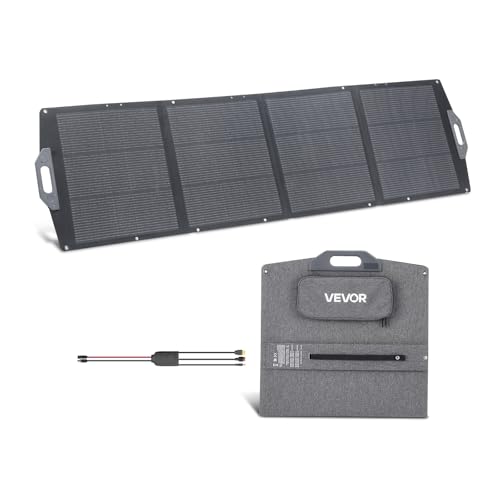
Best for multi‑device charging and flexible power delivery. This panel features 24% efficiency with 16BB PERC cells and a variety of output ports, including USB‑A, USB‑C, and DC, plus an MC4 output with a 3‑in‑1 connector cable that fits XT60 and Anderson inputs. It’s suitable for travelers who need to power a mix of devices and power stations from a single panel.
Who it’s best for: users who want to charge multiple devices at once and connect to various power stations. Why selected: broad port options and convenient connector set improve compatibility.
Limitation: higher port variety can complicate cable management, and performance depends on sun exposure and panel orientation.
ZOUPW 450W Portable Solar Panel

Best for high‑demand power stations and large setups. The panel uses 16BB N‑Type cells and maintains up to 25% efficiency in variable light, delivering up to 450W for compatible power stations. Its ultralight fiberglass structure, 4 adjustable kickstands, and IP68 rating position it as a strong option for solo boondocking and rapid deployment. Not compatible with some low‑voltage units, so verify input requirements before purchase.
Who it’s best for: users needing substantial solar input in a portable form, especially with large power stations. Why selected: high capacity, adjustable kickstands, and light framing improve field performance.
Limitation: not suitable for low‑voltage power stations; verify compatibility with your equipment’s input voltage.
Buying Guide
What to consider when choosing a portable monocrystalline solar panel:
- Power target: Match panel wattage to your typical load and power station capacity. Higher wattage provides faster charging in sunny weather but increases weight and size.
- Efficiency and cell type: Monocrystalline cells offer better efficiency than polysilicon, especially in limited space or partial shade. Look for 23–25% efficiency for portable kits.
- Portability vs durability: Foldable designs save space; however, ensure the frame and kickstands are robust for outdoor use and wind exposure.
- Weather resistance: IP ratings (IP65–IP68) indicate protection against water and dust. ETFE lamination can improve durability and light transmittance.
- Connectivity: Assess output ports and cabling compatibility. A single panel with multiple connectors or a 3–5 in‑1 cable simplifies setup with different power stations.
- Controller needs: Some panels include a controller; others require an external controller. Controllers protect against reverse polarity, overcharge, and short circuits.
- Compatibility with power stations: Confirm voltage input requirements (Voc, Vmp) and connector types for your chosen station or battery system.
FAQ
- What makes monocrystalline panels better for portable use? They deliver higher efficiency per area, which is valuable when space and weight are at a premium in vehicles or backpacks.
- Do all panels include a charging controller? No. Some include an external controller, while others require you to provide one separately.
- Can these panels power a power station directly? Yes, when the power station accepts the panel’s output voltage and connects via the correct cable or MC4 connector.
- Are these panels weatherproof enough for outdoor use? Many are IP65–IP67/68 rated, with ETFE lamination and rugged fabrics to resist dust and splashes; never expose to heavy rain for extended periods.
- What should I verify before buying? Check compatibility with your power station’s input voltage, the available ports, and whether a controller is included or needed.
- Is higher wattage always better? Higher wattage increases charging speed in bright sun but adds weight and bulk; choose based on your typical usage and space constraints.