Finding a reliable portable generator that runs on gas or propane is essential for home backup, camping, and remote work sites. This guide highlights five top dual‑fuel models that balance power, portability, safety features, and runtime. Each option is best for different needs: home backup power, quiet camping, heavy duty work sites, and RV readiness. Use the buying guide to compare fuel flexibility, noise levels, run time, and safety features before you buy.
Summary of selected products:
| Product | Best For | Fuel Options | Key Benefit |
|---|---|---|---|
| WEN DF5600X | Home backup and emergency power | Gasoline, Propane | CO Watchdog sensor for safety |
| PowerSmart 3800 | Quiet camping and RV use | Gasoline, Propane | Inverter, low noise |
| DuroStar DS13000MX | Large home power and job sites | Gasoline, Propane | High wattage dual fuel portability |
| Westinghouse 12500 | Home backup with transfer switch | Gasoline, Propane | Remote start and multiple outlets |
| Westinghouse 6500 Dual Fuel | Medium‑duty backup and RVs | Gasoline, Propane | Transfer switch ready, multiple outlets |
WEN 5,600‑Watt Dual Fuel Portable Generator

Best for home backup and family safety, the WEN DF5600X offers dual fuel flexibility with a 224cc engine. On gasoline it delivers 5600 surge watts and 4500 rated watts; on propane, 5000 surge watts and 4050 rated watts. Electric start simplifies operation, especially during outages. A standout safety feature is the CO Watchdog Sensor that automatically shuts down the unit if dangerous carbon monoxide levels are detected. This makes it a solid choice for garages or spaces with limited ventilation.
Who it’s best for: homeowners needing reliable, versatile power for outages, and families prioritizing automatic CO protection. Why selected: strong dual‑fuel performance and integrated CO shutdown support safety-conscious environments. Limitation: high output means heavier weight and more storage space required compared to smaller portable units.
Performance snapshot:
- Fuel: Gasoline or Propane
- Wattage: 5600 surge / 4500 rated (gas); 5000 surge / 4050 rated (propane)
- Safety: CO Watchdog automatic shutdown
PowerSmart 3800 Watt Dual Fuel Inverter Generator
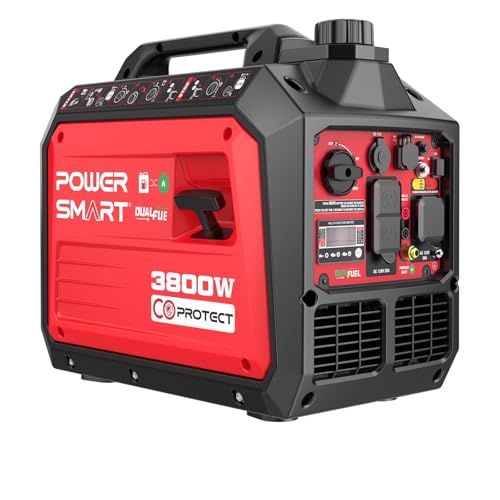
This model is best for quiet, residential use and RV camping thanks to its inverter technology and low noise profile. It runs up to 10 hours on gasoline at 3300 running watts and up to 25 hours on propane at 3100 running watts. Dual‑fuel flexibility is ideal for long outages where fuel availability may vary. The unit provides clean power with a pure sine wave and under 3% total harmonic distortion, making it safe for sensitive electronics like smartphones and CPAP machines.
Who it’s best for: campers, RV enthusiasts, and light power users who need quiet operation and stable electronics. Why selected: best balance of run time, noise, and electronics safety. Caution: propane runtime is long, but power output is slightly lower on propane than gasoline.
Key considerations:
- Noise: designed for low sound output
- Electrical quality: clean sine wave for sensitive devices
- Fuel switching: dual fuel supports fuel availability
DuroStar DS13000MX 13,000‑Watt Dual Fuel

For larger homes or job sites, the DS13000MX is a top high‑power choice with substantial dual‑fuel capability. It delivers 13,000 watts of peak power with gasoline and remains powerful on propane. The CO alert enhances safety, automatically shutting down if hazardous carbon monoxide is detected. Remote electric start adds convenience for frequent outages or remote deployments. It’s a strong pick when you need reliable, heavy‑duty backup power and transfer switch compatibility.
Who it’s best for: households needing substantial backup power or contractors requiring a portable yet robust generator. Why selected: the high wattage and dual fuel capability. Caution: higher power means heavier and less portable than smaller units.
Practical notes:
- Remote electric start helps quick activation
- Dual fuel supports flexibility during outages
- Transfer switch readiness supports integrated home backup systems
Westinghouse 6500 Watt Dual Fuel Home Backup
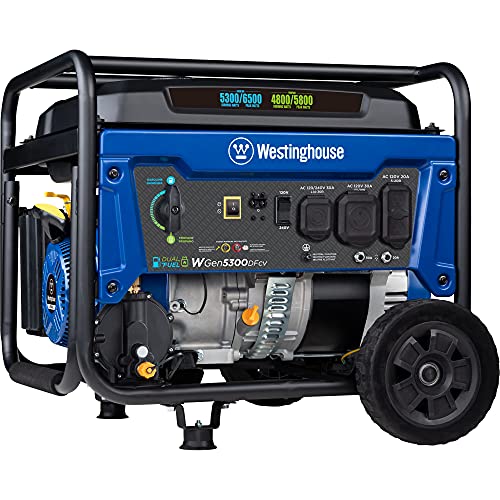
Designed for medium‑duty backup and RV use, the Westinghouse 6500 Dual Fuel provides a solid balance of power and features. Gasoline yields 6500 peak watts and 5300 running watts; propane provides 5800 peak and 4800 running watts. A 4.7‑gallon tank and a 14.5‑hour runtime help cover longer outages. It includes multiple outlets with rubber covers for safety and is transfer switch ready, making it straightforward to pair with a home electrical system.
Who it’s best for: families seeking a versatile, mid‑size backup with transfer switch compatibility. Why selected: good mix of wattage, fuel flexibility, and safety features. Limitation: not as quiet as inverter models, and recoil or remote start may be preferred on cold starts.
Outlet overview:
- Two standard 120V outlets
- One RV outlet and one transfer switch ready port
- Durable, rubber‑covered outlets for safety
Westinghouse 12500 Watt Dual Fuel Home Backup

The Westinghouse 12500 Watt Dual Fuel is a heavy‑duty option with serious backup power capacity. Gasoline power delivers robust running watts with a 6.6‑gallon tank and a gas engine that supports up to 12 hours of operation, depending on load. Propane runs at substantial wattage as well, with six outlets including a transfer switch ready port and RV‑ready outlet options. A remote start key fob adds convenience. It is well suited for whole‑house emergency power and remote job sites where reliability is essential.
Who it’s best for: homeowners needing a large, dependable backup with transfer switch capability. Why selected: strong, versatile outlets and high dual‑fuel flexibility. Limitation: size and weight may limit portability for some users.
Key features:
- Remote electric start option
- Multiple outlets including RV and transfer switch ready
- Powerful dual‑fuel performance for long outages
Buying Guide: Practical Choices For Gas And Propane Generators
Fuel flexibility matters. If you expect fuel inconsistencies, a dual‑fuel model lets you switch between gasoline and propane without purchasing a separate unit. Inverter generators provide cleaner power for sensitive electronics, though they may offer lower peak wattage than traditional open‑frame models. Consider runtime relative to load, noise levels for neighborhood settings, and safety features like CO sensors or automatic shutdown.
- Power needs: estimate starting and running watts for your essential circuits and appliances. Choose a unit with a comfortable safety margin above your calculated load.
- Fuel availability: propane stores longer but requires compatible hoses and fittings; gasoline may be more accessible but degrades faster without stabilizers.
- Noise tolerance: inverter models are typically quieter, making them better for campsites or residential areas.
- Safety features: CO alarms, automatic shutdown, and proper venting are critical for indoor or partially enclosed use.
- Portability vs. durability: larger units offer more power but require more space and wheels or a trailer; lighter models improve transport but may sacrifice output.
- Outlets and transfer switches: ensure your panel compatibility, and verify availability of RV, 120V, and 240V options as needed.
Frequently Asked Questions
- What does dual fuel mean? Dual fuel generators operate on two fuels, typically gasoline and propane, offering flexibility during outages or fuel shortages.
- Is inverter technology worth it? For sensitive electronics and quieter operation, inverter generators are advantageous, though they may provide less peak power than traditional models.
- How much power do I need for a home backup? Calculate the running watts of essential appliances and add a safety margin. A 6000–10000 watt unit often covers basic essentials, while larger homes may require more.
- Can I parallel two generators? Some models are parallel‑ready, allowing you to connect multiple units for extra capacity. Verify compatibility and safety requirements.
- What safety features should I look for? CO sensors with automatic shutdown, proper muffling, low‑oil indicators, and weather‑resistant controls contribute to safer operation.
- How do I maintain dual fuel performance? Use fresh fuel, store propane safely, and perform periodic maintenance as per the manufacturer’s guidelines to ensure reliable startup and operation.