Answer: For reliable home backup and outdoor power, choose portable power stations with sufficient capacity, multiple outputs, and fast charging. This guide highlights five solid options and explains who each is best for, plus practical buying tips for a power-outage plan.
| Product | Capacity / Output | Best For | Key Benefit |
|---|---|---|---|
| Jackery Explorer 1000 v2 | 1070Wh / 1500W AC | Large home backup, RVs, off-grid | High surge support and long lifespan with LiFePO4 |
| MARBERO Portable Power Station 88Wh | 88Wh / 120W peak | Compact emergencies, quick recharging on the go | Ultra-portable with multiple outputs and fast charge |
| MARBERO Solar Generator M82MAX | 111Wh / 120W (80W nominal) | Outdoors, camping, short outages | Solar panel kit option and light weight |
| LIBRIDS C600 | 640Wh / 600W (1200W surge) | Home backup, outage-ready with UPS | Built-in 10ms UPS for seamless power transition |
| DaranEner Portable Power Station | 192Wh / 300W | Compact travel, light outages, camping | LiFePO4 durability and fast charging options |
Jackery Explorer 1000 v2 Portable Power Station

The Jackery Explorer 1000 v2 delivers strong AC power with a 1,500W continuous output and 3,000W surge. It houses a 1,070Wh LiFePO4-equivalent capacity and weighs about 23.8 pounds for mobility. This model supports fast charging via the Jackery App, enabling a 0–100% charge in roughly one hour during emergency charging scenarios. It is best for homes or RV setups that require reliable, higher-wattage support and extended runtimes.
Best for: households needing substantial off-grid power for essential appliances (fridges, lights, small AC units) during outages, or campers who want solid, long-running capacity. Choose this if you prioritize high output and longevity over ultra-lightweight travel.
Caution: Not every high-wattage appliance is ideal for immediate startup; verify startup surges of devices like fans or CPAP machines before use. Data relies on standard testing conditions; real-world loads may vary.
MARBERO Portable Power Station 88Wh
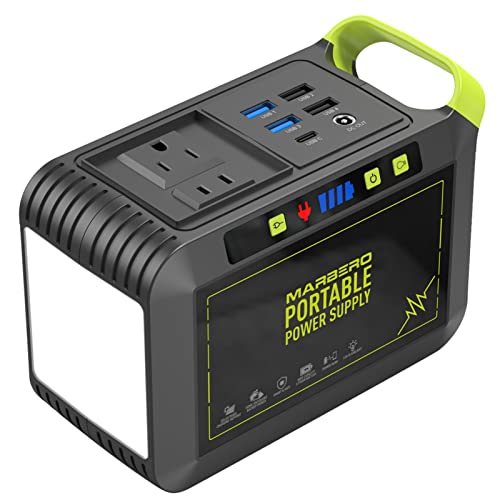
This MARBERO model emphasizes compact, everyday portability with eight output ports and a lightweight 3.2-pound build. It supports efficient charging from 0 to 80% in about two hours, and it can charge other devices simultaneously. Its built-in BMS supports stability and safety, making it suitable for quick outages, dorm rooms, or lightweight outdoor use. Best for: travelers or campers who want a small, dependable backup for smartphones, tablets, and small devices.
Selected for: portability and broad output options in a small package. Limitation: lower total capacity means shorter runtimes for power-hungry appliances.
MARBERO Solar Generator M82MAX

The MARBERO M82MAX combines an 111Wh Li-ion battery with multiple ports (4 USB-A, 1 USB-C, 2 AC outlets at 110V/60Hz with 80W continuous and 120W peak, plus a DC port). It ships with a 30W solar panel, making it suitable for outdoor activities and remote outages where solar charging is practical. Best for: light-duty power needs during camping or short outages where solar recharging improves independence. Consideration: panel and charging speeds may limit performance in low-sun conditions.
DaranEner Portable Power Station

The DaranEner unit offers 192Wh capacity with a 300W continuous output and 600W surge, plus USB-C PD 60W fast charging. Its LiFePO4 chemistry supports longer cycle life and safer operation. This model is well-suited for campers and home back-up where compact size and steady power for devices under 300W are required. Best for: users who want a safe, durable, compact option with modern USB-C charging. Limitation: not ideal for high-wattage appliances or devices with strong startup surges.
Buying Guide
What capacity do I really need?
Choose capacity based on essential devices and runtime. For light usage, 100–300Wh units cover phones, tablets, and small lights. For home backup or RV use, aim for 600–1500Wh with expandable options. Consider peak and continuous power ratings to match your devices’ startup and running watts.
Which outputs are essential?
Look for multiple USB ports (including USB-C PD), standard AC outlets, DC car ports, and, if needed, RV or 12V sockets. A built-in UPS feature can help critical devices stay on during outages.
How important is recharge time?
Fast charging or solar input improves readiness during outages. Some models offer 0–80% in 1–2 hours. MPPT solar controllers and solar panel compatibility increase solar charging effectiveness.
What about battery chemistry and durability?
LiFePO4 batteries offer longer life cycles and stability, but some units still use other lithium chemistries. Longer cycle life reduces replacement frequency and total cost of ownership.
Portability versus power
Smaller units are easier to carry but provide less runtime. Larger capacity units deliver more power for longer but are heavier. Balance weight, size, and needed runtime for your routine.
Which model fits a specific use case?
- Home outage back-up with high-demand appliances: Jackery Explorer 1000 v2 is a strong option due to high wattage capability and durable battery design.
- Lightweight travel and camping: MARBERO 88Wh or MARBERO M82MAX suit portable, solar-friendly needs.
- UPS-critical devices during outages: LIBRIDS C600’s 10ms UPS provides seamless power transitions for routers and CPAP systems.
FAQ
- What size generator is best for a power outage at home? A: A high-capacity portable power station (600–1500Wh) supports more appliances for longer periods without frequent recharges.
- Can these units run a refrigerator? A: Some models with 600W–1500W continuous output can run small refrigerators, depending on surge requirements. Check appliance wattage and startup surges.
- Is LiFePO4 safer than other Li-ion batteries? A: Yes, LiFePO4 cells generally offer longer cycle life and improved thermal stability, which enhances safety for repeated charging cycles.
- Do I need solar panels? A: Solar panels are optional but useful for off-grid charging. Panels with proper voltage and wattage improve reusability during extended outages or camping trips.
- How do I know which ports I need? A: List your essential devices and their power draw. Ensure the unit has USB-C PD, multiple USB ports, and at least two AC outlets if you plan to power several devices at once.
- How long does a typical recharge take? A: Recharge times vary by model and input source. Some units can reach 80% in about 2 hours when using the included AC adapter, while full charges may require several hours depending on capacity and input.