Access reliable portable power for outages, camping, and remote work with compact, fuel-efficient gas generators. This guide highlights five top models, combining inverter efficiency, open-frame robustness, and dual-fuel versatility to meet common needs. Each product below includes essential specs and features to help you compare performance, runtime, and noise levels for American households and outdoor enthusiasts alike.
| Product | Power (W) | Fuel Type | Key Feature |
|---|---|---|---|
| Aceup Energy 1,200W | 900 running / 1200 peak | Gas | Compact ultralight design; CARB compliant |
| Oxseryn 4400-Watts Inverter | 3400 running / 4400 peak | Gas | Open frame inverter with ECO mode |
| PowerSmart 1200W | 1000 running / 1200 surge | Gas | Ultra-portable, long runtime with efficient fuel mix |
| PowerSmart 4400-Watt Dual Fuel | 3600 running / 4400 peak | Gas/Propane | Dual fuel; quiet operation; CO-sensor |
| Westinghouse 12500 Watt Dual Fuel | 8500 running / 12500 peak (gas) | Gas/Propane | Remote start; transfer switch ready; high output |
Aceup Energy 1,200W Gas Powered Generator

The Aceup Energy 1,200W generator provides 1200 peak watts and 900 running watts from a compact 71cc 2-stroke engine. It runs at 60Hz on 120V household outlets and includes one American-style duplex socket, overload protections for AC and DC, plus an indicator light. Weighing 35.3 lb, it offers recoil-start portability ideal for emergency use, small deployments, or light-home backup. This model is EPA and CARB compliant, prioritizing clean operation for residential settings.
Oxseryn 4400-Watts Inverter Generator
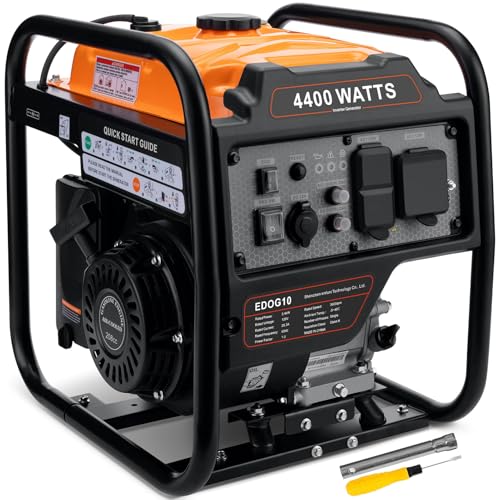
The Oxseryn inverter generator delivers 4400 peak watts and 3400 running watts with multiple ports: two 120V AC outlets, a 30A RV port, and a 12V DC port. Its 2-gallon fuel tank supports up to about 14 hours at 25% load, making it suitable for home backup or RV use. Features include inverter technology, ECO mode, and low-oil protection, plus cold-start capability and EPA compliance. It is designed for quieter operation and reliable power for sensitive electronics during outages or travel.
PowerSmart 1200W Gas Portable Generator

This PowerSmart model supplies up to 1200W surge and 1000W continuous power in a compact 39-pound chassis. Measuring roughly 16x14x13.8 inches, it includes a built-in handle for portability and a 1.1-gallon tank designed for efficiency. The unit supports longer operation with a 50:1 fuel mix, allowing up to about five hours at half load, making it a practical option for light home use, camping, or remote work sites.
PowerSmart 4400-Watt Dual Fuel Portable Inverter Generator

This dual-fuel generator starts at 4400W while offering 3600W running power, suitable for home back-up or RV use. It carries a 1.6-gallon fuel tank for extended runtime with up to 11 hours at 25% load. A key feature is quiet operation (approx. 76 dB at 23 feet) to minimize noise in residential areas or campsites. The unit supports both gasoline and propane via its dual-fuel design, giving flexibility during outages or travel.
Westinghouse 12500 Watt Dual Fuel Generator

The Westinghouse 12500 Watt dual-fuel home backup generator is a heavy-duty option designed for serious power needs. With 12500 peak watts and 9500 running watts on gasoline (and even higher on propane), it includes remote electric start, a 6.6-gallon fuel tank with gauge, and a transfer-switch-ready configuration. It features multiple outlets, a durable 457cc engine, low-oil shutdown, and a digital hour meter for maintenance tracking. This unit targets whole-house resilience, RV applications, and job sites where sustained power is essential.
Buying Guide
- Power requirements: Assess essential appliances and devices to determine continuous and surge wattages. Inverter generators provide cleaner power for sensitive electronics and often run quieter.
- Fuel type and availability: Gasoline, propane, or dual-fuel options affect runtime, storage, and flexibility during long outages. Dual-fuel models offer versatility for fuel shortages.
- Runtime and tank size: Larger tanks extend operation between refueling but increase weight. Match tank capacity to typical outage duration or camping sessions.
- Portability and weight: For frequent transport, lighter units with built-in handles or wheels simplify moving the generator around the home or campsite.
- Noise level: Noise impacts neighbor tolerance and comfort. Look for models with ECO mode or inverter technology to minimize sound.
- Outlets and safety features: Ensure the generator has enough 120V outlets, RV ports, and USB/C ports if needed. Features like overload protection, low-oil shutdown, and CO sensors improve safety.
- Starting mechanism: Recoil starts are common, while electric start adds convenience but may require battery maintenance. Consider ease of use for frequent or elderly users.
- EPA and CARB compliance: For residential use, select models that meet emissions standards to minimize environmental impact and local restrictions.
- Transfer switch readiness: If you plan to connect to a home panel, choose units with or compatible with transfer switches for seamless power during outages.
- Maintenance and warranties: Review maintenance intervals, oil requirements, and warranty coverage to protect your investment over time.