Answering the search intent for “plug charger for car,” this guide highlights reliable car power inverters and USB car chargers that convert 12V DC to 110V AC or provide quick USB charging on the road. Best choices are suited for road trips, camping, commuting, and mobile offices. This selection emphasizes safety features, output capacity, and ease of use. Below, quick reference helps buyers compare 5 top options at a glance.
| Product | Best For | Key Benefit |
|---|---|---|
| BESTEK Power Inverter DC 12V to AC 110V | Road trips and camping | High continuous and peak power with multiple outlets |
| PiSFAU 150W Power Inverter | Laptops and tablets | Dual USB ports and built‑in protection |
| FOVAL 150W Car Power Inverter | Compact setups | Aluminum shell, portable, dual USB ports |
| YSOLX 200W Car Power Inverter | Multiple devices on the road | 4 USB ports and two AC outlets |
| [4 in 1] JUNVANG USB C Car Charger | Smartphone and tablet charging | 4 ports with USB‑C and USB‑A, PD/USB charging |
BESTEK Power Inverter DC 12V to AC 110V
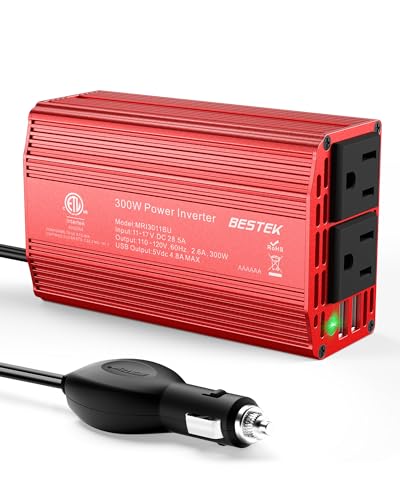
Best for long road trips and camping, this inverter delivers 300 Watts continuous DC to AC power with 700 Watts peak. It includes 2 AC outlets and 2 USB ports, allowing laptops, tablets, and other USB devices to charge simultaneously. The design emphasizes a compact profile and a cigarette lighter plug, making it compatible with most vehicles. Caution: power output is higher than some compact units, so monitor device heat during charging sessions. This is a solid choice when you need reliable multi‑device charging on the go.
PiSFAU 150W Power Inverter

Best for users needing laptop or tablet charging on the road, this inverter provides 150 watts continuous power with 300 watts peak. It features 110V AC outlets and 2 USB ports for fast USB charging. A smart chip plus built‑in fuse offers double protection, automatically shutting off on faults and signaling with a red LED. Use this if you want straightforward dual USB charging alongside laptop or larger device support. Limitation: not ideal for high‑demand power tools or heavy gaming consoles for extended periods.
YSOLX 300W Car Power Inverter

Best for families and mobile offices, this unit provides 200W continuous output with 4 USB ports and two 110V AC outlets. It supports charging laptops, cameras, tablets, and gaming consoles while on the move. The device emphasizes portability and a broader port mix for multiple devices. A potential drawback is that higher power loads can increase heat, so avoid running all high‑draw devices simultaneously for extended periods.
[4 in 1] JUNVANG USB C Car Charger

This 4‑port car charger is best for daily commuting and quick charging, featuring a 90W total output with 2 USB‑C ports and 2 USB‑A ports. It supports PD and QC fast charging to suit iPhone, iPad, and most Android devices. Choose this if you prioritize a compact, multi‑device solution without limiting total power to a single high‑draw port. Limitation: cannot replace an AC inverter for laptop charging, as it is primarily a fast USB charger rather than a traditional car inverter.
FOVAL 150W Car Power Inverter
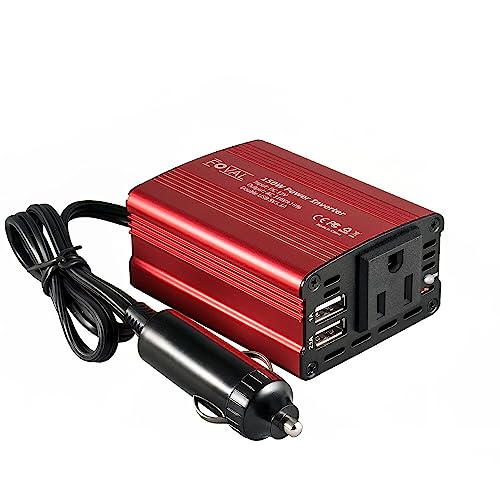
Best for compact setups and travel, this 150W inverter uses a durable aluminum shell and dual USB ports alongside an AC outlet. It emphasizes portability, making it suitable for road trips, business travel, and temporary office setups in vehicles. A consideration is that it’s best for lighter loads; avoid running high‑power equipment on both USB ports and the AC outlet for extended periods.
Buying Guide: Key Considerations for Car Inverters and USB Chargers
- Power needs: Determine if you primarily need AC power for laptops and appliances or USB charging for phones and tablets. Choose continuous wattage that comfortably covers your typical devices.
- Number of outlets: If you travel with multiple devices, prefer units with multiple AC outlets and USB ports. Consider USB‑C PD support for future‑proof charging.
- Portability: For frequent travelers, compact and lightweight models are easier to store in a glove compartment or bag.
- Protection features: Look for short‑circuit, over‑voltage, over‑load, and temperature protections. A built‑in fuse and smart shutoff add safety during faults.
- Cooling: A quiet cooling fan helps maintain performance during extended use but may add noise. Consider passive cooling for silent environments.
- Vehicle compatibility: Some models fit better with standard cigarette lighters; others are more compact but need careful placement to avoid dashboard clutter.
- Use cases: If you need to power laptops or CPAP machines, select higher continuous wattage and sufficient USB ports. For casual charging, smaller USB‑A/C units may suffice.
Frequently Asked Questions
- What is the difference between continuous and peak wattage?
Continuous wattage indicates steady power the device can deliver, while peak wattage shows short‑term surge capacity for brief high‑draw devices. - Can I run a laptop from a car inverter?
Yes, many inverters provide 110V AC outlets suitable for laptops, but ensure the laptop’s power needs stay within the inverter’s continuous wattage rating. - Are USB PD ports worth it on a car charger?
Yes, USB Power Delivery can significantly speed up charging for compatible devices like recent iPhones and many Android devices. - Is it safe to leave an inverter plugged in while the car is off?
Many units include automatic shutoff for faults or low voltage; however, leaving devices connected can drain the vehicle battery, so monitor usage. - Which inverter is best for camping?
Inverters with higher continuous wattage, multiple outlets, and robust cooling are preferable for extended use away from power sources. - Do car USB chargers need special adapters?
No; standard USB ports (including USB‑C PD) are widely compatible with modern devices, but verify port type and power output for your devices.