Peel-and-stick solar panels offer a flexible, easy-install option for owners of RVs, boats, cabins, and other curved or uneven surfaces. This guide highlights five top-performing panels suited to irregular rooftops, curved hulls, and other hard-to-mount scenarios. Each option is evaluated for portability, ease of installation, and power output to help buyers choose the right panel for off-grid, mobile, or temporary setups. The best picks target different use cases: stealthy roof setups, high-efficiency needs, and durable performance in shaded or partial-sun conditions.
Summary of selected products
| Product | Brand | Suggested Use | Approx. Power |
|---|---|---|---|
| Renogy Flexible Solar Panel 100W | Renogy | Curved RV/marine surfaces | 100 W |
| Renogy 100W Flexible Panel | Renogy | All-black, glare-free finish on curved surfaces | 100 W |
| BougeRV Arch Pro 200W | BougeRV | Shading-prone or variable light, higher power | 200 W |
| Renogy 200W Flexible Panel | Renogy | High output on curved surfaces | 200 W |
| BougeRV Yuma 200W | BougeRV | CIGS, ultra-flexible with tape installation | 200 W |
Renogy Flexible Solar Panel 100 Watt

This ultra-flexible 100W panel is designed for extreme mounting versatility. It is remarkably light, weighing about 70% less than rigid panels, and its lamination is extremely thin—nearly flattened to a tenth of an inch in height. Best for: vehicles with curved or irregular roofs where stealth and low profile matter. Caution: ensure compatible mounting surfaces and hardware since flexible panels rely on secure, even adhesion for optimal performance.
Renogy 100W Flexible Panel With High Efficiency
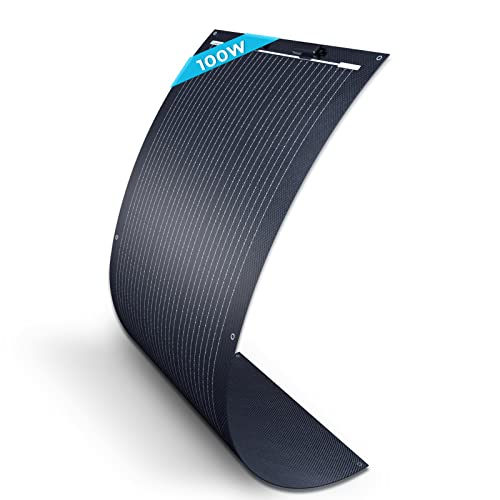
This 100W model emphasizes high-efficiency output with half-cut PERC cell technology, designed to maximize energy capture on curved surfaces. Best for: users who want more energy per sun hour on compact, bendable panels. Caution: weighs slightly more than ultra-light options, and performance may vary with mounting quality and shading.
BougeRV Arch Pro 200W Flexible Panel

Arch Pro is a robust 200W option with enhanced shading tolerance and a 25% conversion rate from the high-level N-type 16BB cell design. Best for: higher power needs on curved surfaces where partial shading might occur. Caution: open-circuit voltage information may require exact compatibility checks with your power system or inverter before pairing in a multi-panel string.
Renogy Solar Panels 200W Flexible

This 200W flexible model delivers substantial power on curved surfaces while staying lighter than rigid options. Best for: campers and boaters who need a higher power footprint without compromising on flexibility. Caution: the panel remains sensitive to sharp bending or edge impact; avoid exposing it to rough handling that could crease or degrade the lamination.
BougeRV Yuma 200W Flexible Panel

Yuma uses CIGS thin-film technology, offering high flexibility and ease of installation with tape-based mounting. Best for: very curved surfaces where tape installation is favored and long-term light sensitivity is acceptable. Caution: confirm surface compatibility and that the tape method aligns with your mounting surface and weather exposure.
ECO-WORTHY 2x130W Flexible Panels

Two 130W panels provide higher combined output on irregular surfaces and are designed for RVs and boats with curved roofs. Best for: buyers who want scalable power with modular installation. Caution: total weight and windage increase with multiple panels; verify roof strength and mounting feasibility.
Buying Guide: Peel and Stick Solar Panels
What to consider when choosing peel-and-stick panels for irregular surfaces:
- Surface compatibility: Some panels require clean, smooth surfaces for optimal adhesion; others tolerate minor irregularities with proper tape and sealants.
- Power needs: Match panel wattage to daily energy use and sun exposure. Higher-watt models deliver more daily energy, especially in consistently sunny environments.
- Flexibility and thickness: Ultra-thin, ultra-flexible panels are easier to mount on curved surfaces but may have different durability profiles than thicker options.
- Shading tolerance: Panels with shading mitigation (bypass diodes, high-efficiency cells) perform better under partial shade or uneven sunlight.
- Installation method: Tape-based mounting is quick but depends on surface cleanliness and weather conditions; hardware mounting with adhesive and seals may be needed for long-term installations.
- Electrical compatibility: Confirm the panel’s voltage, current, and wiring configuration align with your battery bank and controller. Some higher-voltage panels require specific wiring or inverters.
- Durability and weather proofing: Look for UV resistance, temperature tolerance, and protective lamination suitable for outdoors and vehicle travel.
Frequently Asked Questions
- Are peel-and-stick solar panels waterproof?
Most are designed to withstand outdoor use, but long-term waterproofing depends on surface prep and sealing around edges. Always follow manufacturer guidance for mounting and sealing. - Can these panels be mounted on a boat or RV roof?
Yes. They are designed for curved or irregular surfaces common on boats and RVs, with adhesive-backed or tape-based mounting options. - What is a good panel wattage for off-grid camping?
A 100–200W panel is typically sufficient for many RV and tent setups, depending on daily energy usage and sun exposure. - Do flexible panels work well in shade?
Shading-tolerant designs and PERC or similar cell technology improve performance in partial shade, but full shade still reduces output significantly. - Are these panels easy to remove?
Many peel-and-stick options are removable, but repeated removal can reduce adhesive effectiveness. Follow care instructions to minimize damage.