Explore versatile oscilloscope solutions that pair high-speed signal capture with built-in function generators. The following selections cover handheld to bench-top models, each offering distinct strengths such as waveform generation, dual channels, adequate bandwidth, and measurement features. Whether you’re tackling hobby projects or professional testing, these options help you visualize signals and synthesize test signals in one device.
| Product | Brand | Key Benefit | Bandwidth | Channels |
|---|---|---|---|---|
| FNIRSI 1014D Oscilloscope | FNIRSI Store | 1GSa/s real-time sampling with built-in DDS generator | 100 MHz | 2 |
| Hantek DSO2D15 | Hantek Store | Economical dual-channel with waveform output | 150 MHz | 2 |
| HANMATEK DOS1102S | HANMATEK Store | 2-in-1 with built-in waveform generator and FFT | 110 MHz | 2 |
| FNIRSI 2C53T | FNIRSI Store | 3-in-1 with multimeter features plus oscilloscope | 50 MHz | 2 |
| FNIRSI DSO-510 | FNIRSI Store | Compact handheld with DDS generator | 10 MHz | 1 |
Below are five detailed product sections, each highlighting how the device can support both observation and signal generation tasks. Consider your use case, such as desktop lab work, field service, or education, to choose the model that best balances bandwidth, memory, and form factor.
FNIRSI 1014D: 2-in-1 With DDS Generator
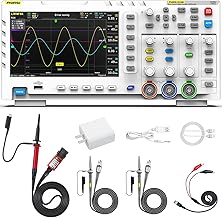
The FNIRSI 1014D combines real-time sampling with a built-in DDS function signal generator. It features up to 1 GSa/s sampling across two channels and a 100 MHz analog bandwidth, enabling precise capture of fast waveforms. Its DDS generator offers 14 predefined signal types and adjustable chopping signals, with user storage for up to 1000 customized signals. A 1 GB storage space supports waveform data retention. Trigger options include single, normal, and automatic modes, making it suitable for both periodic and aperiodic signals.
Hantek DSO2D15: Economical Dual-Channel

The Hantek DSO2D15 provides an affordable route to dual-channel waveform analysis. It supports arbitrary waveform output and multiple trigger modes, alongside standard serial protocol triggers and decodes. This makes it a practical choice for general electronics debugging, education, and development work where a budget-friendly bench instrument is desired without sacrificing essential functionality.
HANMATEK DOS1102S: Dual-Channel Powerhouse

The HANMATEK DOS1102S offers 110 MHz bandwidth across two channels and 2 × 500 MSa/s sampling, enabling precise waveform capture for complex signals. It supports dual-channel math and FFT analysis for in-depth signal processing, plus a 7-inch high-resolution LCD for clear visualization. The device is well-suited for professionals who require simultaneous measurement and signal generation capabilities in teaching labs and field work.
FNIRSI 2C53T: 3-in-1 Multimeter Oscilloscope
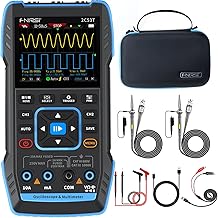
The FNIRSI 2C53T blends a two-channel oscilloscope with a built-in multimeter and DDS generator in a compact package. With 50 MHz bandwidth and 250 MSa/s sampling, it supports a wide range of measurements, including voltage, current, and resistance, as well as diode and continuity tests. It also adds enhanced math operations and cursor-based measurement, aiding quick analysis in school labs and field projects.
FNIRSI DSO-510: Handheld DDS Oscilloscope
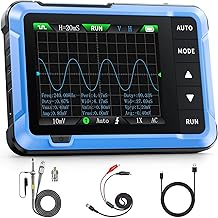
The FNIRSI DSO-510 is a compact handheld oscilloscope with a 10 MHz bandwidth and 48 MS/s sampling rate, paired with a DDS signal generator capable of multiple waveforms up to 50 kHz. Its portability suits field testing and quick diagnostics, while the built-in DDS output supports signal generation for testing receivers, amplifiers, and sensor circuits in mobile environments.
Buying Guide: Key Purchase Considerations
- Bandwidth and sampling rate: Higher bandwidth (e.g., 100–150 MHz) and faster sampling (≥1 GSa/s) yield better capture of fast edges and high-frequency components. For basic electronics and education, 50–100 MHz with 500 MSa/s–1 GSa/s can suffice.
- Number of channels and memory depth: Dual-channel models support simultaneous observation of reference and test signals; deeper memory improves long acquisitions and post-processing accuracy.
- Built-in function generator and DDS: A device with an integrated signal generator simplifies testing by providing repeatable waveforms for stimulus, calibration, and system validation.
- Display and interface: A clear color display with intuitive controls reduces setup time. Look for cursors, FFT, and persistence features for signal analysis.
- Form factor: Bench-top units offer comfort for long sessions, while handheld models are ideal for field work and quick checks. Consider power options and battery life if portability is essential.
- Probes and accessories: Ensure the kit includes or is compatible with appropriate probes, high-voltage safety features, and storage for waveforms and screenshots.
- Software and data export: Easy export of waveforms, screenshots, and measurement data supports documentation and collaboration.
- Price-to-performance balance: Budget-minded buyers may prioritize core oscilloscope features, while advanced users may invest in higher bandwidth, more channels, and deeper math capabilities.
- Use case alignment: Education, hobby projects, embedded systems, automotive diagnostics, and RF work each demand different combinations of bandwidth, sampling, and waveform capabilities.
- Support and upgradability: Consider models with active firmware updates, community support, and availability of replacement parts or probes.