Discover top on-grid hybrid solar inverters that blend solar, grid, and battery or batteryless setups for reliable home power. This guide highlights models suited for homes, cabins, RVs, and sheds, with clear pros and cautions to help buyers pick the right system.
| Product | Best For | |
|---|---|---|
| Y&H 10.2KW On/Off Grid Hybrid Inverter | Large homes, battery-backed storage | Dual MPPT, 10.2 kW, 500V PV input |
| POWLAND 12000W Grid-Tied Hybrid Inverter | Grid-tied with high solar harvest | Battery-free design, 12 kW, high MPPT efficiency |
| ZLOCYIVHE On Grid Hybrid 10KW | Affordable grid-tie with dual MPPT | Hybrid capability, multiple outputs |
| Anjfylque 12000W Hybrid Inverter | Large loads, parallel expansion | Dual MPPT, 12 kW, supports 6 units in parallel |
| Y&H 6.2KW Hybrid Inverter | Mid-size homes, batteryless or battery-ready | Pure sine, MPPT, 6.2 kW |
Y&H 10.2KW On/Off Grid Hybrid Inverter

The Y&H 10.2KW hybrid inverter combines a pure sine wave output with a built-in 160A charge controller and dual MPPT input. It supports PV input up to 500V and is designed for 48V battery systems, making it suitable for home energy storage or off-grid sheds linked to the grid. Best for homeowners needing strong solar harvesting and flexible charging modes.
Best for: large homes or cabins with solar arrays and a need for uninterrupted power during grid outages. The inverter offers Off-Grid and On-Grid capabilities with four charging modes and three output modes, enabling solar-first or grid-first configurations. A caution: ensure PV wiring complies with the 500V limit and that battery capacity matches your load profile.
POWLAND 12000W Grid-Tied Hybrid Solar Inverter

This 12,000W grid-tied unit emphasizes a battery-free design that directs excess solar power back to the grid and optionally uses a CT sensor for monitoring. It supports 48V systems and multiple photovoltaic inputs, making it ideal for large homes or RV parks seeking significant solar harvest with grid back-up.
Best for: users seeking high solar output without battery storage, aiming to lower grid reliance and maximize daytime generation. Caution: performance depends on grid compatibility and you may need a grid-tie compatible solar setup and proper anti-backflow configuration.
ZLOCYIVHE On Grid Hybrid 10KW
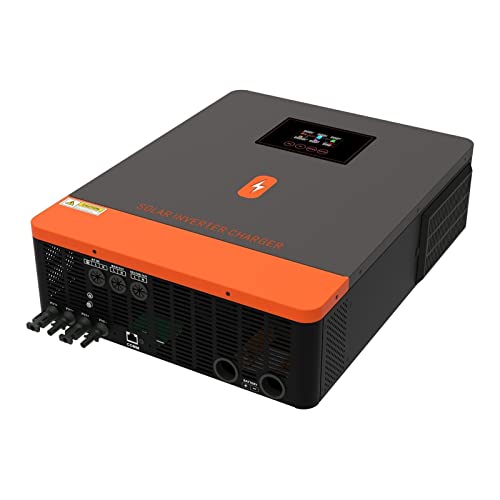
The ZLOCYIVHE hybrid inverter supports grid-tied operation with hybrid capabilities and dual MPPT tracking. It’s positioned as an affordable option for 10 kW class systems, making it easier to harvest from different solar orientations or partial shading. Best for budget-conscious installations that still require robust MPPT performance.
Best for: users needing a compact, dual MPPT solution with straightforward grid-backup. Limitation: data on long-term reliability and local compatibility varies by region; verify support with your installer.
Anjfylque 12000W Hybrid Inverter

The Anjfylque 12 kW hybrid inverter uses dual MPPT controllers and supports 48V systems with a 500VDC PV input. It enables parallel expansion (up to six units) for higher total output and offers multiple operation modes, including Solar Priority and Hybrid Mode. Best for: homeowners planning scalable power with grid-ted operation and diverse PV layouts.
Caution: parallel operation requires correct configuration and matching of units to prevent imbalanced loads across inverters.
Y&H 6.2KW Hybrid Inverter

The 6.2KW Y&H model combines a pure sine wave inverter with a built-in MPPT charger for 6500W PV input and 450V open-circuit voltage. It supports batteryless operation and offers flexible two-load-output configurations. Best for: mid-size homes seeking reliable backup with a compact footprint.
Caution: ensure your loads stay within the single-unit capacity and verify that batteryless operation aligns with your local outage patterns and grid requirements.
Buying Guide
Key factors to consider when choosing an on-grid hybrid solar inverter:
- System type: batteryless vs. battery-ready. Battery-ready models offer storage flexibility for future upgrades, while batteryless units prioritize cost and simplicity.
- Power rating and surge capacity. Match continuous output and surge capacity to peak loads in your home to avoid tripping breakers during startup of devices like pumps or air conditioners.
- MPPT and PV input range. Dual MPPT and higher PV input voltages enable better energy harvesting, especially with shaded panels or long cable runs.
- Grid compatibility. Confirm that the inverter aligns with your local utility requirements, anti-backflow features, and any necessary certification (UL1741 or equivalent).
- Parallel operation. If you plan to scale, choose models that support parallel connections with compatible units and clear instructions for installers.
- Monitoring and connectivity. Built-in WiFi or optional remote monitoring helps track generation, load, and battery status for optimized usage.
- Installation environment. Consider indoor vs. outdoor suitability, cooling needs, and the inverter’s dimensions to fit your space.
Frequently Asked Questions
- What is an on-grid hybrid inverter?
– It blends solar generation with utility power, and may include a battery or be batteryless, to provide continuous power with control over energy flow between solar, grid, and loads. - Do I need batteries with a hybrid inverter?
– Not always. Battery-ready models allow future battery integration, while batteryless designs rely on grid power and solar without storage. - What is MPPT and why does it matter?
– MPPT (Maximum Power Point Tracking) maximizes energy harvest from solar panels by dynamically adjusting voltage and current to match panel conditions. - Can I expand my system later?
– Some models support parallel expansion or multi-unit configurations. Check compatibility and required settings before adding more inverters. - How do I select the right inverter size?
– Size based on peak load and critical loads. Include a safety margin for startup currents of devices like HVAC and pumps. - Is professional installation required?
– Most jurisdictions require licensed installation for safety and compliance with electrical codes, utility interconnection, and safety standards.