Answering the question: these off-grid solar EV chargers combine high-efficiency solar charging with durable, independent power for electric vehicles and mobile setups. They’re best for RV owners, remote cabin dwellers, and DIY solar enthusiasts who need dependable charging without grid power. The top picks below balance capacity, real-world use, and portability, helping you choose the right system for your EV charging needs.
| Product | Type | Best For | Key Benefit |
|---|---|---|---|
| POWLAND 120A MPPT Solar Charge Controller | MPPT Charge Controller | Medium-to-large off-grid setups | High efficiency and broad voltage auto-detection |
| AuraSolar 7000W Hybrid Inverter | Inverter/Charge Controller | Storage-heavy off-grid homes | All-in-one with WiFi/BT control and scalable power |
| Topsolar 30W Panel Kit | Panel Kit + PWM Controller | Entry-level off-grid charging | Simple, compact, and easy to install |
| ECO-WORTHY 5000W Kit | Inverter Kit + Batteries | Full home-off-grid system | Integrated battery bank and high output |
| Renogy 400W RV Kit | Panel Kit + PWM Controller | RVs and campers | Compact, proven RV-specific kit |
POWLAND 120A MPPT Solar Charge Controller

Best for mid-to-large off-grid solar setups requiring robust charge management. The POWLAND controller supports 12V to 96V systems with automatic voltage detection and a 120A charging capacity. Its 98% MPPT efficiency helps extract more energy, particularly useful for RVs, remote cabins, or mobile power stations where every watt counts. It supports LiFePO4, AGM, GEL, and flooded lead-acid batteries and uses a three-stage charging profile to extend battery life.
Who it’s for: Builders aiming for high-efficiency solar charging in variable vehicle and off-grid environments, especially with larger battery banks. It’s also ideal for users needing quick recharges from sizeable PV arrays.
Why selected: The wide voltage range and high MPPT efficiency maximize harvest from diverse solar setups, and multiple protections help safeguard batteries and wiring. The 3-stage charging supports longevity across battery chemistries.
Caution: Installation requires careful wiring and protection; miswiring can negate protections or cause faults. Ensure battery voltages stay within supported ranges during setup.
AuraSolar 7000W Hybrid Solar Inverter

Best for home backup and scalable off-grid systems. The AuraSolar 7000W all-in-one inverter charger delivers clean pure sine wave power with a native 120/240V split-phase output and 14kW surge. It supports parallel operation with up to six units, enabling expansive off-grid systems. The built-in MPPT inputs handle up to 500V PV input with 99.9% tracking efficiency, and a 120A max charge current ensures fast battery refill for 48V systems. It includes a smart display and remote monitoring via WiFi/Bluetooth.
Who it’s for: Homeowners or workshop setups needing high-capacity, expandable off-grid power with remote management. Suitable for EV charging alongside other heavy loads.
Why selected: Combines inverter, charger, and MPPT controller in one unit, reducing clutter and improving system orchestration. The remote app and LCD touchscreen simplify configuration and monitoring.
Caution: High power systems require solid electrical knowledge for safe parallel operation and correct breaker sizing.
Topsolar 30W 12V/24V Panel Kit

Best for compact, entry-level off-grid charging or as a maintenance charger for 12V systems. This kit includes a 30W monocrystalline panel and a 10A PWM controller with mounting hardware. It is designed to keep 12V batteries topped up in cars, RVs, boats, and other 12V installations. The controller provides overcharge, over-discharge, short-circuit, and reverse polarity protection, helping prevent battery damage.
Who it’s for: Campers, boat owners, or garages needing a simple, low-cost solar boost for 12V batteries.
Why selected: Simple plug-and-play setup with a reliable PWM controller makes it a practical starter solution for maintaining battery health in off-grid vehicles.
Caution: 30W is modest; don’t expect rapid charging for larger battery banks or high-load EV charging from this kit alone.
ECO-WORTHY Complete Off-Grid Solar Kit
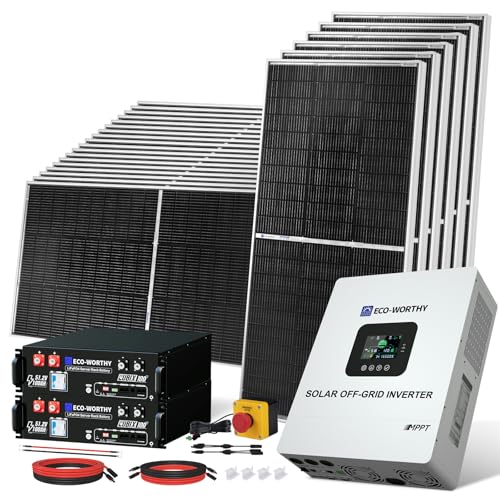
Best for a full off-grid home or RV backup with integrated storage. The ECO-WORTHY kit includes two 48V 100Ah LiFePO4 batteries, 24×195W mono panels, a 5000W off-grid inverter, and a 100A MPPT controller, plus cables and mounting hardware. It supports single-phase and split-phase 120V outputs, with parallel capability to scale up to 30 kW. This package emphasizes system integration, remote monitoring, and safety protections across components.
Who it’s for: Those seeking an all-in-one, scalable off-grid solution for home backup or remote living spaces with substantial energy needs.
Why selected: The integrated battery bank and high-power inverter provide a complete ecosystem, simplifying design and installation for larger off-grid power requirements.
Caution: The system requires careful planning for ventilation, wiring, and component placement due to higher energy capacity and wiring complexity.
Renogy 400 Watts RV Kit

Best for RVs and campers needing a compact, proven off-grid charging setup. This kit features 400W of monocrystalline solar panels, an Adventurer 30A PWM LCD charge controller, mounting brackets, and connectors. The kit emphasizes a smaller footprint with a corrosion-resistant frame and protective features for overcharge, voltage, discharge, short circuit, and reversed polarity.
Who it’s for: RV owners or travelers seeking a reliable, space-efficient solar charging solution for 12V or 24V systems on the road.
Why selected: It’s a long-standing, RV-friendly option that balances performance with ease of use, enabling straightforward installation on vehicles or small off-grid setups.
Caution: PWM controllers are generally less efficient than MPPT at higher temperatures or with larger arrays; energy harvest may be more limited in sunny but hot conditions.
Buying Guide
What size system do I need?
Determine daily energy use and peak loads. For EV charging, plan for battery capacity that can absorb the daily solar production plus a buffer for cloudy days. Larger systems benefit from MPPT controllers and an inverter capable of surge power for high-draw loads.
MPPT vs PWM controllers
MPPT controllers optimize power from solar arrays, especially with higher voltage or larger arrays. PWM controllers are simpler and cheaper, suitable for small setups or trickle charging. For off-grid EV charging, MPPT options generally deliver better energy harvest.
Battery chemistry and management
LiFePO4 offers long life and safety, but requires compatible BMS and wiring. AGM and flooded lead-acid are lower-cost options but require more maintenance. Ensure controllers support your battery type and that safety protections are in place.
System expansion and scalability
Consider future expansion: parallel inverters, additional panels, and battery banks. Hybrid inverters with built-in MPPT inputs simplify expansion and remote monitoring.
Protection and safety considerations
Include adequate fusing, proper grounding, and weather-rated enclosures. Off-grid installations can be exposed to harsh conditions, so protective housings and correct cable sizing are essential.
Monitoring and control
Remote monitoring via WiFi or Bluetooth helps you track PV production, battery status, and loads. Choose systems with intuitive displays or mobile apps for easier maintenance and optimization.
Practical checklist
- Define power needs and critical loads for EV charging.
- Match controller and inverter capacities to battery bank size.
- Ensure compatibility across panels, controller, and battery chemistry.
- Plan for future expansion when selecting components.
FAQ
- What is the role of an MPPT controller?
It dynamically tracks the maximum power point of a solar array to maximize charging efficiency, especially under varying light conditions.
- Can these systems charge an EV directly?
Most off-grid kits charge auxiliary batteries for storage; EV charging typically requires a high-capacity, grid-tied or dedicated off-grid charger setup with appropriate safety provisions.
- Are LiFePO4 batteries necessary?
They provide long life and stability, but other chemistries can work with compatible BMS and charge controls.
- Is parallel operation safe?
Yes, when designed for proper voltage, current rating, and wiring; follow manufacturer guidelines and use appropriately rated equipment.
- What maintenance is required?
Regular inspections of wiring, connections, and venting; monitor battery health and inverter performance via the included display or app.