When preparing for camping, RV trips, or emergency power needs, having a reliable off-grid power generator is essential. This guide highlights five top-rated portable power stations that balance capacity, safety, and versatility. Each pick accommodates different scenarios—from weekend getaways to extended outages—while offering practical charging options and user-friendly features. Explore the options below to find a model that fits your power needs and lifestyle.
| Product | Capacity | Output | Best For |
|---|---|---|---|
| Jackery Explorer 1000 v2 Portable Power Station | 1070Wh | 1500W AC | Camping, emergencies |
| Jackery Solar Generator 1000 v2 (200W Panel) | 1070Wh | 1500W AC | Off-grid living, solar charging |
| EF ECOFLOW Delta 2 | 1024Wh | 1800W AC | Home backup, camping |
| ABOK Portable Power Station | 3840Wh | 3600W | Heavy-use off-grid, RVs |
| OUPES Guardian 6000 Solar Generator Kit | 4608Wh | 6000W | Whole-house backup, off-grid |
Jackery Explorer 1000 v2 Portable Power Station

The Explorer 1000 v2 combines a robust 1,070Wh LiFePO4 battery with a 1,500W continuous AC output and a 3,000W surge capacity. A lightweight frame and a foldable handle enhance portability for outdoor activities, camping, and road trips. It supports fast charging and is compatible with solar panels for off-grid recharging, making it a versatile option for both everyday and backup use. The unit emphasizes safety and longevity, leveraging a durable battery chemistry designed for many charge cycles.
Key Features
- 1,500W AC output and 3,000W surge
- 1,070Wh LiFePO4 battery with long cycle life
- 1-hour fast charging option via emergency mode
- Lightweight, portable design with foldable handle
Jackery Solar Generator 1000 v2 with 200W Panel

This kit pairs a 1,070Wh capacity with a 1,500W continuous output and includes a foldable 200W solar panel for off-grid recharging. The modular solar generator design supports outdoor use, RV living, and emergencies where conventional power is unavailable. It features rapid charging options and a focus on battery longevity, with design elements aimed at simplifying outdoor energy management. The combination of solar input and battery capacity makes it suitable for extended outdoor stays or power outages.
Key Features
- 1,500W AC output; 1,070Wh capacity
- One-hour fast charging with emergency mode
- Included 200W solar panel for solar charging
- Compact, portable form with long-term durability
ABOK Portable Power Station

The ABOK model offers a substantial 3,840Wh capacity with a 3,600W continuous output and 4,500W peak power. It supports multiple charging methods, including AC, PV, and vehicle charging, and includes a broad 15-port array to support a wide range of devices. Built for longevity, this station uses LiFePO4 chemistry rated for thousands of cycles and long lifespan. It is well-suited for home backup, garage use, or off-grid living where heavy load requirements are common.
Key Features
- 3840Wh capacity; 3600W continuous power
- Multiple charging methods: AC, PV, car
- 15 output ports for simultaneous device charging
- LiFePO4 chemistry with long cycle life
OUPES Guardian 6000 Solar Generator Kit
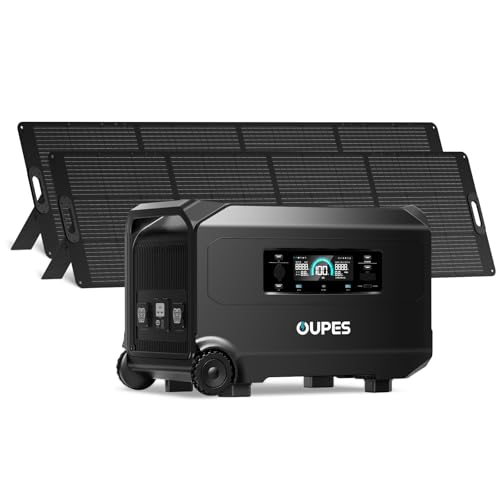
The Guardian 6000 kit delivers a large-capacity power solution with 4,608Wh and a robust 6,000W continuous output (7,200W boost). It includes dual voltage support (120V/240V) and a ready-to-use solar-ready setup with two 240W panels. This system is designed for immediate off-grid home backup and can seamlessly connect to transfer switches for whole-house performance. It is intended for users who require substantial power for appliances, medical devices, and essential systems during outages or remote living conditions.
Key Features
- 4608Wh capacity; 6000W continuous output
- Dual voltage support (120V/240V)
- Includes two 240W solar panels; off-grid ready
- Instant home integration with transfer switches
EF ECOFLOW Delta 2 Portable Power Station

The Delta 2 merges a 1,024Wh LiFePO4 battery with 1,800W continuous AC output. It is designed for fast charging, including 0-80% in about 50 minutes via AC input, and 0-100% in around 80 minutes. Expandability is a core feature, allowing increased capacity with additional battery modules to support larger off-grid needs. With 15 ports and strong energy management, it meets a wide range of camping, RV, and home backup requirements while maintaining quiet operation and portability.
Key Features
- 1,024Wh LiFePO4 battery; 1,800W AC output
- Ultra-fast charging; expandable capacity
- Multiple outputs and versatile charging options
- Compact design suitable for travel and emergencies
Buying Guide: Key Purchase Considerations
When selecting an off-grid power generator, consider capacity needs, output power, and recharge options. A higher wattage rating helps run appliances that demand surge power, such as refrigerators or power tools. Battery chemistry matters for longevity; LiFePO4 batteries generally offer longer life and safer chemistry than some other lithium types. Solar compatibility is essential for renewable charging, with panel wattage affecting how quickly the unit recharges under daylight conditions. Finally, portability and weight influence usability during travel. Compare units by capacity, discharge rate, charging speed, number and type of outlets, and the availability of expansion options for future power requirements.
For different use-cases, balance the following perspectives:
- Occasional camping or RV trips: prioritize portability, 1,000–1,500Wh capacity, and AC outlets for common devices.
- Home backup during outages: emphasize larger capacity, reliable battery chemistry, and integration with home transfer switches.
- Extended off-grid living: plan for scalable capacity with expandable batteries and multiple charging methods, including solar.
- Emergency preparedness: consider one-hour or near-immediate charging capabilities and robust surge performance for critical appliances.
Across these options, the five highlighted products provide a range of capacities, outputs, and charging configurations to suit diverse off-grid scenarios. Always verify compatibility with your devices, climate conditions, and the typical duration of off-grid use to choose the most effective system for your needs.