Flexible solar panels are a practical choice for off-grid living, RVs, boats, and campers. This guide highlights top options that balance portability, performance, and ease of installation. The list focuses on lightweight, bendable panels designed for curved surfaces and varying conditions. Suitable buyers include frequent travelers, boaters, and anyone updating a non-traditional roof or trailer. Below is a quick comparison and detailed product insights to help you decide which panel fits your setup.
| Product | Best For | Key Benefit | Open Note |
|---|---|---|---|
| DOKIO 100W 18V Flexible Solar Panel | Travelers & campers | Ultra-light, ultra-thin, bendable to 30° | Not a permanent roof replacement |
| Renogy 100W Flexible Solar Panel | Marine & RV curved surfaces | High efficiency with PERC tech | All-black, glare-free look |
| BougeRV Arch Pro 200W Flexible Panel | Shade-prone setups | Stabilized output with bypass diodes | Open-circuit voltage varies; check power station specs |
| Renogy 100W Flexible Panel (Semi-Flexible) | Uneven surfaces & stealth installs | Ultra-thin, low profile | Requires proper ventilation and mounting |
| BougeRV Butyl Rubber Tape | Easy installation | Long, wide tape for secure mounting | Surface prep required for best adhesion |
DOKIO 100W Flexible Solar Panel

Best for travelers and casual campers who need portable off-grid power. This panel weighs about 2.3 lb and is 0.03 inches thick, making it easy to carry and hang on irregular surfaces. It’s ideal for temporary setups on RVs, boats, or tents, not a permanent roof replacement.
- Ultra-light and thin; easy to transport and mount
- Flexible up to 30° to fit curved surfaces
- Ventilation-friendly installation; avoid combustible mounting surfaces
Selected for its combination of light weight and flexible arc, which suits campers and caravans that require portable charging. Caution: avoid over-bending and stepping on the panel to protect the cells.
Renogy 100W Flexible Solar Panel
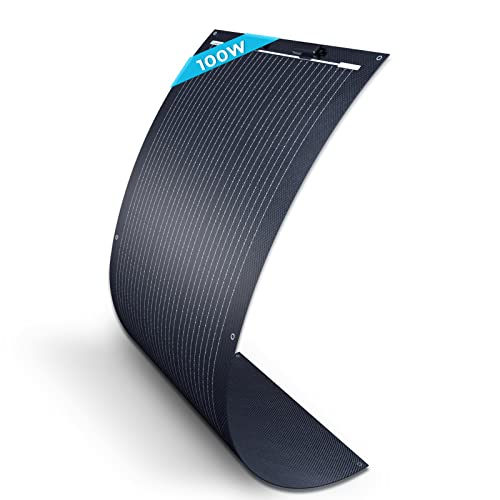
Best for RVs and boats with curved surfaces seeking reliable, efficient output. The 100W panel is lightweight—about a third of a rigid panel’s weight—and can bend up to 240 degrees. It features half-cut PERC cell technology to improve light capture and overall efficiency.
- High power relative to weight; good for limited space
- Bendable to complex roofs or curved hulls
- All-black aesthetic reduces glare
Chosen for its strong efficiency tech and versatility on curved surfaces. Caution: ensure mounting surface ventilation to prevent heat buildup.
BougeRV Arch Pro 200W Flexible Panel

Best for shading-prone installations where stable power is critical. The Arch Pro uses advanced bypass diode technology to maintain energy capture even with partial shading, and its 16BB N-type cells offer strong efficiency for light input conditions.
- Stable output in low light or partial shade
- Suitable for 12V and multi-panel series for higher voltages
- Open-circuit voltage may vary; verify compatibility with power stations
Selected for environments where shade is common or uneven sun. Caution: check system open-circuit voltage versus your charge controller before wiring in series rows.
Renogy Flexible Solar Panel 100 Watt

Best for uneven or curved surfaces where a low-profile solar solution is desired. This panel is extremely flexible, lightweight, and barely noticeable when installed flat, making it ideal for stealthy setups on campers and vans.
- Very thin, low-profile installation
- Advanced polymer materials keep weight down
- Requires clean mounting surface for best adhesion and air flow
Chosen for its stealth-friendly design and minimal thickness. Caution: ensure proper ventilation to prevent heat buildup behind the panel.
BougeRV Butyl Rubber Tape

Best for secure, quick installations of flexible panels on metal or glass surfaces. The wide 32.8 feet length supports multiple panel installations and different configurations.
- Wide compatibility for flexible panels
- Easy to cut and apply to back of panels
- Requires surface cleaning for optimal adhesion
Selected to help installers achieve durable mounting. Caution: ensure surface cleanliness and plan tape length to avoid exposed edges.
Buying Guide: How to Choose the Right Flexible Solar Panel
What determines the right panel for your setup?
- Surface compatibility: Are you mounting on curved or flat surfaces? Flexible panels excel on irregular roofs, boat decks, and trailer ceilings.
- Weight and thickness: For portable use, lighter and thinner panels reduce handling effort and wind resistance.
- Degree of bend: Panels have different flex tolerances. Choose one that matches your roof curvature without risking damage.
- Electrical output: Consider wattage (W) and efficiency. Higher efficiency cells improve output in limited sun conditions.
- Ventilation and heat management: Leave space for air to escape; overheating can degrade performance.
- Installation materials: Use compatible mounting tape or brackets and verify surface compatibility (metal, glass, etc.).
- Series vs parallel: If wiring multiple panels, verify open-circuit voltage and compatibility with your charge controller or power station.
Installation, Durability, and Safety Considerations
- Ventilation: Do not seal panels in enclosed spaces without airflow.
- Mounting surfaces: Avoid direct mounting on combustible materials unless spec’d as safe.
- Handling: Avoid stepping on flexible panels; bending limits must be respected to protect cells.
- Weather resistance: Check IP ratings and wiring junction boxes’ suitability for outdoor use.
- Cabling: Plan cable routing to prevent heat buildup and avoid pinching wires.
FAQ
- Q: Are flexible solar panels as durable as rigid panels? A: They are designed for durability in portable scenarios, but handling and mounting limits should be observed. Avoid sharp impacts and excessive bending beyond rated angles.
- Q: Can I mount a flexible panel on a curved RV roof? A: Yes, many models bend to 240° or 30° depending on design, enabling curved installations with proper mounting.
- Q: Do flexible panels require a different charger? A: Most 12V systems work with standard charge controllers matched to the panel’s open-circuit voltage; verify compatibility.
- Q: How many panels do I need for a 12V system? A: It depends on daily energy needs and sun exposure; larger systems may require multiple panels in series or parallel.
- Q: Is a sealed mounting tape enough for installation? A: Tape helps, but ensure surface cleanliness and consider additional secure mounting for windy environments.
- Q: What is the best panel for shade-prone areas? A: Panels with improved bypass diode technology tend to maintain output better under partial shading.