Discover top-performing solar panels that deliver reliable power for homes, RVs, boats, and off-grid systems. This guide highlights five widely relevant options designed for different needs—from high-power rooftop arrays to compact portable kits. Each option is evaluated for who it’s best for, potential limitations, and why it stands out in popular use cases. The quick comparison table below helps you decide which panels suit your installation goals.
| Product | Best For | Key Benefit | Limitations |
|---|---|---|---|
| Callsun 450W Bifacial 2-Pack | Large rooftop systems and off-grid installations | High power per panel; bifacial design increases total yield | Higher upfront cost; installation alignment matters for bifacial gain |
| Callsun N-Type 400W Bifacial 2Pcs | Rooftop systems where shading is a concern | Excellent shading tolerance with dual-module anti-shade | Requires space for two panels to maximize benefit |
| Renogy 200W Portable Foldable | Temporary off-grid power and travel trailers | Compact, lightweight, easy setup, MC4 compatibility | Lower wattage per panel; best used in daylight with mobility |
| SOLPERK 20W Kit with MPPT Controller | RVs, boats, trickle charging, small battery maintenance | Waterproof, versatile mounting, smart MPPT controller | Low power output; not for high-demand loads |
| Voltset 20W MPPT Charger Kit | 12V battery maintenance on vehicles and trailers | Advanced protection and universal 12V compatibility | Small size; limited charging for larger systems |
Callsun 450W Bifacial Solar Panel 2-Pack

Best for high-output rooftop arrays and large off-grid installations. This 900W total design uses N-Type 16BB cells and a bifacial backsheet to capture light from both sides, boosting total energy yield. The dual-module parallel anti-shade design helps maintain power when part of the panel is shaded. Choose this if you need fewer modules to achieve high capacity and want improved shading tolerance.
Best for: Home rooftops, ground mounts, or RV installations with ample space.
Caution: Bifacial gains depend on reflective surroundings; ensure mounting surface and orientation maximize rear-side exposure.
Callsun N-Type 16BB 400W Bifacial Panel (2-Pack)

Best for shaded environments or installations where reliability matters. The N-Type 16BB technology reduces hot spots and improves longevity, while bifacial design adds extra energy from rear illumination. The twin-module parallel layout maintains output even when part of the panel is shaded. This makes it a solid choice for RV roofs, marine applications, or limited-space rooftops where shading is unavoidable.
Best for: RVs, boats, or off-grid homes with partial shading nearby trees or structures.
Caution: Optimal gains depend on rear-side light; plan mounting to maximize rear exposure when possible.
GRECELL 100W Portable Solar Panel for Power Station
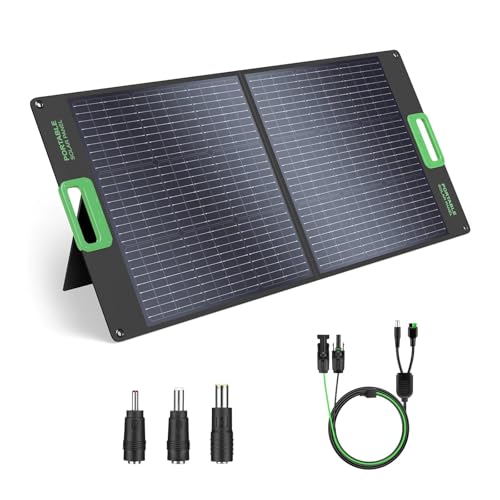
Best for emergency power and on-the-go charging. This 100W foldable panel is designed for solar generators and portable power stations, with a built-in smart charging chip that maximizes speed while protecting devices from overcharging. The foldable form and included connectors enhance portability for camping, van life, and remote trips.
Best for: Portable setups, camping, and emergency backup power.
Caution: Not ideal for large daily energy needs; best used to top off smaller battery packs or power stations.
Voltset 12V Solar Battery Charger Kit

Best for maintaining 12V batteries in vehicles, boats, and trailers. The kit combines an 20W monocrystalline panel with a smart MPPT controller and multiple protections to prevent overcharge and short circuits. It’s a compact solution for trickle charging and extending battery life in mobile setups.
Best for: RVs, cars, boats, trailers, and other 12V systems needing steady maintenance.
Caution: Power output is modest; pair with larger arrays if higher daily charging is required.
Buying Guide
What should I look for in a popular solar panel?
Power output, efficiency, and reliability top the list. For rooftops, prioritize higher wattage panels with good efficiency and shading resilience. For portable use, foldable designs and lightweight frames matter. Consider mounting space, climate, and whether bifacial or anti-shade features align with your site.
Which panel technology is most dependable?
N-Type and bifacial designs often deliver higher efficiency and better long-term stability than traditional P-Type modules. Anti-shade and dual-module architectures help maintain output in real-world conditions where shading and soiling occur.
What installation considerations affect performance?
Shading, orientation, and sunlight exposure determine yield. Bifacial panels gain from reflective surroundings; ensure rear-side irradiance is maximized. For portable kits, include appropriate connectors and a compatible power station or battery system.
How do I size a system for a home or RV?
Calculate daily energy usage and match it with panel wattage plus battery capacity. For high-demand loads, use higher-wattage rooftop panels in combination with a robust inverter or battery bank. For maintenance or backup power, smaller portable kits or trickle chargers may suffice.
What about protection and longevity?
Look for IP ratings, wind and snow load specifications, and robust frames. MPPT controllers improve charging efficiency, while overcharge and short-circuit protections extend battery life and system reliability.
Comparison snapshot
- High-output vs. portability: Callsun 450W offers rooftop power; Renogy 200W is strongest among portable options.
- Bifacial and anti-shade benefits: Callsun 450W and 400W pair provide resilience in mixed light.
- Budget-friendly starter kits: SOLPERK 20W and Voltset 20W offer scalable, low-cost maintenance charging.
Frequently Asked Questions
- What is the advantage of bifacial solar panels?
They capture light on both sides, increasing total energy yield when rear-side irradiance is available. - Are N-Type panels better than P-Type?
N-Type cells tend to have lower degradation and higher efficiency, improving long-term performance. - Can I use portable panels for home backup?
They’re suitable for light charging and emergencies, but may not meet full daily energy needs. - How important is shading tolerance?
High shading tolerance reduces power loss in real-world, partially shaded environments. - Do I need a technician to install rooftop panels?
For safety and code compliance, professional installation is recommended, especially for high-wattage systems.