When your car battery dies or barely cranks, a reliable mobile car battery charger jump starter is essential. This guide highlights top portable jump starters ideal for American drivers who want fast starts, safer connections, and built-in power banks. The best picks are suited for cars, trucks, motorcycles, and light commercial vehicles, with attention to engine size and climate. Below, you’ll find concise comparisons, who each product is best for, and practical buying tips to help you choose confidently.
Summary table of selected products:
- Product: NOCO Boost GB40 — Best for quick starts on small to mid-size engines; built-in power bank.
- Product: Scatach 3000A — Best for larger engines; robust protection and many jump starts per charge.
- Product: S ZEVZO ET03 — Best for powerful, versatile performance with USB charging and LCD display.
- Product: TREKURE 4000A — Best for extreme cold/heat ranges; high jump count and integrated USB power.
- Product: Joltekon 4500A — Best for multi-function kit with tire inflator and lighting.
NOCO Boost GB40: 1000A UltraSafe Jump Starter

Best for quick starts on small to mid-size engines and for drivers who want an all-in-one power bank. The GB40 delivers up to 1000 amps of peak lithium power and can start engines up to 6.0L gas or 3.0L diesel. It includes patented spark-proof and reverse polarity protection for safe, simple connections to any 12V vehicle. An integrated USB power bank recharges phones and tablets in about three hours, making it ideal for emergencies on the go.
Who it’s for: Commuters or RV users who need reliable starts for common 4- to 6-cylinder engines and want a portable charger that doubles as a smartphone charger. Limitations: Not ideal for larger diesel engines beyond 3.0L or heavy-duty trucks.
Scatach 3000A Car Battery Jump Starter

Best for larger, demanding engines and frequent jump starts. The Scatach unit boasts up to 3000A peak, capable of starting up to 9.0L gas or 7.0L diesel engines, and up to 50 jumps per full charge. It features intelligent protection systems to guard against sparks, reverse polarity, and temperature fluctuations. Its compact form enables easy carrying, making it a solid choice for serious battery boosters on the road.
Who it’s for: Fleet vehicles, boats, or household owners who need frequent, high-amperage starts. Limitations: Heftier than smaller models; check compatibility with very large diesel engines.
S ZEVZO ET03 4000A Jump Starter

Best for high-powered starts with a built-in power bank and USB charging. The ET03 delivers up to 4000A peak for engines up to 8.0L gas and 7.0L diesel, and supports about 50 jumps per charge. It includes a 74Wh portable battery pack and USB outputs, plus an LCD display to monitor status. The device also features storage case and an LED light, useful for roadside emergencies.
Who it’s for: Owners needing substantial jump-start capability along with USB charging and display feedback. Limitations: Higher price point and larger footprint than compact jump starters.
TREKURE Portable Jump Starter 4000A

Best for extreme temperatures and long-life endurance. The TREKURE model offers 4000A peak, capable of restarting 12V vehicles up to 8.0L gas or 6.5L diesel, even in challenging conditions (-4℉ to 140℉). It claims 1000+ jumps per charge and doubles as a 16800mAh power bank for USB devices. A bright multi-mode light improves safety during late-night roadside tasks.
Who it’s for: Drivers in regions with temperature extremes or those who require a robust, multi-function jump starter. Limitations: Slightly heavier and larger than entry-level models.
JOLTEKON Car Battery Jump Starter with Air Compressor
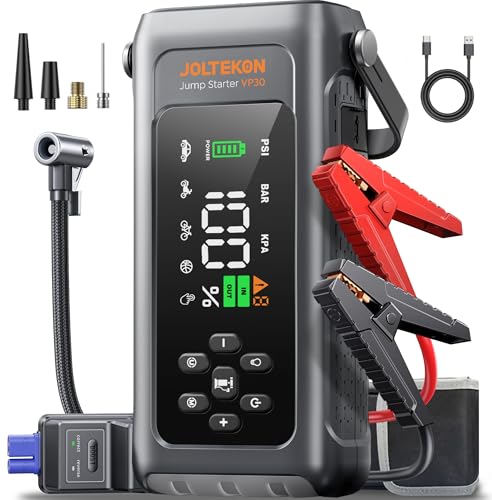
Best for all-in-one emergency capability. The Joltekon unit provides 4500A peak, supports 9L gas and 8L diesel engines, and includes a tire-inflation compressor with up to 150 PSI. It features multiple lighting modes, a robust clamp design, and 1000+ recharge cycles. This makes it a strong pick for those who want a single device covering starts, inflation, and light charging needs.
Who it’s for: Outdoor enthusiasts or drivers who need tire inflation alongside jump-start capability. Limitations: The integrated compressor adds to size and weight; may be overkill for urban daily use.
Buying Guide
What engine size and vehicle type should guide your pick?
Choose a jump starter rated for the engine size of your vehicle. For most passenger cars and smaller SUVs, 1000A–3000A units suffice. Larger trucks or diesel vehicles may require 4000A or higher to ensure reliable starts after a dead battery.
Power bank and charging features: are they important?
Many jump starters include built-in USB ports to charge phones and tablets. If you routinely need mobile charging in emergencies, prioritize models with higher-capacity power banks and multiple USB outputs. Some units also function as recharging banks for other devices.
Safety and ease of use: what protections matter?
Look for spark-proof protection, reverse polarity safeguards, and temperature monitoring. Auto-shutoff and clear LED indicators simplify safe operation, especially for first-time jump starts.
Portability versus capability: how to balance?
Smaller models are ultra-portable and easy to store, but may have lower peak amperage. Larger units provide more power and features, but require more storage space. Consider your typical use scenarios, travel habits, and how often you expect to perform jumps.
Additional features to consider
- Integrated LED lighting for nighttime use
- Multiple jump-start modes or “force start” options
- Air compressor capability for tire inflation
- Case or carrying handle for portability
- Compatibility with both gasoline and diesel engines
Maintenance and lifecycle considerations
Check expected jump-start cycles per charge and battery chemistries (lithium versus lead-acid). Some models advertise 1000+ starts per charge, which is useful for frequent users. Ensure you recharge after use to keep the unit ready for the next emergency.
Practical buying checklist
- Match engine size and vehicle type to amperage rating
- Assess portable power bank needs and USB ports
- Confirm safety protections and user-friendly indicators
- Evaluate added tools (air compressor, flashlight, SOS modes)
- Consider weight, dimensions, and included case
Frequently Asked Questions
- What size jump starter do I need for a typical sedan?
Most sedans respond well to 1000A–3000A units, depending on engine size and battery condition.
- Can I use a jump starter as a power bank for my phone?
Yes, many models offer USB outputs to charge phones and tablets.
- Is a jump starter safe for beginners?
Yes, with proper connections and following the manufacturer’s instructions, safety features help prevent sparks and incorrect connections.
- Will a higher amperage unit be heavier?
Typically yes; higher amperage units tend to be larger and heavier, so portability should be weighed against capability.
- What maintenance is needed after a jump start?
Recharge the unit fully as soon as possible after use to ensure readiness for the next emergency.
- Do these units work in cold weather?
Most models operate across a wide temperature range, but performance may vary with extreme cold or heat.