Choosing the right vacuum switch is essential for any woodworking setup that uses a miter saw. The best switches automate cleanup, prevent circuit overloads, and reduce dust in your shop. This guide highlights five top options, explaining who each is best for, and why they stand out.
Summary table of selected products:
- Ortis Automatic Vacuum Switch with Two Tool Outlets (B0CKPLQQST) — Best for multi-tool setups in small shops.
- SENCTRL Automatic Vacuum Switch for Power Tools (B0BFDB9MSB) — Best for users needing clear overload protection and rapid start/stop control.
- Palawell Automatic Vacuum Switch (B0GDXRRRWN) — Best for adjustable sensitivity and long hose setups.
- AWROY Tool-Activated Dust Control Switch (B0GTGS9W7P) — Best for simple 3-outlet setup and easy wiring.
- Ortis Vacuum Switch with Adjustable Threshold (B0CYGPMYDC) — Best for precise actuation control in varied tools.
Ortis Automatic Vacuum Switch With Two Tool Outlets

Best for: small shops that run multiple tools from one switch. This Ortis model provides two power-tool outlets, enabling simultaneous use of a miter saw and dust extractor without extra power strips. It offers three operation modes—auto, off, and on—with automatic switching to streamline starting sequences. A 1-second start delay plus a 7-second off delay helps prevent circuit overload and reduces airborne dust. Easy installation supports screw mounting or traceless wall-mounting adhesive.
Why it’s chosen: It combines dual-tool control with a practical auto-delay feature. The two outlets reduce clutter and simplify wiring, which is ideal for compact woodworking spaces. Caution: ensure your tools do not exceed the switch’s current rating when connected together.
SENCTRL Automatic Vacuum Switch for Power Tools

Best for: builders seeking strong overload protection and a clear manual override option. This SENCTRL unit adds a manual switch and three run modes (Auto, Off, On), plus a robust 14AWG, UL-certified cord capable of handling higher currents. The load-sensing feature delays the vacuum by 1 second if the tool draws more than 30W, reducing circuit stress during simultaneous tool startup. It emphasizes safety and reliability in busy shops.
Why it’s chosen: The combination of overload protection, large-current handling, and a visible, straightforward mode system makes it a solid choice for users with a mix of tools and frequent vacuum usage. Limitation: the manual switch adds wiring complexity for beginners.
Palawell Automatic Vacuum Switch With Adjustable Sensitivity

Best for: shops needing precise activation thresholds for different tools. Palawell offers 30W/60W selectable sensitivity, accommodating heavy-duty saws and lighter rotary tools without false triggering. It provides a 1-second power-on delay and customizable shut-off delays (3s/7s/10s) to align with hose length and cleanup needs. A 3.3-foot cord supports flexible wall mounting. The LED indicators make status quick to read in dim spaces.
Why it’s chosen: The adjustable thresholds and delay options allow tailored operation for varied tools, improving both safety and efficiency. Caution: ensure the selected threshold matches your typical tool current to prevent nuisance activations.
AWROY Automatic Vacuum Switch With 10s Delay-Off

Best for: workshops that want a simple 3-outlet setup with a reliable 10-second delay-off after tool shutdown. AWROY’s device turns on automatically when the connected tool starts and keeps the vacuum running for about 10 seconds to clear residual dust, then shuts off. Clearly labeled ports simplify wiring, making it a practical choice for straightforward dust-control workflows.
Why it’s chosen: The straightforward design and 10-second delay-off support steady dust management with minimal setup. Limitation: it emphasizes a single delay-off duration, which may not fit all dust collection lengths or hose configurations.
Ortis Automatic Vacuum Switch With Adjustable Actuation Threshold
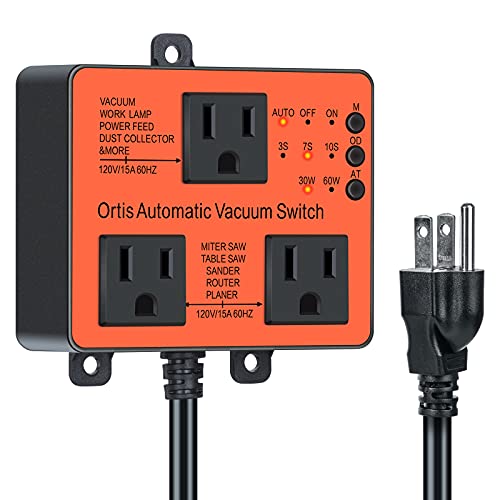
Best for: more advanced setups where precise control over activation is needed. This Ortis model adds a configurable actuation threshold, with two tool outlets and three run modes (Auto, Off, On). The adjustable threshold helps prevent false activations from standby current and enables better integration with a variety of tools, including miter saws. It also supports a customizable shut-off delay of 3s/7s/10s for tailored cleanup cycles.
Why it’s chosen: The ability to fine-tune sensitivity makes it ideal for workshops with mixed tool loads and longer dust paths. Caution: confirm your power budget to avoid exceeding switch limits when multiple tools are active simultaneously.
Buying Guide: How to Choose the Right Miter Saw Vacuum Switch
- Number of tool outlets: If you run multiple tools from a single station, a model with two outlets helps reduce cable clutter and power strips.
- Delay timing: Short delays (1s start, 3–7s off) suit quick-start workflows; longer delays suit long dust paths and extended cleanup.
- Adjustable thresholds: For mixed tools, adjustable 30W/60W or similar thresholds prevent nuisance activation or missed starts.
- Manual override: A manual on/off switch can be beneficial for precise control during sensitive tasks or testing.
- Cord and mounting options: UL-certified cords and multiple mounting methods enable easier installation on walls, carts, or benches.
- Safety and compatibility: Check that the device supports your current draw and is compatible with your miter saw and dust collection setup.
Practical Setup Tips
- Place the vacuum switch near your miter saw and dust collector to minimize cord runs.
- Label tool outlets to prevent cross-activation when changing tasks.
- Test the activation thresholds with your common tools to ensure consistent performance.
- Periodically inspect for heat buildup or loose mounting, especially in high-dust environments.
Frequently Asked Questions
- What is a vacuum switch for power tools? A vacuum switch automatically turns a dust collector on or off when connected tools start or stop, helping manage dust and protect circuits.
- Do I need a dual-outlet vacuum switch? Dual outlets are beneficial if you run more than one tool or accessory at the same time, reducing cable clutter and separate power strips.
- How is the delay setting useful? Delays prevent abrupt starts that could trip breakers and ensure thorough dust collection after a tool finishes.
- Can I use a vacuum switch with any miter saw? Most switches are designed for standard workshop tools; verify current ratings and compatibility with your specific miter saw model.
- What should I consider when choosing sensitivity? Higher thresholds prevent false activation from standby currents, but could delay vacuum start for light tools. Choose based on your typical tool load.
- Is mounting important? Yes. Secure mounting reduces movement and improves reliability in busy shops where tools are moved or repositioned often.