Discover compact wind-turbine options designed for education, demonstrations, and small-scale power experiments. This guide compares five micro wind turbine generators, highlighting how each unit converts wind energy into electricity, suitable applications, and key factors to consider before purchase. Whether you’re teaching physics, exploring renewable energy at home, or building a classroom demo, these devices offer hands-on learning about wind power generation.
| Product | Brand | Voltage Range | Best For | Notes |
|---|---|---|---|---|
| Small Wind Turbine Generator Micro DC Motor Power Wind Turbines | QINIZX | 0–36V | Educational demos, teen/ adult projects | Large blades; not for natural light winds |
| EUDAX DIY DC Power Micro Motor Wind Turbine | EUDAX | DC 3–12V | Science demonstrations, classroom kits | Compact, multiple voltage options |
| EUDAX Mini Generator Motors 3V-12V | EUDAX | DC 3–12V | DIY toys, experiments | Plastic motor holder included |
| 10w Micro Spiral Wind Turbine Generator Archimedes Rose | Generic | Varies with motor | Wind energy testing in light to moderate winds | Rose blade design, compact |
| Electricity Generator, Micro Wind Turbines Dc Motor | Walfront | DC 0.5–5V (typical demo range) | Hands-on wind power demos | Rotatable 360°, teaching tool |
Small Wind Turbine Generator Micro DC Motor Power Wind Turbines

QINIZX’s micro wind turbine operates with large, multi-blade 17.5 cm diameter blades designed to optimize wind energy capture. The device uses a DC 280 motor rated for 0–36V, with performance increasing as wind energy increases. It is noted for higher output at higher RPMs (e.g., 3800 rpm at 12V, 7600 rpm at 24V). The kit is targeted at teens and adults and is recommended for demonstrations rather than outdoor natural-wan wind due to the need for a directional drive; the product can generate electricity when driven by a fan or blower at the correct angle. The author emphasizes safety and supervision, as this is not a toy.
EUDAX DIY DC Power Micro Motor Wind Turbine
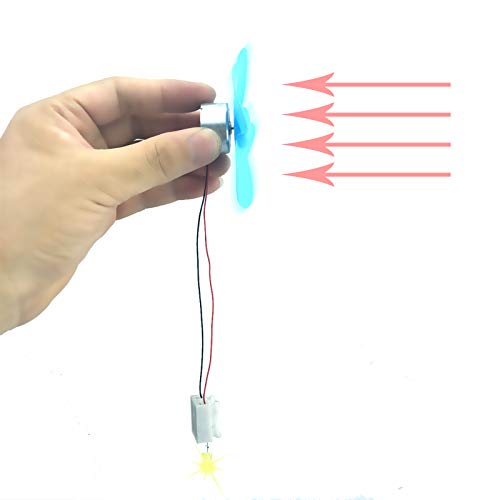
EUDAX presents a compact micro wind turbine generator kit suitable for teaching demonstrations. It showcases a DC power output with multiple voltage references (notably 3V, 4.5V, and 12V) and corresponding rated speeds (ranging from 1500 to 6500 RPM). The kit provides a straightforward platform for students to observe how wind energy translates into electrical energy through a small generator. Its simple design makes it a popular choice for classroom demonstrations and science fairs where hands-on exploration is encouraged.
EUDAX Mini Generator Motors 3V-12V DC Motor

This EUDAX model provides a small motor-based generator system with a 24 mm motor body diameter and a height of about 22 mm. It supports a range of voltages (3V to 12V) and RPMs (up to 6500 RPM), with a compact shaft size and a 14 cm lead length. The included plastic motor holder makes it convenient for experiments and DIY projects, such as creating micro wind-up devices or small wind-powered displays. It’s well-suited for science classrooms exploring the fundamentals of motor-to-generator energy conversion.
10w Micro Spiral Wind Turbine Generator Archimedes Rose

This model features a rose-shaped spiral fan blade design aimed at improving wind capture efficiency. The device integrates with a permanent magnet DC generator, promising low vibration, low noise, and a compact form ideal for portable demonstrations. The PAL material blades offer environmental durability—resistant to rust, corrosion, UV exposure, and damp conditions. It’s positioned for use in light to moderate wind environments and excels in classroom or display settings where a tangible wind-powered energy demonstration is needed.
Electricity Generator, Micro Wind Turbines Dc Motor

Walfront offers a 5.5 m/s wind-capable micro wind turbine system designed for teaching and experiments. The product emphasizes 360° rotatability to operate in any wind direction, making it a versatile teaching tool for wind power generation concepts. It’s marketed as a great resource for classrooms and DIY projects that aim to demonstrate how wind energy becomes electrical energy, comparing different orientations and blade configurations to optimize output.
Buying Guide: Key Purchase Considerations
- Wind source and environment: Many micro wind turbines require a directional drive or a sufficiently strong airflow for meaningful output. For indoor demos, a small fan suffices; outdoor natural wind may vary by location and weather.
- Voltage range and power needs: Consider the operating voltage (3V–12V typical in these kits) and the expected current. Match the device to what you plan to power or demonstrate, such as LEDs, small motors, or measurement instruments.
- Blade design and material: Blade diameter and blade count influence energy capture. Look for durable materials (e.g., PAL plastics, nubuck-finished blades) and blade geometry that suits your wind conditions.
- Generator type and efficiency: Permanent magnet DC generators are common in these kits. Evaluate RPM requirements to achieve target voltages and how efficiency scales with wind speed.
- Educational value and safety: Choose kits with clear instructional materials, assembly steps, and safety guidelines. For younger students, select simpler, safer designs with supervised use.
- Durability and maintenance: Consider blade protection, ease of assembly/disassembly, and replaceable parts. Durability matters for classroom use or frequent demonstrations.
- Portability and setup time: If you need quick demonstrations or travel between classrooms, pick compact, lightweight options with straightforward setup.
- Expansion potential: Some kits support adding additional blades, controllers, or optional measurement sensors. This can help scale experiments as you explore different wind scenarios.
- Cost vs. value: Compare multiple kits not only on price but also on the breadth of educational features, included hardware, and longevity of components.
- Safety and supervision: Especially with higher RPM outputs, ensure supervision and clear safety instructions to prevent injuries or damage to equipment.
Across these options, the core concept remains: wind energy is converted into electrical energy through rotating blades driving a generator. The best choice depends on your setting (classroom, home lab, or demonstration event), target age group, and how deeply you want to explore wind-powered generation. For outdoor demonstrations, prioritize robust blades and a generator with a broad, stable output. For indoor lessons, focus on ease of assembly, clear data collection opportunities, and safe operation.