If you’re searching for micro inverter solar panel kits, you want compact, reliable solutions that simplify installation and maximize panel output. This guide highlights five practical options, each suited to different buyers—from DIY hobbyists to RV travelers and small home setups. It covers who each product is best for, why it was selected, and potential limitations to consider. Below, a quick summary table helps you compare key points at a glance.
Quick comparison table
| Product | Best For | Key Benefit | Limitation |
|---|---|---|---|
| MHBXYZ Solar Micro Grid Tie Inverter | Small home or cabin setups needing LCD monitoring | High efficiency MPPT with LCD data display | Aluminum body, may be pricier |
| Y&H 1200W Solar Grid Tie Micro Inverter | Residential rooftops with IP65 protection | Real-time AC data and water-resistant design | DC input range up to 50V |
| FiueStur 600W Grid Tie Micro Inverter | Outdoor installations needing rugged build | IP65 waterproof and robust protection | 600W peak; smaller for large arrays |
| Yunseity Solar Micro Inverter 2000W | Modular solar arrays with independent module control | Individual module management and MPPT | Higher power; ensure compatible panels |
| ECO-WORTHY 200W Starter Kit | Beginner DIY projects and RV off-grid | All-in-one kit with panels, controller, inverter | Lower total system power |
MHBXYZ Solar Micro Grid Tie Inverter

Best for: Small residential or cabin setups that want LCD monitoring. The MHBXYZ unit combines a compact aluminum body with a high-precision MPPT circuit to boost solar harvest and transmit unused power back to the grid. The LCD display offers real-time readings of voltage, power, frequency, and current, helping you verify performance at a glance.
Why chosen: The combination of durable construction and precise MPPT helps maximize energy capture, potentially increasing output by over 25% in many installations. The 99.9% power transmission efficiency supports efficient grid interaction when regulations permit.
Caution: As with all grid-tie devices, ensure local grid interconnection rules are followed and that installation uses proper safety practices to prevent back-feed issues.
OLONETO 4000W/6000W Complete Solar Inverter Kit

Best for: Outdoor power needs where a complete kit is preferred. This package includes a 50A controller, a 12V solar panel, and a robust inverter for off-grid or hybrid use. The kit design emphasizes portability and straightforward setup for home or camping scenarios.
Why chosen: It provides a compact 50A charge controller with a ready-to-run inverter, making it a practical all-in-one choice for enthusiasts who want a simple upgrade to solar support without sourcing multiple components separately.
Caution: Verify your total load and inverter compatibility with existing devices; the listed continuous power should stay below your peak household demand to avoid overloading.
Y&H 1200W Solar Grid Tie Micro Inverter

Best for: Residential rooftops needing reliable IP65 protection. The Y&H micro inverter supports real-time power monitoring via an AC digital meter and provides a safer low-DC-voltage installation with MC4 input connections to protect polarity. It is suitable for single-phase or three-phase configurations depending on your setup.
Why chosen: Real-time monitoring and improved wiring solution reduce installation risk and simplify maintenance. The IP65 waterproof rating makes it a solid outdoor option for variable weather conditions.
Caution: Ensure compatibility with your PV panels’ voltage range and your local electrical code requirements for grid-tied systems.
FiueStur 600W Grid Tie Micro Inverter

Best for: Outdoor grid-tied setups requiring rugged protection. The FiueStur unit delivers 600W peak power with IP65 protection and an LCD interface for monitoring. It’s well-suited for compact solar arrays in variable climates and can be integrated into small off-grid hybrids.
Why chosen: The robust housing and protection features help ensure long-term operation in outdoor conditions. The LCD display supports quick diagnostics and performance checks on-site.
Caution: Its 600W peak capacity may be limited for larger roof arrays; plan system sizing to stay within the inverter’s peak output.
ECO-WORTHY 200W Solar Panel Starter Kit
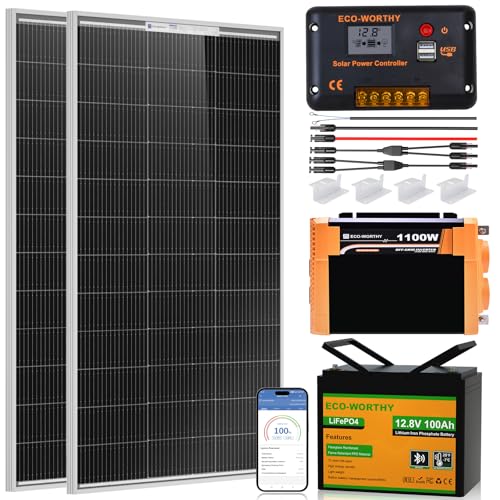
Best for: Beginners and RV users who want an all-in-one starter kit for off-grid power. This kit combines two 100W panels, a 12.8V battery, an inverter, and a 30A PWM controller for simple, guided setup.
Why chosen: It offers a straightforward entry into solar power with everything needed to start generating electricity quickly. The included inverter and battery provide immediate off-grid capability for basic loads.
Caution: This kit has lower total system power; scale up carefully if you plan to run higher-wattage appliances or longer off-grid periods.
Buying Guide: Practical Considerations For Your Micro Inverter Kit
What should you consider when choosing a micro inverter kit? Start with system goals, compatibility, and installation practicality.
- Power needs: Match inverter wattage to your expected load. Choose higher peak ratings if you plan to run multiple devices simultaneously.
- Voltage range: Ensure MPPT input voltage matches your solar panels. A narrow range can limit harvest, especially on taller arrays.
- Outdoor suitability: For outdoor installations, IP ratings (IP65) and corrosion resistance improve longevity in weather exposure.
- Monitoring: LCD or digital monitoring helps track performance, detect faults, and verify real-time energy production.
- Wiring and safety: Look for MC4 connections and properly rated wiring to minimize miswiring risks and electrical hazards.
- Expandability: If you expect future growth, choose a modular kit or one with easier add-ons to avoid reconfiguring your system.
How to compare these kits quickly
Consider the kit’s total power rating, whether it integrates a charge controller with panels, and the ease of installation. For outdoor use, prioritize IP65 protection and robust housings. For beginners, all-in-one starter kits streamline setup, even if they offer lower total wattage.
FAQ
- What is a micro inverter kit best for?
Best for small to mid-sized solar installations where module-level optimization and simple wiring reduce overall complexity.
- Do I need LCD monitoring with a micro inverter?
Not required, but it helps with immediate visibility of voltage, current, and power output for performance checks.
- Can micro inverters handle outdoor use?
Yes, especially models with IP65 or similar protection, though verify the weather rating for your climate.
- Are all-in-one kits easier for beginners?
Yes, they simplify sourcing and assembly, though you should still plan for your expected energy needs.
- How do I size a micro inverter for my roof?
Sum the wattage of connected devices and match it to the inverter’s continuous and peak ratings; avoid exceeding the peak rating of any single unit.
- What safety considerations matter?
Follow local electrical codes, secure proper grounding, and avoid reversing polarity on DC inputs.