Answer: For low RPM generator heads, choose units designed for gearless, high-efficiency operation at slow shaft speeds. These are best for wind or hydro setups where rotational speed is limited but steady power is needed. This guide highlights five reliable options suited for off-grid or renewable energy systems, with who they are best for and potential limitations.
Buyer’s quick reference table
| Product | Best For | Key Note |
|---|---|---|
| NorthStar Belt Driven Generator Head | Toolshed workshops and small turbines needing 120/240V outputs | Standard 20A 120V and 240V options |
| Lissontine 12000W Low Speed AC Generator Head | Wind or hybrid renewable projects | Gearless, permanent magnet design |
| EODSAD Permanent Magnet Synchronous Generator | Simple, dual-voltage charging and lighting | PM and full-wave stabilizer |
| WANGYYDS 12000W Low Speed AC Generator | Wind/water turbine builds requiring high output | Rare earth magnets, gearless |
| FRANREADER 12000W Low Speed Generator | Long-term wind or water projects | 3-phase PM with robust aluminum housing |
Note: This article uses product features as listed by the manufacturers. Always verify compatibility with your turbine, controller, and battery system before purchase.
NorthStar Belt Driven Generator Head
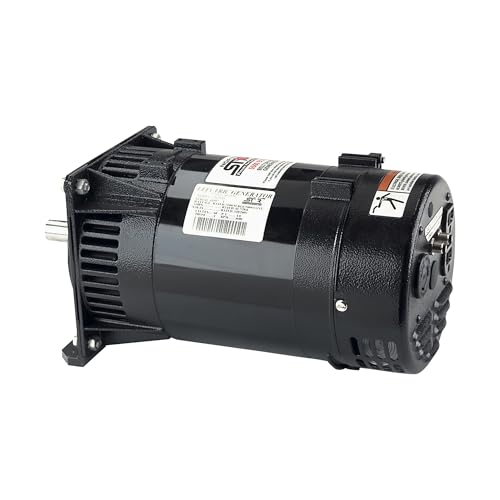
The NorthStar unit operates as a belt-driven generator head delivering 5,500 surge watts and 5,000 rated watts, requiring an 11 HP input. It provides two 20 Amp 120V receptacles and a 20 Amp 240V locking plug receptacle, compatible with NEMA 5-20R and NEMA L6-20R plugs. This setup is best for small off-grid shops or backup systems that demand steady 120V or 240V output. Best for users who want straightforward electrical integration with standard receptacles. Caution: ensure belt drive alignment and motor compatibility to avoid vibration or belt wear over time.
Lissontine 12000W Low Speed AC Generator

Designed for wind and hybrid systems, this 12,000W low-speed generator uses a permanent magnet design with a direct-drive setup. It claims high efficiency and stable output with a gearless configuration that reduces maintenance and noise. It is built with an aluminum housing for rugged environments and can handle wide temperature ranges (-40°C to 120°C). Best for wind-dominated sites or coastal installations where low start torque at low wind speeds matters. Limitation: direct-drive units may require compatible mounting and vibration isolation in DIY builds.
EODSAD Permanent Magnet Synchronous Generator

The EODSAD PMA unit combines a permanent magnet excitation with silicon rectification and a full-wave voltage stabilizer. It emphasizes dual-purpose charging and lighting, with a compact design intended to improve efficiency while reducing reliance on mechanical brushes. Best for small off-grid charging stations or lighting rigs where a simple, robust AC output is important. Caution: documentation emphasizes electric rectification features; verify compatibility with your battery charger and load profile.
WANGYYDS 12000W Low Speed Generator

WANGYYDS emphasizes rare earth NdFeB magnets and pure copper windings, delivering higher efficiency and stable power. The three-phase generator is die-cast aluminum with corrosion resistance, designed for gearless, direct-drive operation. Best for wind or hydro setups where longevity and high power density are essential. Better for installations needing robust housing and durable construction. Limitation: ensure ample cooling in hot environments to avoid performance throttling.
FRANREADER 12000W Low Speed Generator

The FRANREADER unit features a 3-phase permanent magnet design with a die-cast aluminum housing and NdFeB magnets. It emphasizes stable performance, reduced wear due to a brushless design, and resilience to corrosive environments. It is well-suited for wind or water turbine projects that require dependable, long-life operation. Choose this if you value low maintenance and a robust enclosure. Caution: confirm the voltage and frame size align with your system’s controller and switchgear.
Buying Guide — Key Considerations For Low RPM Generator Heads
- Voltage and phase compatibility: Ensure outputs match your controller or battery bank (12V/24V/48V; single or three-phase).
- Gearless design benefits: Gearless PM generators generally offer quieter operation and lower maintenance, but verify cooling needs for your site.
- Magnet material and winding: Rare earth NdFeB magnets with pure copper windings typically provide higher efficiency and longer life.
- Environmental resilience: Aluminum housings and corrosion resistance are important for marine, desert, or dusty environments.
- Mounting and integration: Check base mounting compatibility, shaft speed, and required drive components (belt or direct-drive).
- Temperature range: Consider devices rated to operate across wide temperatures if your locale experiences extremes.
Frequently Asked Questions
- What does low RPM mean for a generator head? It means the unit is designed to produce power efficiently at slower shaft speeds, often suitable for wind or hydropower sources with variable speeds.
- Are gearless generators better for my off-grid setup? Gearless designs reduce mechanical complexity and maintenance, but cooling and enclosure considerations are important.
- Can I use these with a standard inverter? Yes, but ensure voltage, phase, and frequency compatibility and include proper protection devices.
- Do these units require special mounting? Most require a solid base and may need vibration isolation; verify mounting dimensions in the product specs.
- What maintenance is typical for PM generators? Regular inspection of bearings, belts (if belt-driven), and cooling pathways is advised; brushless designs reduce wear.
- Are these suitable for DIY wind turbines? Yes, many are designed for use with wind turbines, but ensure turbine matching and electrical safety.