The search for a lightweight 3000-watt generator combines portability with reliable power. This guide highlights five compact models that balance weight, runtime, and quiet operation, making them suitable for camping, tailgating, or home backup. Each selected unit emphasizes efficient power delivery without sacrificing convenience or safety.
Summary Of Chosen Products
| Product | Key Strengths | Weight (approx.) | Fuel Type |
|---|---|---|---|
| PowerSmart 3000-Watt Portable Inverter Generator (CO Protect) | Quiet, portable, CO protection | 52 lb | Gas |
| PowerSmart 3000-Watt Portable Inverter Generator Gas Powered | Compact, easy to carry, camping-ready | 52 lb | Gas |
| Honda EU3000IS1AN 3000-Watt Inverter (CO-MINDER) | Reputable reliability, long run on tank | ~140 lb | Gas |
| DABBSSON 3000L Solar Generator | Solar-ready, high capacity, compact for class | Lightweight for capacity | Solar + AC |
| FIRMAN Inverter 3300W Whisper Series | Very quiet, fuel-efficient | ~109 lb | Gas |
Note: Each product prioritizes a balance of 3000-watt output with reduced weight and noise. Specifications below reflect typical configurations and may vary by model or production run.
PowerSmart 3000-Watt Inverter Generator With CO Protect
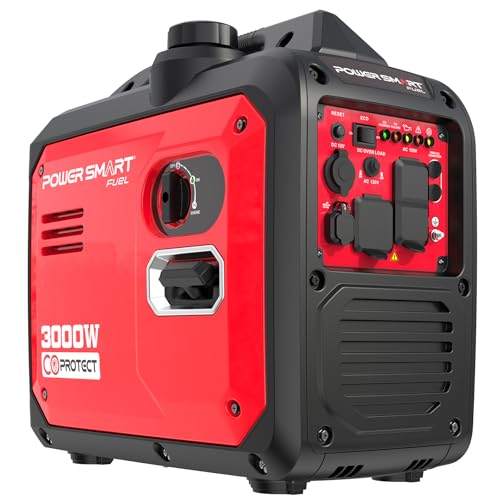
This model delivers 3000 starting watts and 2600 running watts with a clean power profile (less than 3% THD). It runs about 5 hours at 50% load, and weighs approximately 52 pounds, making it a practical choice for campers and light home backup. It features a built-in handle for easy carrying and a quiet operation level of 52 dBA from 23 feet at 25% load, increasing usability around quiet zones and gatherings. Built-in CO protection adds a safety layer for outdoor use and urban campsites.
PowerSmart 3000-Watt Gas Powered Inverter for Camping

This gasoline-powered variant mirrors the same 3000 starting watts and 2600 running watts, with a 5-hour runtime at 50% load. It also weighs about 52 pounds and includes a built-in handle to aid in transport. Quiet operation sits around 52 dBA from 23 feet at 25% load, rising to about 59 dBA at full load. The compact design and similar runtime make it a strong alt for users prioritizing mobility and dependable backup power in outdoor settings.
Honda EU3000IS1AN 3000-Watt Inverter with CO-MINDER

Honda’s EU3000IS1AN offers 3,000 starting watts and 2,800 running watts, powered by a 3.4-gallon tank for extended runtimes. With Honda’s GX200 engine and a CO-MINDER feature, it emphasizes safety and reliability for home backup or camping. It runs efficiently, and from a 23-foot distance, the motor operates at about 57 dBA. While heavier than portable camp models, it remains a trusted option for users prioritizing long-term performance and Honda’s service network.
DABBSSON 3000L Solar Generator With Charger

The DABBSSON 3000L offers a high-capacity 3072Wh semi-solid LiFePO4 system with a 560W alternator charger and multiple AC outputs (up to 3000W AC output). It’s designed for RVs, camping, and home use, with features aimed at safety and durability, including a UL94-V0 fire-resistant design. It emphasizes fast charging (up to 6X faster on road) and extended runtime thanks to advanced BMS protection. The model is notably portable for its capacity and includes an integrated LED light for emergencies.
FIRMAN Inverter Portable Generator, Whisper Series

The FIRMAN Whisper Series provides a 3300W output with a compact 171cc engine. It runs for up to nine hours on a typical fuel load, and its inverter technology ensures stable power with low total harmonic distortion. The unit is designed for quiet operation—an important attribute when using generators in residential or campground environments. While it weighs more than some ultralight models, its efficiency and run time make it a viable option for longer outings or backup situations where portability remains essential.
Buying Guide: Key Purchase Considerations
- Power output and suitability: Ensure the generator provides adequate starting and running watts for your devices. A true 3000-watt rating with a clean power output helps avoid damage to sensitive electronics.
- Weight and portability: If you plan to transport the unit regularly, prioritize models around 50–60 pounds with a comfortable carrying handle or wheel kit.
- Noise level: Look for models rated around 50–60 dBA at a reasonable distance for acceptable campsite or home-use noise, especially if you’ll be near sleeping areas or neighbors.
- Fuel type and efficiency: Gasoline options offer quick refueling, while solar-assisted models provide silent operation and longer-term energy storage potential. Consider runtime at a practical load and fuel tank size.
- Starting mechanism: Electric start provides convenience; some units offer manual recoil as a backup. For frequent camping, a dependable start is beneficial under varying weather conditions.
- Safety features: CO protection, automatic low-oil shutdown, and CO-MINDER certifications help reduce risk in outdoor or semi-enclosed spaces.
- Runtime and fuel consumption: Longer runtimes reduce the need for frequent refueling during outings. Compare efficiency ratings alongside tank size or battery capacity.
- Maintenance and support: Reputable brands with accessible service networks help ensure ongoing reliability and easier parts replacement.
- Portability versus capacity: Heavier models may offer longer run times or higher peak output, but weigh the trade-off against transportability for your typical use case.
- Parallel capability: If you anticipate needing more power, check whether the model supports parallel operation with another unit.
When selecting a 3000-watt option, weigh the balance among weight, noise, and runtime against your primary use—camping, tailgating, or home backup. Solar-ready or CO-protected models add safety and flexibility. Consider your typical travel distance to your power needs and the environment where the generator will operate to choose the most suitable balance of features.