The best lightweight solar panels deliver reliable power without adding excessive weight to your vehicle, boat, or camping setup. This guide highlights five top options that balance portability, efficiency, and ease of installation. Ideal buyers include RV and van lifers, boaters, hikers, campers, and anyone needing flexible, easy-to-mount panels for curved or irregular surfaces. Below is a quick comparison to help you decide which lightweight panel fits your needs, followed by detailed product insights and a practical buying guide.
| Product | Brand | Best For |
|---|---|---|
| Renogy 100W Flexible Panel | Renogy | Curved surfaces on RVs, boats, vans |
| Topunive 100W Flexible Panel | Topunive | Irregular surfaces and off-grid setups |
| Renogy 200W Flexible Panel | Renogy | Higher daily power on curved surfaces |
| DOKIO 100W Flexible Panel | DOKIO | Lightweight mobility for camping and travel |
| FlexSolar 100W Portable Panel | FlexSolar | Portable power for small devices and emergency use |
Renogy 100W Flexible Solar Panel
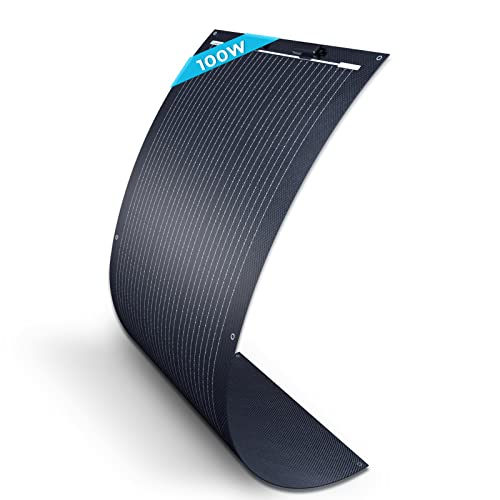
Best for curved surfaces on marine vessels, RVs, and campers where a low-profile, bendable panel is needed. This 100W panel uses half-cut PERC technology to enhance light capture and output efficiency. It weighs about one-third that of a rigid panel and presents a glare-free, all-black appearance, making it a discreet choice for sleek installations.
Who it’s best for: buyers needing a lightweight, flexible solution on curved roofs or deck areas where rigid panels won’t fit. Why selected: high power per weight, bendability within 240 degrees, and improved efficiency from PERC technology.
Caution: ensure proper mounting on surfaces that can tolerate flexing and avoid placing directly on heated or irregular substrates where clearance is limited.
Renogy 200W Flexible Panel

Best for higher daily energy needs on curved installations, such as large RV roofs or cabin campers. The 200W flexible panel shares the same 240° bendability as the 100W version and features half-cut PERC technology to maximize efficiency. It weighs about half of a comparable rigid panel, making it a strong balance of power and portability.
Who it’s best for: users requiring more daily energy without sacrificing flexibility. Why selected: higher wattage with similar flexibility and advanced cell tech to boost output.
Caution: handling and mounting require careful attention to weight distribution and surface temperature to prevent stress damage over time.
DOKIO 100W Flexible Panel

Best for travel-oriented, off-grid charging where ultra-lightweight and compact dimensions matter. This panel weighs about 2.3 lb and is 0.03 inches thick, designed for easy portability. It safely flexes up to 30° to fit curved surfaces on vans, campers, boats, and tents.
Who it’s best for: hikers, campers, and travelers seeking a truly portable solar option. Why selected: exceptionally light and thin with a moderate bend radius for irregular surfaces.
Caution: not a permanent roof replacement; ensure ventilation and avoid direct mounting on combustible materials or trapping heat beneath the panel.
FlexSolar 100W Portable Panel

Best for emergency power and small device charging when weight matters. This 100W foldable panel uses PD3.0 USB-C, USB-A, and DC outputs, with a high-efficiency monocrystalline design for reliable charging in varied conditions. It folds compactly and includes a carry bag for portability.
Who it’s best for: those needing a portable power source for devices, small power stations, or quick camping trips. Why selected: versatile outputs, foldable form, and strong efficiency in a compact package.
Caution: best suited for mobility and temporary setups; avoid relying on it for permanent, high-load power needs.
Buying Guide: Lightweight Solar Panel Considerations
- Weight versus power: How much energy do you need daily, and how much weight can your vehicle carry?
- Flexibility and mounting: Do you need a panel that conforms to curved surfaces or irregular roofs?
- Cell technology: Half-cut PERC cells improve efficiency; 9BB cells can boost output and durability on flexible modules.
- Durability and weatherworthiness: Look for ETFE or similar protective laminates and IP ratings. Foldable panels should have robust hinges and protective layers.
- Portability: Consider foldable designs with carrying cases for easy transport and deployment.
- Outputs and compatibility: Ensure available DC, USB-C, and USB-A ports fit your devices and power stations.
- Temperature and shade performance: Cells perform differently in heat and partial shading; plan for shade management and ventilation when installing.
Frequently Asked Questions
- What is considered a lightweight solar panel?
Lightweight panels typically weigh under 5 pounds for portable options and under 10 pounds for certain flexible modules, prioritizing portability and easy installation.
- Are flexible solar panels durable on curved surfaces?
Yes, many flexible panels are designed to bend up to 240 degrees, enabling mounting on curved RV roofs, boats, and irregular surfaces. Follow mounting guidelines to prevent damage.
- Should I choose a higher wattage panel for camping?
Choose higher wattage if your daily power needs are substantial or if shade and weather reduce energy. Heavier panels may still be preferable for higher daily output.
- What maintenance is required for portable solar panels?
Keep surfaces clean, avoid crushing or bending beyond recommended limits, and store in a protective bag when not in use to extend life.
- Can I mix lightweight panels with a larger rigid array?
Yes, but ensure the system voltage and current match the charge controller and battery bank, and manage different performance characteristics under real-world conditions.