Powering camping trips with reliable, clean electricity is essential for comfort and safety. This guide highlights five inverter generators well suited for camping, caravans, and outdoor adventures. Each option balances portability, quiet operation, and clean power suitable for sensitive electronics. Read on to find which unit best fits your camping style—whether you’re a weekend camper, a full-time RV traveler, or a family needing emergency backup power. The table below compares key specs at a glance.
| Product | Best For | Running Watts | Weight | Fuel Type |
|---|---|---|---|---|
| PowerSmart 3600-Watt Portable Inverter Generator | Mid-size RV trips, high-demand appliances | 3200 | ~ | Gas |
| Oxseryn 2800-Watts Portable Inverter Generator | Lightweight camping, emergency backup | 2000 | ~39 lbs | Gas |
| PowerSmart 3800W Portable Inverter Generator | Quiet, mid-range power for campsites | 3200 | ~52 lbs | Gas |
| Oxseryn 4400-Watts Inverter Generator | RV camping with higher power needs | 3400 | ~ | Gas |
| All Power America 2000W Portable Inverter Generator | Lightweight backpacking and small tools | 1800 | ~40 lbs | Gas |
PowerSmart 3600-Watt Portable Inverter Generator

This unit provides 3600 starting watts and 3200 running watts, powered by a 149cc 4-stroke OHV engine. It is intended for campers who need to run RV air conditioners, refrigerators, and power tools with stable output. With advanced inverter technology, it maintains a clean sine wave (THD under 3%), protecting sensitive electronics like laptops and smartphones from voltage spikes. A 1.3-gallon fuel tank supports up to eight hours at 25% load, making it suitable for overnight use or longer trips without frequent refueling.
Best for: Campers who require higher surge power for RV air conditioning and robust appliances while prioritizing clean power. Limitations: Moderate weight means slightly less portability for hikers or backpackers.
Oxseryn 2800-Watts Portable Inverter Generator

With 2800 peak watts and 2000 running watts, this 79.8cc engine generator targets lightweight camping and home backup needs. Its 1.1-gallon fuel tank supports up to nine hours at 25% load, and it includes ECO mode and parallel capability to expand power when needed. It offers multiple outputs (two 120V AC ports, one 12V DC port, one USB port, and one Type-C port) to cover phones, laptops, cameras, drones, and small devices.
Best for: Campers seeking a compact, versatile option with multiple ports and energy-saving ECO mode. Limitations: Lower running watts mean it’s not ideal for running large RV air conditioning or heavy appliances simultaneously.
Oxseryn Power Equipment 4400 Watts Inverter Generator
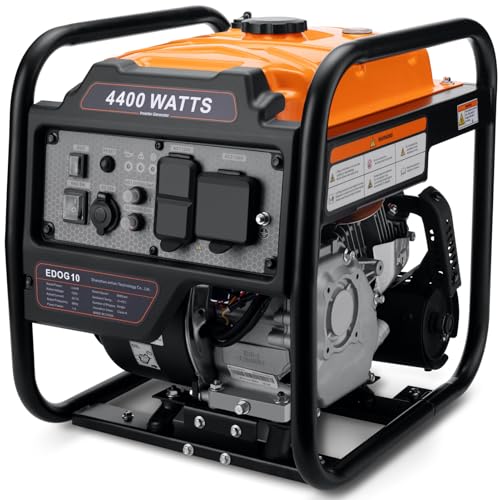
This open-frame generator delivers 4400 peak watts and 3400 running watts, making it a strong choice for RV setups and longer camping stays. It provides two 120V outlets, a 12V DC port, and an RV port, with up to 14 hours of runtime at 25% load thanks to a two-gallon tank and ECO mode. The inverter technology and Eco mode help keep output stable for sensitive electronics while offering extended run time for overnight activities.
Best for: Campers who need higher sustained power and RV readiness. Limitations: It’s larger and heavier than smaller models, potentially reducing portability for hikers.
PowerSmart 3800W Portable Inverter Generator

This model delivers 3800 starting watts and 3200 running watts with a 59 dBA noise footprint at 23 feet, making it one of the quietest options in its class. It is described as lightweight for its power class, at roughly 52 pounds, and is parallel-ready, allowing two units to be linked for extra capacity. The clean sine wave (<3% THD) protects electronics during outages or outdoor adventures, especially in quiet campgrounds.
Best for: Campers who prioritize quiet operation and the possibility to scale power with a second unit. Limitations: Higher weight than the smallest campers may affect portability.
WEN 6800-Watt Dual Fuel RV-Ready Inverter Generator

This dual-fuel model runs on gasoline (6800 surge, 5100 rated) or propane (6000 surge, 4500 rated). It includes a Bonded-neutral 240V configuration for Level 2 EV charging compatibility and a CO watchdog to improve safety in enclosed spaces. It is designed for RV use and backup power, offering significant surge capacity for heavy-duty camping setups and home backup scenarios.
Best for: Campers needing substantial power flexibility and emergency backup capabilities. Limitations: Higher fuel consumption and weight compared to smaller units.
WEN 4800-Watt Dual Fuel RV-Ready Inverter Generator

This model delivers 4800 surge watts and 4000 running watts with dual-fuel capability (gasoline or propane). It emphasizes quiet operation and clean power to protect electronics, suitable for camping and RV environments where noise restrictions apply. It includes CO watchdog protection to enhance safety in temporary living spaces, making it a practical choice for extended outdoor stays.
Best for: Campers who want robust power with good noise management and dual-fuel flexibility. Limitations: While powerful, it’s not the lightest option for backpacking scenarios.
Buying Guide: Key Purchase Considerations
- Power needs: Match running watts to your essential devices. For RV ACs and refrigerators, prioritize models with 3000–3400 running watts and a healthy surge rating.
- Noise level: Look for units labeled as quiet or with a decibel rating around 50–60 dBA at a practical distance to avoid campsite disturbances.
- Fuel capacity and runtime: Consider tanks large enough to cover overnight camping without frequent refueling; ECO mode can extend runtime when load is light.
- Portability: Check weight and handle design. Lighter units are ideal for hikers and tent campers; heavier units suit vehicle-based camping or RVs.
- Power quality: Inverter technology with THD under 3% protects sensitive electronics like laptops and cameras.
- Safety features: CO watchdog, automatic low-oil shutdown, and overload protection help reduce risk in camping and home backup scenarios.
- Parallel capability: If you expect higher power needs, choose models that support pairing with another inverter for extra capacity.
- Fuel type and availability: Gasoline is common, but propane-compatible models can be convenient for long trips without storing gasoline.
Frequently Asked Questions
- What size inverter generator do I need for camping?
Choose a model with enough running watts to power your essential devices, such as lights, small appliances, a microwave, or a mini-fridge. For moderate camping with a RV AC, aim for 3200–3400 running watts or higher with a solid surge rating.
- Are inverter generators quieter than conventional ones?
Yes. Inverter generators are engineered to run at variable speeds and produce cleaner power with lower noise levels, typically 50–60 dBA at practical distances.
- Can I run sensitive electronics on an inverter generator?
Yes. Inverter power with THD under 3% is suitable for laptops, cameras, and other electronics that require stable voltage and frequency.
- Should I buy a dual-fuel inverter generator?
Dual-fuel models offer flexibility if you have both gasoline and propane sources, which can be advantageous for long trips or when gasoline is scarce.
- Is parallel operation worth it?
Yes for expanding capacity. If you anticipate needing more power than a single unit provides, ensure the generator supports parallel connections.
- What maintenance is required for camp-ready generators?
Follow manufacturer guidelines for oil changes, air filter checks, spark plug inspection, and proper fuel stabilization to ensure reliable performance in outdoor settings.