Looking for the right inverter battery setup for off-grid, RV, or home backup needs? This guide highlights five versatile inverters that are easy to compare for buyers shopping online. Each product is evaluated for who it’s best for, what it can power, and practical limitations to consider before you buy.
Summary of selected products:
| Product | Best For | Key Strength | Limitations to Consider |
|---|---|---|---|
| Aninerel 12000W Solar Hybrid Inverter | Large off-grid or microgrid setups needing high surge and expandability | High continuous output, dual MPPT, parallel up to 6 units | High power; requires appropriately sized PV and battery system |
| ECO-WORTHY 3000W 12V Inverter Charger | Full-size off-grid or RV systems needing UPS and battery charging | 3kW inverter with 25-100A adjustable charging | Higher installation needs; quality integration with batteries |
| ECO-WORTHY 1000W Pure Sine Wave Inverter Charger | Home or RV backup with 12V battery support and UPS | UPS mode with 20ms switch; robust protection | Limited peak capacity compared to 3kW units |
Note: This article uses objective product data to help you compare options for online purchasing. It avoids unverified claims and focuses on what buyers care about: compatibility, performance, and practical trade-offs.
Aninerel 12000W Solar Hybrid Inverter

The Aninerel model converts 48V DC from solar panels or batteries into 120V single-phase or 240V split-phase AC. It delivers 12,000W continuous output with a 24,000W peak, making it suitable for heavy-duty appliances and daily loads. It supports parallel connection of up to six units, enabling a total output up to 72kW. The device includes two MPPT solar charging controllers and a max battery charging current of 220A, increasing harvest efficiency and allowing compatibility with high-voltage PV arrays up to 500VDC.
Best for: Home, workshop, or off-grid systems that require scalable, high-output power and fast charging. Choose this if you plan to run substantial loads or expand capacity with multiple inverters. Best for: users who want 3-phase options achieved via parallel units.
Caution: Parallel configurations require proper wiring and electrical planning to ensure balanced loads and safe operation. Data notes assume standard PV array and battery configurations; verify local code compliance before installation.
Power Inverter for Bauer 20V Battery

This 220W portable inverter is designed for Bauer 20V batteries, turning DC into 110-120V AC with additional USB and Type-C outputs, plus a 200-lumen LED light. It’s compact and suited for emergency power, outdoor use, and light back-up needs. It provides a practical, on-the-go solution when a full home backup is unnecessary.
Best for: outdoor enthusiasts or emergency kits needing compact, portable power with multiple output options. Better for: smaller electronics and devices rather than high-draw appliances. Limitation: It is not a high-capacity solution for larger loads or sustained power.
ECO-WORTHY 3000W Pure Sine Wave Inverter Charger

The ECO-WORTHY 3000W unit combines a 3000W pure sine wave inverter with a 25A to 100A adjustable charger. It supports UPS mode with a 30ms transfer time, protecting connected devices during grid failures. It is compatible with a wide range of 12V battery chemistries, including LiFePO4 and various lead-acid types, and aims to simplify installation for home, RV, or off-grid setups.
Best for: larger off-grid or RV systems needing both significant inverter power and flexible charging. Choose this if you want UPS capability and wide battery compatibility. Limitation: Higher capacity units require careful setup and adequate ventilation to maintain performance.
EFFORTWAY 500W Power Inverter
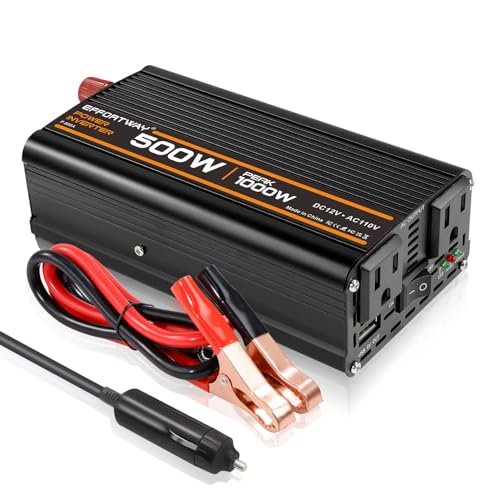
The EFFORTWAY inverter converts 12 V DC to 110 V AC with continuous 500W and peak 1000W. It includes a car cigarette lighter plug and battery clamps, plus USB and power delivery options for charging multiple devices. It is designed for camping, road trips, and quick power in mobile scenarios.
Best for: budget-conscious users needing portable power for camping or roadside use. Better for: smaller devices and charging scenarios rather than heavy appliances. Limitation: Automotive-style power limits may restrict use with high-energy appliances or sustained loads.
ECO-WORTHY 1000W Pure Sine Wave Inverter Charger

This 1000W inverter charger offers a UPS mode with a 20ms transfer to battery power, providing a stable, uninterrupted supply during grid outages. It includes 12V to 110V pure sine wave output and multiple protections to safeguard connected devices. It supports multiple battery chemistries and is suitable for RVs or small homes.
Best for: users needing reliable backup with automatic switchover and broad battery compatibility. Choose this if you want a balanced size-to-power ratio and integrated charging capabilities. Limitation: Not as much surge capacity as higher-watt models for heavy appliances.
Buying Guide: Key Considerations for Inverter Battery Shopping
- Power needs: Compare continuous vs. peak wattage. If you run high-draw appliances (microwave, well pump), prioritize higher peak power and surge capacity.
- Battery chemistry compatibility: Confirm support for LiFePO4, AGM, GEL, or lead-acid. Some inverters handle multiple chemistries; others are targeted to one type.
- Ups and UPS transfer time: For grid-tied setups or home backup, look for UPS features with fast transfer times (e.g., 20ms or less).
- PV integration: If using solar, check MPPT capability, maximum PV input voltage, and whether parallel operation is supported for expandable power.
- Warranty and safety features: Prioritize units with protections against overvoltage, overcurrent, short circuit, and temperature; verify installation requirements.
- Form factor and installation: Consider space, ventilation, and whether the unit is portable or fixed. Parallel units require proper electrical design.
- System compatibility: Ensure the inverter matches your battery bank voltage (12V, 24V, 48V, etc.) and the intended AC output configuration (110/120V vs. 220–240V).
Frequently Asked Questions
- What is a pure sine wave inverter?
A pure sine wave inverter delivers smooth, clean AC power suitable for sensitive electronics and appliances, mirroring utility-grid power.
- Do I need MPPT inverters for solar charging?
MPPT controllers maximize solar harvest by tracking voltage and optimizing current, improving efficiency in varying light conditions.
- What is UPS mode in inverters?
UPS mode automatically switches to battery power within a short transfer time when grid power fails, protecting loads from interruptions.
- Can I run multiple inverters in parallel?
Yes, parallel operation increases total power and surge capacity, but it requires proper configuration and adherence to safety standards.
- Which battery type should I pair with these inverters?
Common options include LiFePO4, AGM, and GEL batteries. Check inverter compatibility and charging parameters for best results.