Understanding your industrial charging needs is essential for keeping fleets, service trucks, and work vehicles ready. This guide highlights five capable car battery chargers designed for heavy use, durable construction, and precise control. Each product targets a slightly different buyer: fleet operators seeking high starting power, DIY pros needing smart auto features, and seasonal users requiring reliable maintenance and repair modes. The selections cover 12V and 6V/12V setups, multiple battery chemistries, and built-in safety features. Use the quick-reference table to compare key specs at a glance.
| Product | Best For | Key Benefit | Limitations |
|---|---|---|---|
| Schumacher SC1445 | Fleet garages and service bays | 250A engine start, 135-minute manual control | Heavier unit, manual operation |
| TowerTop 12V Charger | Auto shops needing smart automation | 4 current settings, auto start, desulfator | Best with compatible 12V batteries |
| NOCO GENIUS1 | Small fleets and DIY pros | Compact, multi-chemistry support, temperature sensing | Lower current for heavy starting tasks |
| Schumacher SC1280 | Everyday drivers and hobby fleets | Automatic 12V/6V detection, trickle/float mode | Limited high-amp starting power |
| YONHAN 20A Charger | Winter storage and long-term maintenance | 20A max, repair/pulse mode, multi-protection | Not a jump-starter |
Schumacher Electric Wheeled SC1445 250A Engine Start Charger

The Schumacher SC1445 integrates a 250-amp engine start with 135-minute manual charging control. It is built for durability with a steel case, solid wheels, and a retractable handle, making it suitable for garages and fleet bays. Best for high-demand scenarios where quick recovery of dead batteries is critical, such as trucks or marine fleets. A potential limitation is its larger form factor, which may require dedicated storage space in busy workshops.
TowerTop 12V Smart Car Battery Charger (4 Current Settings)

TowerTop offers four adjustable settings (2A/10A/25A/AUTO) and an 85% efficiency, enabling rapid charging for large batteries and energy savings. The unit automatically detects battery status and starts charging within 30 seconds if forgotten to press Start. It remembers last settings after power outages and supports 12V sealed lead-acid batteries across various chemistries. Choose this if you want an all-in-one charger with automatic safety features; note that it targets standard 12V systems and may not jump-start very old or severely discharged batteries.
NOCO GENIUS1: 1A 6V/12V Smart Battery Charger
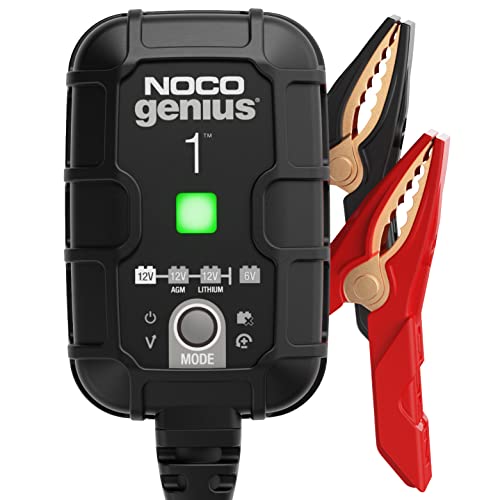
NOCO GENIUS1 serves as an all-in-one charger, maintainer, trickle charger, and desulfator. It supports multiple chemistries including lead-acid and LiFePO4, with an integrated thermal sensor to prevent overcharging in heat and undercharging in cold conditions. Best for small fleets or maintenance setups where space is limited and precise, temperature-adjusted charging is valuable. A limitation is the lower current rating, which is less suited for heavy engine starts or very large battery banks.
Schumacher Electric SC1280 12V/6V Trickle Charger Maintainer

SC1280 combines automatic voltage detection with a 15A rapid charge and a maintain/float mode, making it a strong pick for automotive and marine batteries. It is ideal for everyday drivers and hobby fleets that need reliable maintenance plus occasional fast charging. Best for long-term battery health in storage and seasonal vehicles; it may not provide high-amp starting power for large industrial fleets.
YONHAN 20A 12V/24V Battery Charger With Repair Mode

The YONHAN charger supports 12V and 24V systems with a 20A max output, winter and smart repair modes, and robust protections. It is designed for AGM, GEL, Deep Cycle, and similar batteries and offers pulse repair to reactivate sulfated cells. Best for seasonal vehicles and long-term storage scenarios where batteries require occasional revival and maintenance. It should not be used as a jump starter for completely dead batteries.
Buying Guide
What should you consider when choosing an industrial car battery charger?
- Starting power vs. maintenance: If you need to start engines quickly, prioritize high-amp models like the Schumacher SC1445. For long-term battery health, maintenance-focused chargers like the SC1280 or NOCO GENIUS1 are ideal.
- Battery chemistry compatibility: Look for chargers that support lead-acid variants (AGM, GEL, flooded) and, if needed, LiFePO4 compatibility as with NOCO GENIUS1.
- Automation level: Fully automatic chargers detect battery status and adjust charging automatically. Manual control is useful for precise tailoring, as seen in the SC1445.
- Auto shutoff and safety: Features like automatic shutoff, reverse polarity protection, and temperature compensation improve safety in busy workshops.
- Portability and durability: Wheeled units are easier to move in a service bay, while compact units save space in smaller shops.
- Winter and repair modes: For seasonal storage, look for winter modes and pulse repair functions to extend battery life.
Frequently Asked Questions
- What is the difference between a battery charger and a jump starter? A jump starter provides a high current burst to start an engine; a charger reconditions and charges the battery, with some models offering engine-start features.
- Can I use a 12V charger on 6V batteries? Some models support both 6V and 12V, but always verify compatibility with the battery you are charging to avoid damage.
- Do smart chargers automatically stop charging? Yes, many models automatically detect battery status and transition to maintenance or float modes when full.
- Is a higher amperage charger always better? Higher amperage reduces charging time for large batteries but can overcharge small batteries if not properly managed. Choose based on battery size and usage.
- Are desulfation or repair modes effective? Pulse repair modes can help recover sulfated lead-acid batteries, but may not revive a completely dead battery.
- What safety features should I look for? Look for reverse polarity protection, overcharge protection, temperature compensation, and automatic shutoff for safe operation in busy environments.