Propane-powered home backup generators offer a clean, stable fuel source with remote start, transfer switch compatibility, and robust runtime. This guide highlights five reliable models that support propane operation, detailing their features to help American homeowners choose a dependable power solution for outages, extreme weather, or off-grid living. Each option balances portability, performance, and ease of use while emphasizing safe operation and long-term durability during critical power events.
| Product | Brand | Fuel Type | Key Strength |
|---|---|---|---|
| Westinghouse 12500 Watt Dual Fuel | Westinghouse Store | Gas/Propane | Remote start; Transfer switch ready; Large capacity |
| Westinghouse 14500 Peak Watt Tri-Fuel | Westinghouse Store | Gas/Propane/Natural Gas | Highest peak power; long runtime |
| A-iPower 4600W RV-Ready Quiet Inverter | A-iPower Store | Gasoline/Propane | Inverter, lightweight, CO sensor |
| WEN 4750-Watt Dual Fuel | WEN Store | Gas/Propane | Dual fuel; wheel kit; electric start |
| Westinghouse 6500 Watt Dual Fuel | Westinghouse Store | Gas/Propane | Multiple outlets; transfer switch ready |
Westinghouse 12500 Watt Dual Fuel Generator

The Westinghouse 12500 Watt Dual Fuel Generator provides flexible fuel options with dependable performance during outages. Operating on gasoline yields 9500 running watts and 12500 peak watts, while propane delivers 8500 running watts and 11200 peak watts. It features a remote start with a key fob, plus both electric and recoil start capabilities. A 6.6-gallon tank delivers up to 12 hours of runtime, depending on load. The unit includes essential outlets: two GFCI 120V receptacles, a 30A transfer switch-ready receptacle, and an RV-ready 50A outlet, all with protective rubber covers for safety. A 457cc Westinghouse engine with a digital hour meter and VFT display provides real-time voltage, frequency, and hours data for informed operation.
Westinghouse 14500 Peak Watt Tri-Fuel Generator

Designed for larger homes, the Westinghouse 14500 Peak Watt Tri-Fuel model supports gas, propane, and natural gas. It delivers 11,500 running watts on gasoline, 13,500 peak watts, and 10,500 running watts on propane, with 12,000 peak and 9,500 running watts for natural gas. This versatility is paired with a rugged 550cc Westinghouse engine and a long runtime: up to 19 hours on a 9.5-gallon tank, or up to seven hours on a 20-pound propane cylinder. The unit is built for heavy use, with a built-in fuel gauge and multiple output options, plus transfer switch readiness for seamless home integration.
A-iPower 4600W RV-Ready Quiet Inverter
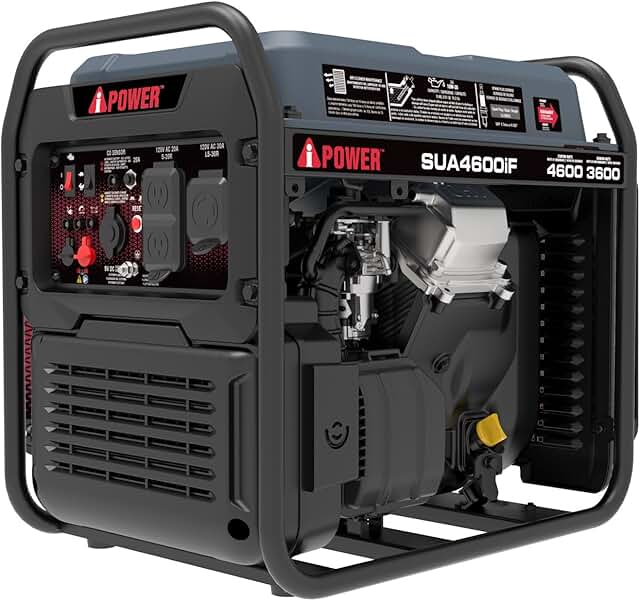
This inverter model idles as a compact backup option with propane compatibility. It delivers 4600 starting watts and 3600 running watts, with clean power (3% THD) suitable for sensitive electronics. Weighing around 56 pounds, it’s notably portable for RVs or light-duty home backup. While designed for quieter, efficient operation, its open-frame construction focuses on portability rather than high-output industrial use. The CO sensor adds an added layer of safety for enclosed spaces. It’s best for smaller homes or specific critical circuits rather than full-home power replacement during extended outages.
WEN 4750-Watt Dual Fuel Portable Generator

The WEN 4750-Watt dual fuel model offers flexible operation with gasoline (4750 surge, 3800 running watts) and propane (4350 surge, 3500 running). It supports 120V and 240V output, making it suitable for transfer switches and emergency backup. An electric start simplifies operation during outages. This generator is designed to balance cost with capability, providing adequate power for essential circuits, sump pumps, and lighting, while maintaining portability via a built-in wheel kit. It is a practical choice for moderate power needs in homes with propane as a preferred fuel source.
Westinghouse 6500 Watt Dual Fuel Generator

The Westinghouse 6500 Watt Dual Fuel unit offers gasoline operation with 5300 running watts and 6500 peak watts, or propane with 4800 running watts and 5800 peak watts. A 4.7-gallon fuel tank paired with a fuel gauge provides up to 14.5 hours of runtime at continuous use. It includes a 120V receptacle, an RV-ready 30A TT-30R, and a 30A transfer switch-ready L14-30R receptacle, along with rubber-covered outlets for safety. Additional accessories such as an oil funnel, propane hose, and a wheel kit come included for quick setup. This model is a solid mid-to-large home backup solution with strong propane adaptability.
Buying Guide: Key Purchase Considerations for Propane-Powered Home Backup Generators
- Fuel availability and dual-fuel flexibility: Propane storage stability is a major advantage, and dual-fuel models offer versatility if gasoline or natural gas is temporarily unavailable.
- Run time and fuel capacity: Larger tanks and efficient engines extend runtime. Consider your outage risk and whether you need power for essential circuits or full-house operation.
- Transfer switch readiness: Ensure the generator supports a transfer switch to safely isolate house circuits from the grid during outages and to prevent backfeeding.
- Outlets and safety features: Look for GFCI outlets, RV-ready connections, rubber outlet covers, CO sensors, and automatic low-oil shutdown to protect the engine and occupants.
- Starting method and convenience: Remote start or electric start simplifies operation during inclement weather. Recoil starts offer a backup option when batteries fail.
- Noise level and portability: Inverter-based units are quieter and better for sensitive electronics but may offer less peak power. Weight and wheel kits affect maneuverability for storage and setup.
- Warranty and service support: A robust warranty and accessible service network add long-term value and peace of mind for homeowners.
- Size, power output, and household needs: Reduce risk by matching generator capacity to your essential loads first (fridge, heating, sump pump, communications) and then add for lifestyle requirements.
- Installation considerations: If you plan to run a transfer switch, check compatibility with your home electrical panel and whether a professional installation is recommended or required.