For Americans seeking dependable, high-capacity portable generators, understanding the options that deliver peak wattage, fuel flexibility, and safety features is essential. This guide highlights top models designed for home backup, job sites, and recreation, focusing on units with substantial peak output and dual- or tri-fuel capabilities. Read on to compare performance, runtime, and user-friendly features that help you pick the right generator for your needs.
The following table provides a quick snapshot of the five highlighted products, including peak wattage, running watts, and fuel type. Use it to orient your choices before diving into detailed sections.
| Product | Peak Watts | Running Watts | Fuel Type |
|---|---|---|---|
| Westinghouse 14500 Peak Dual Fuel | 14,500 | 11,500 (gas) / 13,500 (propane) | Gas / Propane |
| Westinghouse 12500 Watt Dual Fuel | 12,500 | 9,500 (gas) / 11,200 (propane) | Gas / Propane |
| Westinghouse 13500 Peak Dual Fuel | 13,500 | 10,500 (gas) / 9,500 (propane) | Gas / Propane |
| Westinghouse 14500 Peak Tri-Fuel | 14,500 | 11,500 (gas) / 13,500 (propane) / 12,000 (natural gas) | Gas / Propane / Natural Gas |
| Westinghouse 11000 Peak Dual Fuel Inverter | 11,000 | 9,000 (gas) / 8,100 (propane) | Gas / Propane |
Westinghouse 14500 Peak Dual Fuel Generator

This dual-fuel model is positioned as a robust backup for larger homes or remote sites, offering up to 14,500 peak watts and 11,500 running watts on gasoline. Propane operation provides a peak of 13,500 watts with 10,500 running watts. A lengthy runtime—up to 19 hours on a 9.5-gallon tank—and a fuel gauge add practical value for continuous power during outages. It is designed for transfer switch compatibility, enhancing its suitability for whole-house standby setups.
Westinghouse 12500 Watt Dual Fuel Generator

This unit stresses versatility with 9,500 running watts (gas) and 11,200 peak watts (propane). It includes a remote start (key fob), electric and recoil starting options, and a run-time of up to 12 hours on a 6.6-gallon tank with fuel gauge. It provides multiple receptacles including a L14-30R transfer switch-ready outlet and an RV-ready 14-50R, making it a practical choice for emergency power, outdoor events, or job sites that require flexible connections.
Westinghouse 13500 Peak Dual Fuel Generator

With 13,500 peak watts and 10,500 running watts on gasoline, this model balances power and efficiency. Propane operation yields 12,500 peak watts and 9,500 running watts. The generator includes a remote start, digital hour meter, and a VFT display showing voltage, frequency, and runtime. It is built around a 500cc Westinghouse engine with a durable cast-iron sleeve and CO shutdown features, enhancing safety for mixed-use environments and residential neighborhoods.
Westinghouse 14500 Peak Tri-Fuel Generator
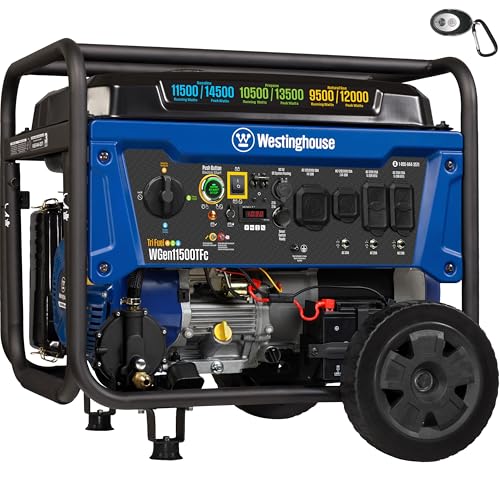
This tri-fuel option expands flexibility by supporting natural gas in addition to gasoline and propane. It delivers 14,500 peak watts and 11,500 running watts on gasoline, 13,500 peak and 10,500 running on propane, and 12,000 peak with 9,500 running on natural gas. A 9.5-gallon tank powers up to 19 hours, with a 7-hour runtime on a 20-pound propane tank. It uses a heavy-duty 550cc engine and includes safety features like rubber-covered outlets and CO shutdown for safer operation in various environments.
Westinghouse 11000 Peak Dual Fuel Inverter

This inverter generator emphasizes clean power with dual-fuel capability, offering 11,000 peak and 9,000 running watts on gasoline, and 10,000 peak with 8,100 running watts on propane—both with low total harmonic distortion for sensitive electronics. Features include remote start with a key fob, a digital display (voltage, frequency, runtime), and multiple transfer switch-capable outlets. Its lighter footprint and inverter efficiency suit mobile setups, exterior work, or backup power without sacrificing reliability.
WEN 6800-Watt Dual Fuel RV-Ready Inverter

The WEN DF680iX is a compact, dual-fuel inverter with 6,800 surge watts and 5,100 running watts on gasoline, rising to 6,000 surge and 4,500 running watts on propane. It emphasizes vehicle charging compatibility via a bonded-neutral 240V configuration for Level 2 charging and includes the CO watchdog to automatically shut down on elevated CO levels. It is a practical option for RVs, camping, and small backup needs that demand stable power with portability.
WEN 11,000-Watt Dual Fuel Portable Generator
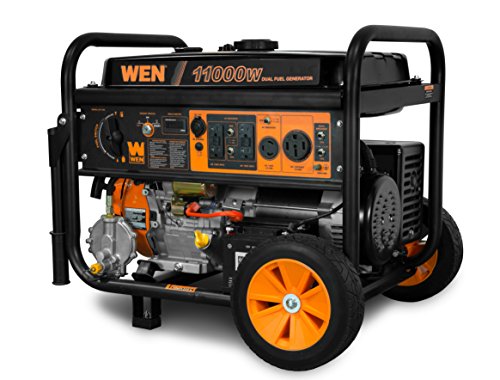
This generator switches between gas and propane, offering 11,000 surge watts and 8,300 running watts on gasoline, plus 9,500 surge and 7,500 running watts on propane. It supports 120V and 240V outputs, enabling easy transfer switch connections for home backup. The electric start with a 457cc engine provides reliable ignition, while the essential outlets and transfer-ready configuration support a broad range of emergency and off-grid scenarios.
ERAYAK 4500W Portable Inverter Generator

ERAYAK offers a compact, quiet option with 4,500 peak watts and 3,500 running watts. It supports gas and is EPA-compliant, making it suitable for camping, home backup, and outdoor activities. It emphasizes clean energy output suitable for electronics, with a focus on portability and efficient fuel use. While not the highest wattage on the list, its compact size and eco-friendly features appeal to users prioritizing reduced noise and emissions.
Buying Guide: Key Purchase Considerations
Power needs and fuel flexibility are the core considerations when selecting a high-wattage portable generator. The following perspectives help users compare options without price biases.
- Peak vs running wattage: Peak watts measure maximum surge capability, essential for starting motors and air conditioners. Running watts indicate continuous load support. For home backup, prioritize models with high running watts to cover essential circuits after startup.
- Fuel type versatility: Dual- and tri-fuel models offer operational resilience when fuel options are limited. Propane and natural gas can extend run times during outages when gasoline is scarce.
- Transfer switch compatibility: Transfer-switch-ready outlets simplify connection to a home’s electrical panel, improving safety during outages and avoiding back-feeding the grid.
- Starting method and control: Remote and electric start reduces manual effort, while digital hour meters and VFT displays provide real-time status to manage load and maintenance.
- Safety features: Look for CO sensors, automatic low-oil shutdown, rubber outlet covers, and robust engine builds (cast-iron sleeves) to protect equipment and users.
- Runtime and fuel capacity: Larger tanks extend operation between refuels. In tri-fuel units, a natural gas option can drastically extend burn time in fixed locations.
- Portability vs durability: Heavy-duty frames, wheels, and handles aid mobility for outdoor work, while stationary backup systems emphasize durability and long-term reliability.
- Noise and emissions: Inverter-based units tend to run quieter and produce cleaner power, which is favorable for residential areas and sensitive electronics.
- Maintenance: Check oil management, filter accessibility, and hour meters. Digital displays help track maintenance intervals and performance metrics.
In selecting among the highlighted models, consider whether you need the maximum peak wattage for short surges (like motor startups), the sustained running watts for continuous loads, and whether a dual- or tri-fuel configuration aligns with your fuel availability. Also assess whether a transfer switch-ready design and remote starting capability are essential for your setup. By balancing these factors, you can choose a generator that meets both current and future power needs while staying within safety and usability expectations.
All listed models provide substantial power with multiple fuel options and safety features. The choice ultimately depends on your anticipated load, preferred fuel source, and how you plan to integrate the generator with your home or work environment. This guide aims to present a clear, objective comparison of high-wattage portable generators to aid in a confident purchase decision.