Answering the demand for dependable, high-capacity solar panels, this guide highlights five top options designed for off-grid living, RV adventures, and home backup systems. These selections emphasize high wattage, robust build quality, and compatibility with mainstream power stations and inverters. Best for power-hungry setups, portable setups with heavy daily use, and scalable home systems, these panels help maximize sun exposure and energy storage. Read on to compare suitability and potential limitations to find the right fit for your needs.
| Product | Best For | Key Benefit |
|---|---|---|
| ZOUPW 450W Portable Solar Panel | Large RV / Off-grid power stations | High input range for 40–60V systems |
| ECO WORTHY 10000W Kit | Whole-home backup | Integrated storage + inverter in one system |
| SOARAISE 48000mAh Charger | Portability with multiple devices | Four built-in cables, solar panels for direct charging |
| STAR 430W Bifacial Panels | Limited space installations | Bifacial, higher density, rugged |
| Callsun 400W Bifacial Pair | RV, van, marine off-grid | N-Type 16BB, anti-shading design |
ZOUPW 450W Portable Solar Panel
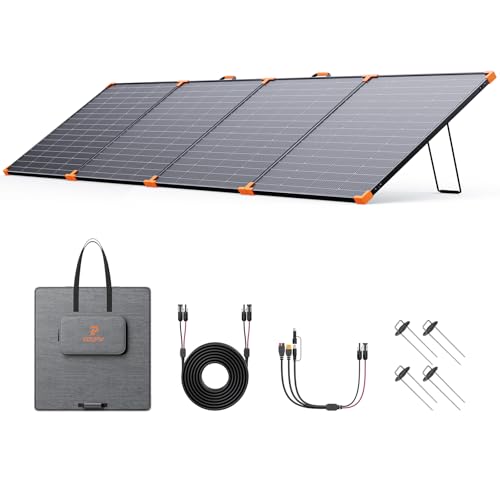
The ZOUPW 450W panel uses Next-Gen N-Type 16BB monocrystalline cells with a 16-busbar design. It maintains high efficiency and delivers up to 450W with an open-circuit voltage around 45.9V, designed for high-capacity power stations such as EcoFlow Delta, Anker C1000/C1000 Gen2, and Bluetti Elite 100. It weighs about 29.5 lbs and includes four adjustable kickstands for optimal sun angle. Best for solo setups, RV boondocking, and emergency deployments where a lightweight, high-output panel is needed. Caution: not compatible with low-voltage inputs below 30V, so verify your generator’s voltage range before pairing.
ECO WORTHY 10000W Off-Grid Kit

This complete system offers up to 10 kW of power with 2950W PV capacity via five 590W panels plus a 48V 314Ah LiFePO4 battery delivering 16.1 kWh stored energy. It includes a 10 kW AIO inverter with 120V/240V split-phase support, Bluetooth/Wi-Fi monitoring, and multi-unit parallel capability. Best for whole-home backup or small business resilience in off-grid settings. Better for users seeking an integrated storage-and-inverter solution. Limitation: the setup is sizable and requires more installation space and planning than single-panel kits.
SOARAISE Solar Charger Power Bank

The SOARAISE charger bundles a 48000mAh lithium-polymer bank with four built-in solar panels and four cables for direct multi-device charging, including USB-C, USB-A, and a wireless pad. This is ideal for campers and hikers who want rapid solar recharging and multi-device compatibility on the go. Choose this if portability and immediate off-grid charging for multiple devices are priorities. Caution: higher capacity units can be heavier and bulkier to carry for longer hikes.
STAR 860W Bifacial Panels (2-Pack)

This pair of 430W bifacial panels uses a half-cell, high-density design and is UL61730 certified with a 30-year service life. The panels’ backsheet captures reflected light for up to 30% more energy in bright conditions. Best for space-constrained installations like RVs, tiny homes, and off-grid cabins. Limitation: bifacial performance is highly dependent on mounting and rear reflections, so real-world gains vary with orientation and surface exposure.
Callsun N-Type 16BB 400W Pair

The Callsun 200W module (paired here for a 400W setup) uses N-Type 16BB cells and anti-shading dual-module parallel design to improve shading tolerance by up to 50%. It also offers bifacial benefits and a robust build for RVs, vans, boats, and home rooftops. Best for users needing reliable output in partially shaded environments or compact two-panel configurations. Caution: two modules combined require adequate wiring and parallel connection planning to maximize efficiency.
Renogy ShadowFlux 120W N-Type Panel
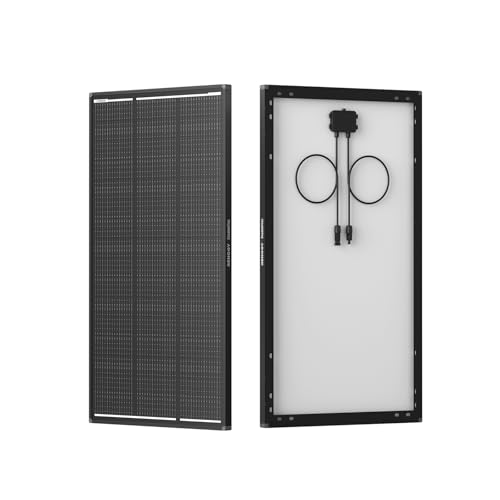
Renogy’s ShadowFlux 120W panel leverages N-Type 16BB cells with anti-shading features to reduce hot spots and improve reliability in shaded conditions. It is compact, lightweight, and 25% efficient with lower risk of micro-cracks compared to some P-Type options. Best for tight installs and spaces where shading is a concern. Limitation: 120W is smaller than the other high-capacity options, so you may need more panels for equivalent total output.
MAJIAOFANG 1W USB Solar Panel

A tiny, high-efficiency USB panel designed for portable charging of small devices. Best for emergency kits and light-use scenarios where ultra-compact solar charging is preferred. Limitation: very low wattage means long charging times for larger devices and energy storage systems.
TWELSEAVAN 200W Foldable Panel Kit

This 200W portable panel uses ETFE lamination and a foldable design for easy transport and durability. It includes a 60W USB-C port and 18W QC3.0, enabling simultaneous device charging in the field. Best for campers who need a compact, durable panel with multiple charging options. Caution: total power is lower than full-size kits, so it’s not ideal as a sole power source for high-demand appliances.
Buying Guide: Key Considerations for High Capacity Panels
- System voltage and compatibility: Match panel output (Voc) with your inverter or solar generator’s input range. High-capacity panels often target 40–60V input ranges.
- Form factor and weight: Portable panels offer mobility; fixed installations benefit from space efficiency and durability. Consider mounting options and weather rating (IP ratings, frame robustness).
- Panel technology: N-Type cells with 16BB busbars reduce hot spots and degradation. Bifacial designs can boost output in ideal conditions but require proper rear-reflection surfaces.
- Inverter and storage integration: For whole-home or large RV setups, choose panels that pair seamlessly with high-capacity inverters and LiFePO4 or other chemistries. Check parallel capacity if planning multiple units.
- Environmental conditions: Temperature, wind, and snow loads affecting performance. Certifications and UL/ETL ratings indicate safety and reliability for long-term use.
FAQ
- What is the advantage of N-Type 16BB panels? They offer higher efficiency, reduced hot spots, and better performance under weak light compared to some P-Type designs.
- Are bifacial panels worth it for RV setups? They can provide more energy when mounted with suitable rear reflections, but gains depend on mounting and surroundings.
- Can high-capacity panels be used with small power stations? Some panels require 40–60V input, so verify compatibility with your power station’s voltage range.
- Is a full solar kit better than individual panels? Kits with integrated storage and inverters offer streamlined setup and monitoring, but modular panels allow more flexible scaling.
- Do these panels work in cloudy conditions? Higher-efficiency cells and good tilt optimize daily energy capture, though output drops with reduced sunlight.
- What should I consider for installation space? Larger wattage panels deliver more energy but need adequate mounting area and ventilation to avoid performance loss.